المتجول الجليدي كايرون محاط بحلقات وقرص سريع
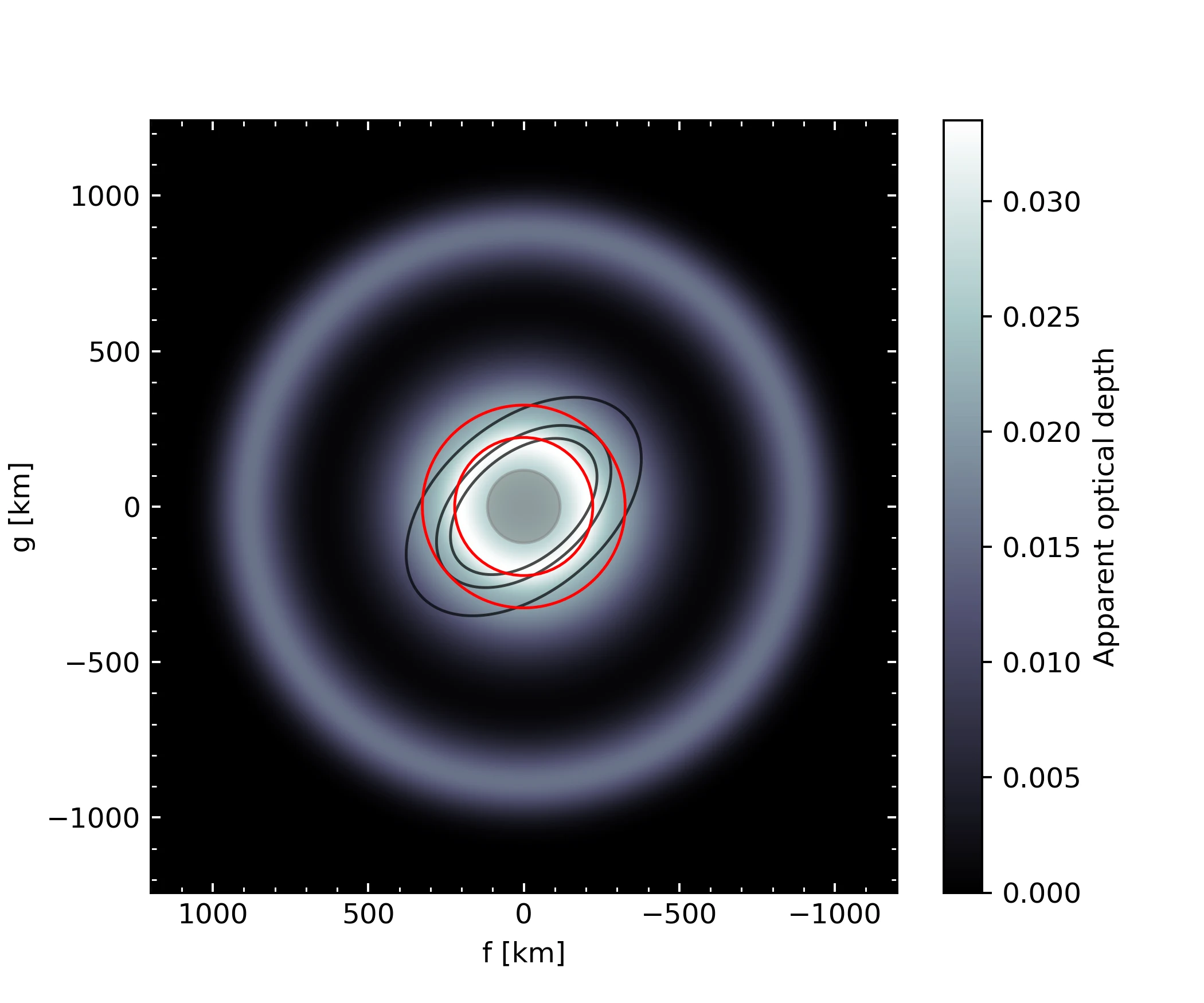
فقط بعد مروره أمام نجم، كشف كايرون سره. ثلاث أطواق جليدية تحيط بجسم يبلغ قطره 200 كيلومتر — مزيج بين مذنب وكويكب. سابقاً، كانت أطياف الضوء المنعكس وتغيرات السطوع فقط تلمح إليهما. أما الآن، فقد غمز النجم ثلاث مرات، وظهر الرقص الجليدي.
قوى الجاذبية لم تعد تمزق الغبار، مما يسمح له بالتكتل. لماذا نرى طوقاً آخر بدلاً من قمر؟ غير معروف. بالقرب منه، قرص غباري وجسم صغير في الأطراف: ربما نواة قمر.
مقارنة الصور عبر 30 عاماً أظهرت أن الحلقات تتغير. اليوم، نرى نظاماً كوكبياً جديداً يلتف حول المتجول الجليدي — من ثلج وصخور.
الملخص الأصلي
كما كتبه المؤلفون، بالإنجليزية arXiv:2510.12388
The centaur (2060) Chiron has long been a candidate for hosting material in orbit, based on occultation and photometric and spectroscopic data. Here, we present a multichord stellar occultation observed on 2023 September 10 UT that reveals new and complex structures surrounding Chiron. High-cadence light curves show multiple secondary events that are best explained (when compared with a multishell interpretation) with a system of three confined rings located at average radii of 273, 325, and 438 km, the outermost of which lies beyond Chiron's Roche limit. The rings appear coplanar, with a mean pole orientation of {\lambda} = 151{\deg} +/- 4{\deg} and \b{eta} = 20{\deg} +/- 6{\deg}. A broader, disklike structure extends from about 200 to 800 km, and a newly detected faint feature is observed at ~1380 km. Chiron thus appears as the fourth small solar system body known for hosting a ring system. Comparisons with previous occultation events that have occurred since 1994 show that these features are not permanent. With these observations, we may witness for the first time the ongoing formation and evolution of a ring system.
حلقات كايرون لا تُرى بالتلسكوب — لا تكشفها إلا ومضات النجوم السريعة أثناء الاحتجاب.