مانحون غير مرئيين في النجوم الثنائية سريع
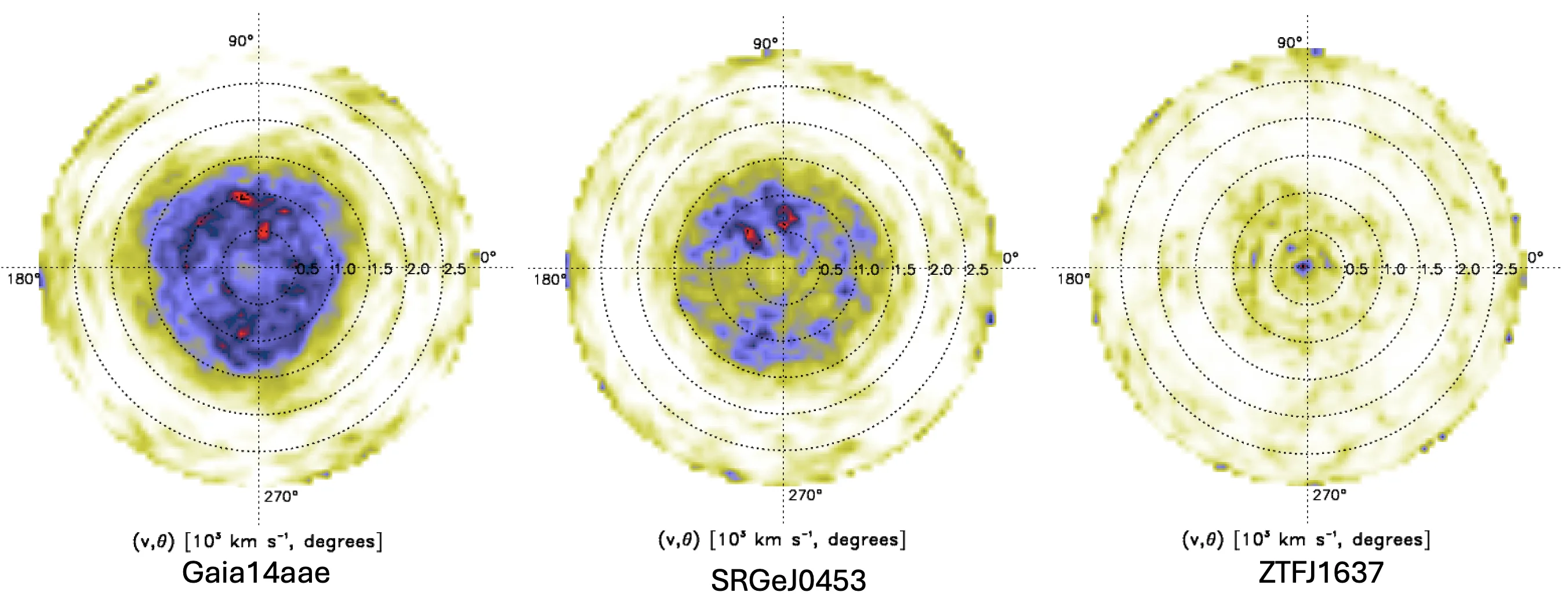
في ثلاثة أنظمة ثنائية، يقوم قزم أبيض — وهو نواة نجم ميتة — بسرقة الغاز من جاره. الجار خافت جدًا لدرجة أنه لا يُرى بالتلسكوب العادي. نظر تلسكوب جيمس ويب إلى هذه الأزواج في ضوء الأشعة تحت الحمراء، مثل كاميرا الرؤية الليلية. ولأول مرة، التقط الضوء الصادر من النجوم المانحة نفسها.
كان يُعتقد سابقًا أن النجم المانح هو الذي يضيء في نطاق الأشعة تحت الحمراء. لكن اتضح أن الضوء يأتي من قرص من الغاز الساخن حول القزم الأبيض. هذا القرص، مثل الدوامة، يلف المادة المسروقة. تظهر فيه خطوط هيليوم ساطعة — قمتان، مثل نارين على طرفي الدوامة. أما من النجم المانح، فلا نرى سوى أثر صوديوم ضعيف، مثل وميض على الخد.
هذا المجال المغناطيسي يمنع القرص من الاقتراب أكثر. يعلق الغاز على مسافة، مثل سيارة أمام حاجز. وهذا يفسر عدم وجود نفاثات سريعة في الأطياف: المادة ببساطة لا يتاح لها الوقت لتتسارع. النجوم المانحة الثلاثة تبين أنها متشابهة مع بعضها، رغم أنها كانت تُعتبر مختلفة سابقًا.
الآن أصبح واضحًا: الفائض في الأشعة تحت الحمراء في مثل هذه الأنظمة يشير إلى القرص، وليس إلى النجم المانح. وبالتالي، النجوم المانحة أكثر خفوتًا مما كان يُعتقد. إنها مثل شركاء هادئين في رقصة، لا يُرون إلا في وميض الصوديوم.
الملخص الأصلي
كما كتبه المؤلفون، بالإنجليزية arXiv:2601.00945
We present JWST/NIRSpec high-cadence infrared spectroscopy of three long-period, eclipsing AM CVn binaries, Gaia14aae, SRGeJ0453, and ZTFJ1637. These systems have orbital periods of 50-62 minutes and cool donors that are undetectable in the optical. The data cover a wavelength range of 1.6-5.2 $$\mu$$m at resolution $$R=1000-2000$$. We obtained 150-200 spectra of each system over two orbits, split between the G235M and G395M gratings. All three systems show strong, double-peaked He I emission lines dominated by an accretion disk. These lines are nearly stationary but contain radial velocity (RV) variable sub-components that trace stream-disk interactions. In Gaia14aae and SRGeJ0453, we detect two Na I doublets in emission whose RVs track the irradiated face of the donor, marking the first direct detection of the donors of long-period AM CVns. No absorption lines from the donors are detected, implying that the IR excesses observed in many long-period AM CVns primarily trace disks, not donors. The He I emission profiles in all systems lack high-velocity wings and show no emission beyond $$\approx 1500,\rm km,s^{-1}$$. The morphology of the disk eclipses and Doppler tomograms are best reproduced by models in which the disk is truncated well outside the white dwarf and only material at $$r \gtrsim 0.07,R_{\odot}$$ contributes to the disk emission. We interpret this as possible evidence of magnetized white dwarf accretors. For plausible mass transfer rates, the truncation radii imply surface magnetic fields of $$B = 30-100$$ kG, consistent with recent constraints based on X-ray periodicity. The absence of cyclotron humps out to 5 $$\mu$$m rules out stronger MG-level fields. We make the data from the program publicly available to the community.
فترات الدوران لهذه الأزواج تتراوح بين 50 و62 دقيقة. خلال الوقت الذي تستغرقه قراءة هذه الفقرة، يكون القزم الأبيض قد أكمل دورة كاملة حول مركز الكتلة المشترك.