كيف يلتقط أيون الفضة الأكسجين في مصيدة سريع
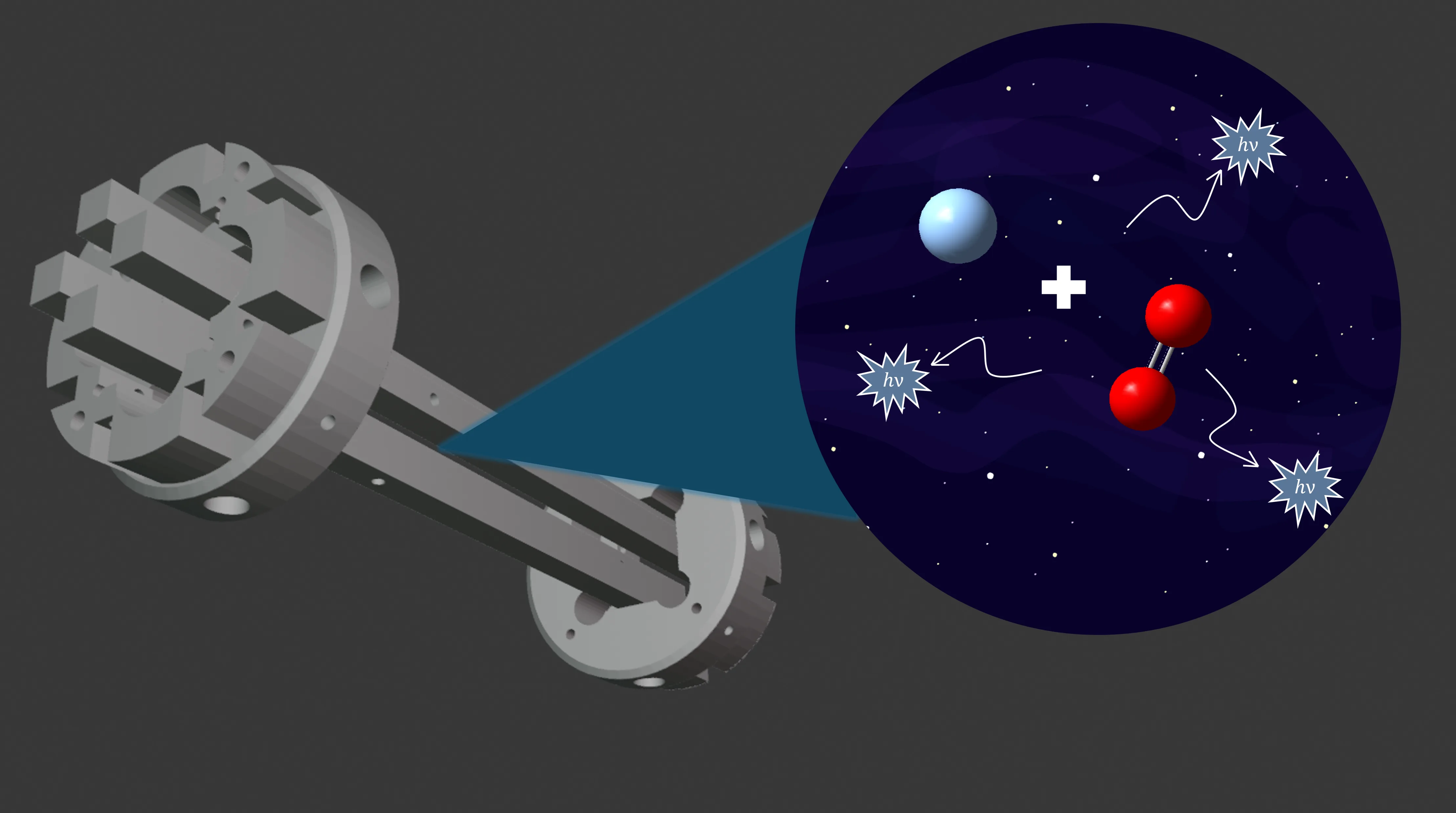
في السحب الباردة المخلخلة في الفضاء، نادرًا ما تلتقي الجسيمات، لكن أحيانًا يمر أيون وجزيء متعادل قريبين بما يكفي ليلتصقا ببعضهما. عندها يبعثان ضوءًا — مثل ومضة خافتة تحمل الطاقة الزائدة. تُسمى هذه العملية بالارتباط الإشعاعي (radiative association)، وهي مسؤولة عن ظهور العديد من الجزيئات في الفضاء بين النجمي.
قياس هذا الالتحام في المختبر صعب: يجب إبقاء الجسيمات معًا لفترة طويلة جدًا دون السماح لها بالتفرق. الجهاز الجديد يفعل ذلك بالضبط. تُحقن أيونات الفضة وجزيئات الأكسجين في مصيدة — جهاز يمسك الجسيمات المشحونة بحقول كهرومغناطيسية، كجدران غير مرئية. تبقى الجسيمات متجاورة لساعات، وخلال هذا الوقت تنجح بعض الأزواج في الاتحاد. تتبع الباحثون لأول مرة كيف تتغير سرعة التفاعل عند ضغوط مختلفة من الأكسجين، وقدّروا مدى سرعة التقاط أيون الفضة لجزيء الأكسجين.
هذه الأداة مثل غرفة هادئة للتعارف، حيث يمكن للأزواج النادرة أن تلتقي أخيرًا. ستتيح قياس سرعات اتحاد أيونات وجزيئات مختلفة توجد في السحب الكونية. فهم هذه العمليات سيساعد في تفسير مصدر الجزيئات المعقدة في الزوايا الباردة من الكون وكيف تؤثر على ولادة النجوم والكواكب.
الملخص الأصلي
كما كتبه المؤلفون، بالإنجليزية arXiv:2601.09862
The ability to directly measure radiative-association rate coefficients for reactions between ions and neutral molecules has long challenged chemical physics laboratories, yet radiative association is one of the most important processes occurring in cold, diffuse regions of space. A reaction kinetics instrument has been developed for the investigation of ion--molecule radiative-association reactions, aimed at measuring slow, effective reaction rate coefficients for species relevant to astrophysical objects. The instrument consists of a glow-discharge ion source for production of bright and stable ion currents, a quadrupole mass filter for mass selection and detection, and a quadrupole ion trap capable of trapping reactants and products for the long times needed to measure slow kinetics. The performance and adaptability of the glow-discharge ion source has been evaluated using several configurations. To assess the feasibility of measuring reaction rate coefficients, the reaction of Ag$$^{+}$$ and O$$_{2}$$ was studied under pseudo-first-order conditions in the ion trap at room temperature. We present the first pressure-dependent study of this reaction and extract a lower limit of $$1 \times 10^{-15}$$ cm$$^3$$ molecule$$^{-1}$$ s$$^{-1}$$ for the Ag$$^{+}$$ + O$$_{2}$$ effective radiative-association rate coefficient. Measurements of effective radiative-association rate coefficients are possible for diverse atomic and molecular ions that react with neutral molecules over a range of rates in this versatile new instrument.
في الفضاء بين النجمي، كثافة المادة صغيرة جدًا لدرجة أنه يوجد أقل من ذرة واحدة في السنتيمتر المكعب الواحد، لذا تجري التفاعلات ببطء شديد — أحيانًا يستغرق التصادم الواحد سنوات.