فقاعات في مصيدة الجليد سريع
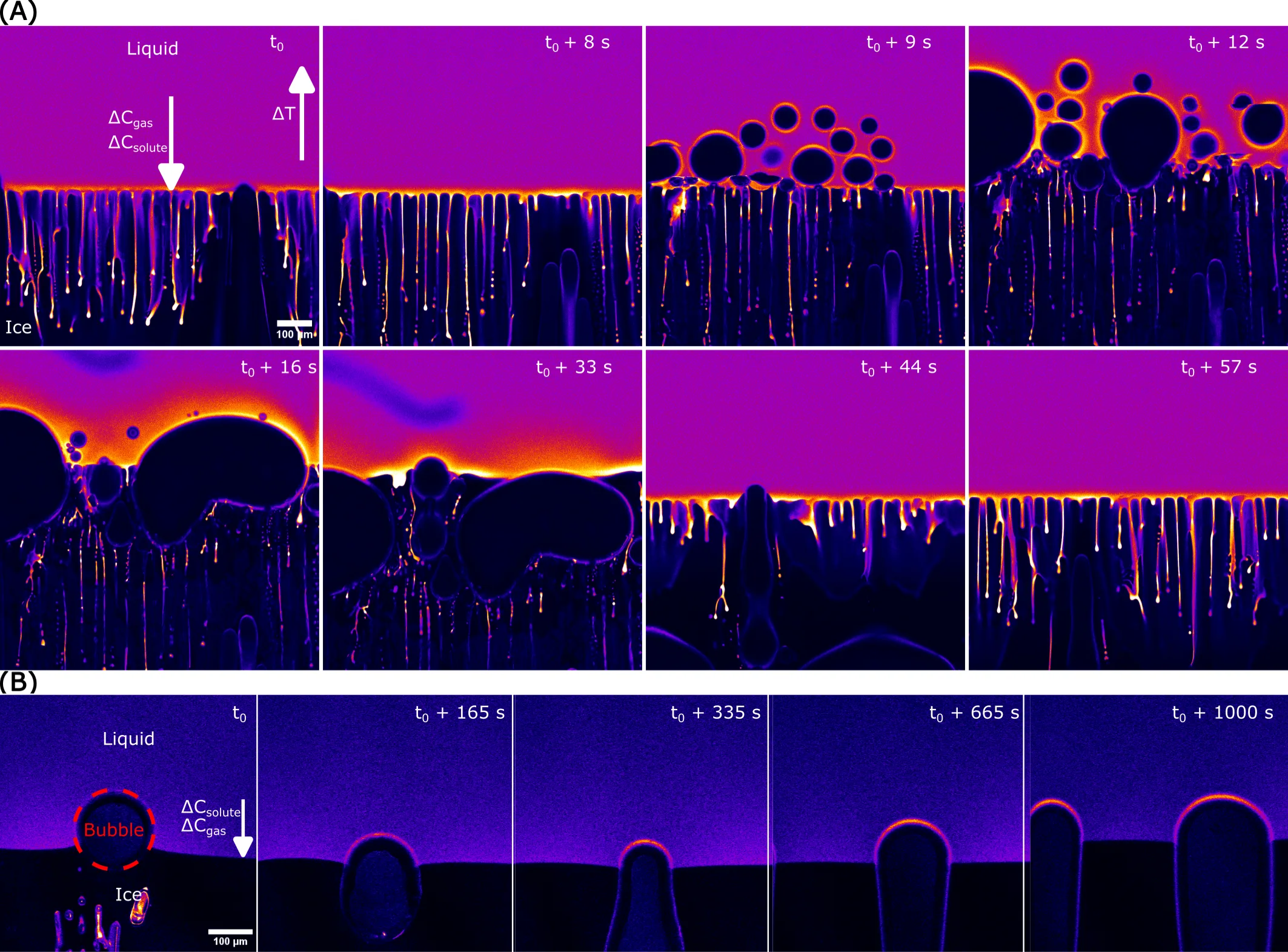
في كأس من المشروب الغازي، ترتفع الفقاعات بمرح إلى الأعلى. لكن إذا جُمّد الماء، فإن بعض الفقاعات يقع في أسر الجليد. كيف تصل إلى هناك؟ فالجليد ينمو ويدفع الغاز بعيدًا — لكنه لا ينجح دائمًا.
أخذ العلماء ماءً غازيًا (ماءً مذابًا فيه ثاني أكسيد الكربون) وجمّدوه بسرعات مختلفة: من 1 إلى 20 ميكرومترًا في الثانية. هذا يشبه أن يزحف جبهة الجليد للأمام بسرعة تتراوح بين سُمك شعرة إنسان في الدقيقة وسُمك شعرة في ثلاث ثوانٍ. وفي الوقت نفسه، غيّروا درجة الحرارة بتدرج ثابت — 15 درجة لكل مليمتر.
تحت المجهر بإضاءة فلورية، كان يُرى كيف يتجمع الغاز أمام الجليد المتقدم في فقاعات صغيرة جدًا. واتضح أن لكل فقاعة "وقت تفكير" خاصًا بها: عدد الثواني التي يحتاجها الغاز ليتجمع في فقاعة. إذا زحف الجليد ببطء، تكبر الفقاعات وتنجو بالهروب. أما إذا كان سريعًا، فيلحق بها الجليد ويدفنها.
هذا ليس مجرد تسلية مع مشروب غازي. ففي علم المعادن، الفقاعات الغازية داخل المسبوكات هي عيب يضعف القطعة. وفي الجليد، على العكس، تحفظ الفقاعات هواءً قديمًا — ومن خلالها يعرف العلماء كيف كان المناخ قبل آلاف السنين. الآن يمكن التنبؤ بدقة أكبر أين وكم عدد الفقاعات التي ستتشكل عند التصلب.
الملخص الأصلي
كما كتبه المؤلفون، بالإنجليزية arXiv:2601.15045
The formation and entrapment of gas bubbles during solidification significantly influence the microstructure and mechanical properties of materials, from metallic alloys to ice. While gas segregation at the solidification front is well-documented, the real-time dynamics of bubble nucleation, growth, and engulfment-and their dependence on solidification velocity-remain poorly understood. In this study, we use in situ cryo-confocal fluorescence microscopy to investigate the coupled gas-bubble dynamics at the solidification front of carbonated water, systematically varying the solidification velocity ($$V = 1-20 \mu m/s$$) while maintaining a constant thermal gradient ($$G = 15 K/mm$$). Our experiments reveal that bubble nucleation is governed by a characteristic nucleation time, which emerges from the interplay between gas diffusion ahead of the front, nucleation kinetics, and bubble growth, all competing with the advancing solidification front. These results allow us to estimate the critical gas concentration for bubbles nucleation in carbonated water. These results offer a detailed understanding of the mechanisms controlling bubble nucleation and entrapment during solidification at constant thermal gradient. They contribute to the development of strategies to control bubble formation in industrial processes where the presence of bubbles can either be detrimental or intentionally harnessed.
في الماء الغازي، يكون ثاني أكسيد الكربون المذاب أكثر بحوالي 3 إلى 4 مرات من الماء العادي من الصنبور. عند التجميد، يُطرد هذا الغاز بواسطة الجليد ويتجمع في فقاعات — وهو نفس التأثير الذي يجعل الجليد من المشروبات الغازية معتمًا.
في رواية كيرت فونيغوت "مهد القطة" يوجد جليد-تسعة — شكل خيالي من الجليد يجمّد كل شيء حوله. تجربتنا مع الفقاعات في الماء المتجمد هي خطوة نحو فهم كيفية التحكم في بنية الجليد والمواد الأخرى.