ثقوب سوداء خفية تكشف عن نفسها بتمزيق النجوم سريع
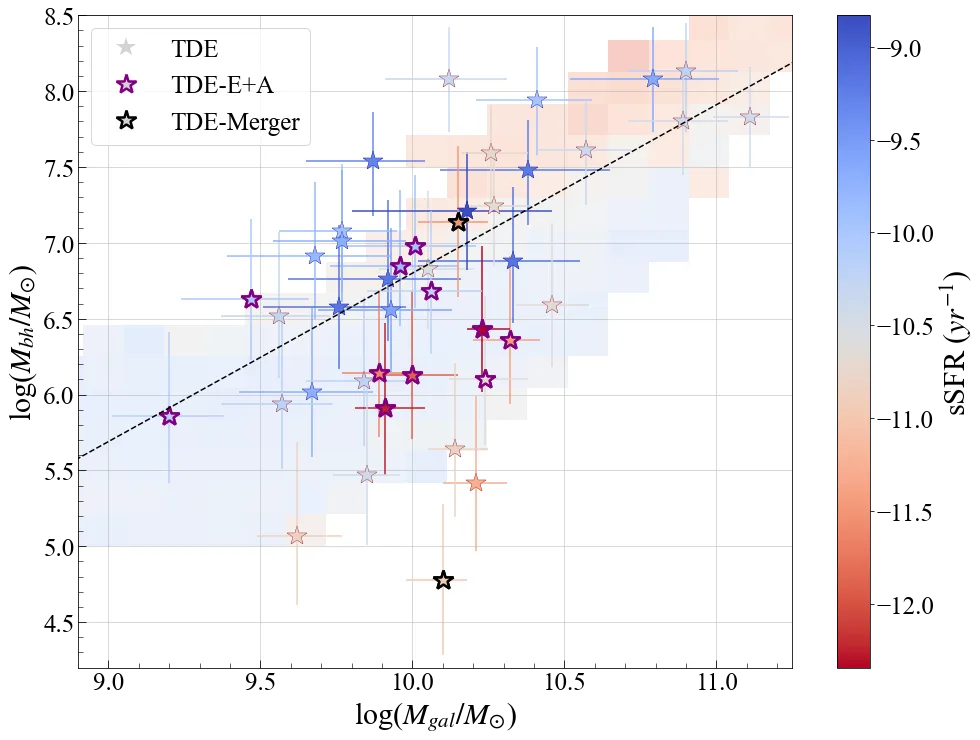
لا يمكن رؤية الثقب الأسود حتى يقترب منه نجم. عندها تعمل قوى المد على تمدد النجم كما يفرد الطباخ العجين، ويسقط جزء من المادة في الثقب، متوهجًا في اللحظات الأخيرة. هذه الأحداث، التي تسمى اضطرابات المد والجزر (tidal disruption events)، هي فرصة نادرة لوزن ثقب أسود كان سيظل خفيًا لولا ذلك.
درس علماء الفلك 42 من هذه التوهجات وقارنوها بالمجرات العادية. اتضح أنه في المجرات الكبيرة التي توقفت فيها ولادة النجوم، تكون الثقوب السوداء أثقل من تلك الموجودة في المجرات ذات النجوم الحديثة. هذه حقيقة معروفة منذ زمن: يُعتقد أن الثقب الأسود "ينفخ" الغاز ويوقف ولادة النجوم.
لكن بين المجرات التي تشهد اضطرابات مد وجزر، وُجدت مفاجأة. في المجرات الصغيرة — التي تبلغ كتلتها حوالي مليار مرة كتلة الشمس — الأمر معكوس: في المجرات "النائمة" تكون الثقوب السوداء أخف من جاراتها النجمية بنفس الحجم. كتلة هذا الثقب تبلغ بضعة ملايين من كتل الشمس فقط، بينما تبلغ كتلة الثقوب في المجرات المجاورة عشرات المرات أكثر.
ربما فقدت هذه المجرات غازها بسبب تأثيرات خارجية — على سبيل المثال، مرورها عبر عنقود مجري حيث يعمل الغاز الساخن على "كنس" الغاز البارد، كما تكنس الرياح أوراق الشجر. عندها توقفت ولادة النجوم، وبقي الثقب الأسود على حصص جوع. إذا لم تكن هذه الحالات نادرة، فسيتعين إعادة النظر في دور الثقوب السوداء في حياة المجرات: في بعض الأحيان لا يكونون قادة الأوركسترا، بل مجرد متفرجين.
الملخص الأصلي
كما كتبه المؤلفون، بالإنجليزية arXiv:2601.20519
Restricted by event horizon suppression, tidal disruption events (TDEs) provide a unique window into otherwise hidden supermassive black holes (SMBHs) at the lower end of the mass spectrum, allowing the connection between star formation and SMBH mass to be explored across a broad stellar mass range. We derive stellar masses and specific star formation rates using Prospector fits to UV-MIR broadband spectral energy distributions (SEDs) for 42 TDE hosts, together with a high-mass comparison sample, and combine these with SMBH mass estimates from the literature. We first verify our approach by reproducing the established result that quenched galaxies host more massive SMBHs than star-forming systems at fixed stellar mass, a result widely interpreted as evidence for SMBH growth driving the blue-to-red sequence transition. However, examining the TDE sample in isolation reveals a trend reversal at lower masses, uncovering a surprising population of low-mass ($$10^{9.6} \lesssim M_{\rm gal} \lesssim 10^{10.5}$$ M$$_\odot$$), quenched galaxies hosting SMBHs systematically less massive ($$M_{\rm BH} \lesssim 10^{6.5}$$ M$$_\odot$$) than those in star-forming galaxies of comparable stellar mass. After ruling out degeneracies in our SED fits, we conclude that this reflects a physical difference in the quenching mechanism between these TDE hosts and the more massive galaxies. This is unlikely to be driven by AGN feedback, and could instead result from environmental processes, which can end star formation and hinder SMBH growth. We also show that the quenched and post-starburst population within the TDE sample is likely under-represented due to selection biases, suggesting the true fraction could be even higher than observed.
يستمر اضطراب المد والجزر لنجم بفعل ثقب أسود بضعة أشهر فقط، لكن التوهج قد يكون أكثر سطوعًا من مجرة بأكملها.
في فيلم "Interstellar"، يمر الأبطال بالقرب من ثقب أسود لكنهم لا يرونه — فقط تشويه الضوء. وبنفس الطريقة تقريبًا، يجد علماء الفلك الثقوب السوداء من خلال الأدلة غير المباشرة، مثل توهج النجم الممزق.