الاضطراب في الفضاء: كيف تغيّر السحب كيمياء النجوم سريع
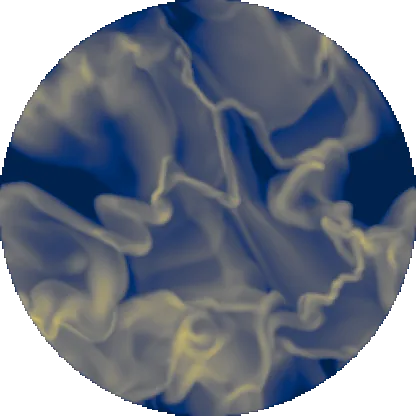
مرجل يغلي: البخار يتصاعد، والماء يغلي، وتختلف درجة الحرارة من نقطة إلى أخرى. هكذا في الفضاء أيضًا: سحب الغاز حول النجوم الشابة ليست كرات ملساء، بل خليط متلاطم مع دوامات وتفاوت في الكثافة. ظل علماء الفلك يعتبرون هذه السحب متجانسة لفترة طويلة، لكن هذا التبسيط قد يشوّه الاستنتاجات.
بنى العلماء نموذجًا حاسوبيًا لسحابة حول نجم حار منفرد — مع الاضطراب وبدونه. وتبيّن أن الدوامات تؤثر مباشرة على سطوع خطوط الإشعاع: خط النيتروجين [N II] يصبح أكثر سطوعًا، وخط الأكسجين [O III] يصبح باهتًا. هذا يخلّ بتقديرات نسبة المعادن (كمية العناصر الثقيلة في الغاز) وغيرها من الخصائص. يصل الخطأ إلى 0.1 ديسيبل (dex) — كما لو كنت تزن السكر بميزان يخطئ دائمًا بنسبة 20%.
الفرق يظهر أيضًا في الكثافة: المؤشرات تحت الحمراء والبصرية وفوق البنفسجية تعطي أرقامًا مختلفة لنفس السحابة. هذا مثل قياس طول شخص بمساطر مختلفة — كل واحدة تعطي قراءة مختلفة. لاستخلاص استنتاجات دقيقة، نحتاج إلى جداول كبيرة من النماذج مع الاضطراب، تغطي الظروف في المجرات القريبة والبعيدة.
الملخص الأصلي
كما كتبه المؤلفون، بالإنجليزية arXiv:2602.02949
Reliable nebular emission line diagnostics are essential for accurately inferring the physical properties (e.g. electron temperature, density, pressure, and metallicity) of H II regions from spectra. When interpreting spectra, it is typical to adopt a single zone model, e.g. at fixed density, pressure, or temperature, to infer H II region properties. However, such an assumption may not fully capture the complexities of a turbulent interstellar medium. To understand how a complex density field driven by supersonic turbulence impacts nebular emission lines, we simulate 3D H II regions surrounding a single O star, both with and without supersonic turbulence. We find that turbulence directly impacts the values of common strong line ratios. For example turbulent H II regions exhibit systematically higher [N II]/H$$\alpha$$, lower [O III]/H$$\beta$$, and lower O32, compared to homogeneous H II regions with the same mean density and ionizing source. These biases can impact inferences of metallicity, ionization parameter, excitation, and ionization source. For our choice of turbulence, direct $$T_e$$ method metallicity inferences are biased low, by up to 0.1 dex, which is important for metallicity studies, but not enough to explain the abundance discrepancy problem. Finally, we show that large differences between measured electron densities emerge between infrared, optical, and UV density indicators. Our results motivate the need for large grids of turbulent H II regions models that span the range of conditions seen at both high and low redshift to better interpret observed spectra.
يمكن أن يكون الاضطراب في الغاز بين النجمي ناتجًا عن انفجارات المستعرات العظمى — حيث تخلط الموجات الصدمية الغاز كما تخلط الملعقة السكر في الشاي.