شبه النجوم: شرانق بداخلها ثقب أسود سريع
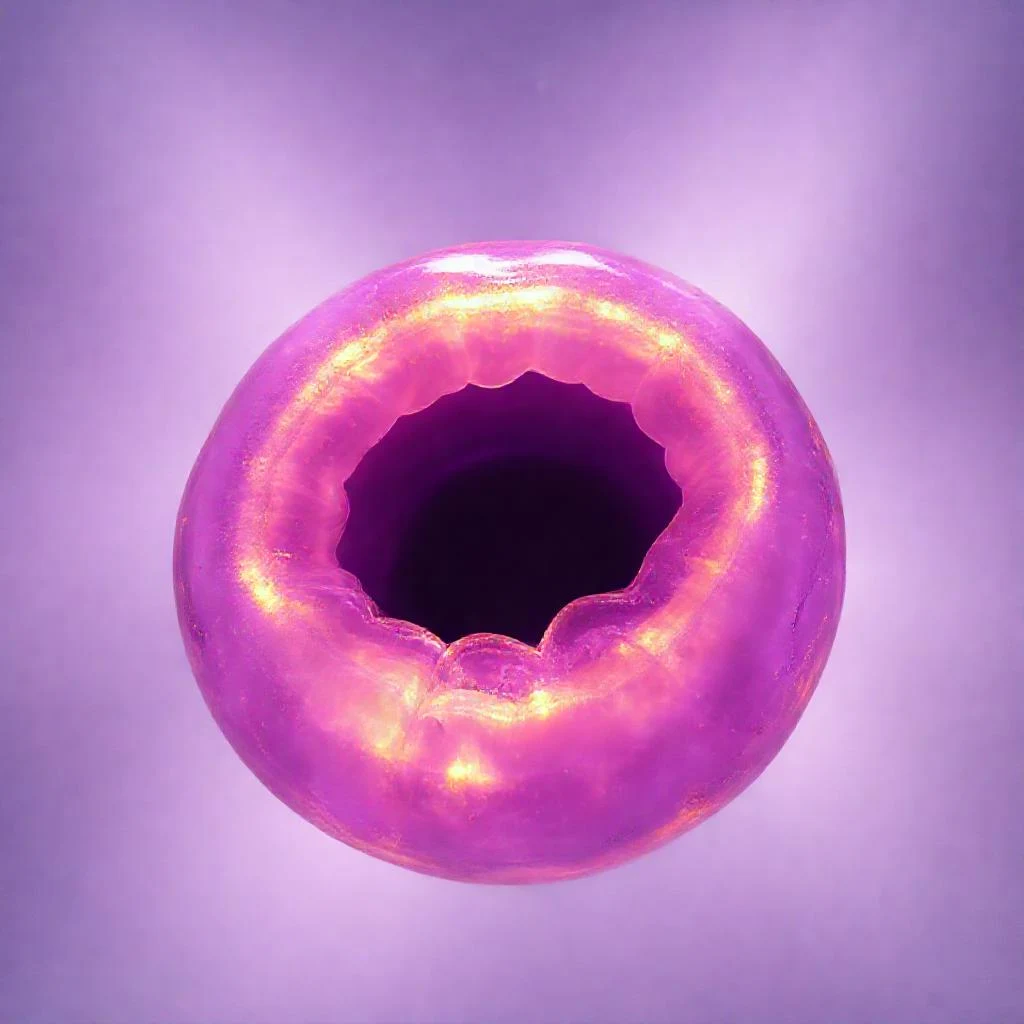
قد تفسر أشباه النجوم لغز النمو السريع لـالثقوب السوداء في الكون الفتيّ. إنها شرانق غازية عملاقة تخفي بداخلها ثقباً. تسقط المادة داخله وتتوهج، مشعةً ضوءاً يمنع الشرنقة من الانكماش. يزن هذا الجرم آلاف الشموس ويضيء أكثر سطوعاً من مجرة كاملة.
أظهرت النمذجة الجديدة أنه إذا ابتلع الثقب ما لا يقل عن عُشر كتلة شمسية سنوياً، تمتزج الشرنقة بأكملها وتضيء بضوء محمرّ — تماماً مثل تلك النقاط الحمراء الغامضة في أعماق الفضاء. لطالما حيّرت هذه النقاط علماء الفلك. فبسبب تمدد الكون، ينزاح ضوؤها نحو الأحمر، لكن ماهية مصدر الضوء ظلت مجهولة. عندما تصل كتلة الشرنقة إلى عشرات الآلاف من كتلة الشمس، يُحدث انحناء الزمكان عدم استقرار، ويولد ثقب أسود في المركز.
المفارقة أن الثقب الأسود، الذي عادةً يمتص الضوء، يصبح هو نفسه المصدر الرئيسي للتوهج. بمقارنة السطوع المرصود للنقاط الحمراء مع النماذج، وجد العلماء أنها تطابق معدل الابتلاع المطلوب. وهكذا اشتعلت أشباه النجوم في الكون الفتي، وربما أصبحت بذوراً لثقوب سوداء فائقة الكتلة.
الملخص الأصلي
كما كتبه المؤلفون، بالإنجليزية arXiv:2603.21714
The recently discovered Little Red Dots identified by the James Webb Space Telescope are compact high-redshift sources whose properties have motivated models involving black holes embedded within optically thick gaseous envelopes. We investigate their rest-frame optical emission by modeling quasi-stars, i.e. stellar envelopes powered by accretion onto a central black hole, formed from rapidly accreting proto-stars that reach the supermassive star regime ($$>10^4$$~\Msun) before undergoing general relativistic instability. We compute stellar evolution models with mass gain rates of 0.01, 0.1, and 1~\Msun/yr and metallicities $$Z=0$$-$$0.01$$. For accretion rates $$\ge0.1$$~\Msun/yr, stars remain nearly fully convective with $$T_\mathrm{eff}\sim4000$$-$$9000$$~K. General relativistic instability occurs at $$M_\star\sim3.5\times10^4$$~\Msun\ ($$6.8\times10^4$$~\Msun) for $$\dot{m}=0.1$$~\Msun/yr (1~\Msun/yr), at $$L\sim10^9$$~\Lsun. Assuming the black hole supports the envelope until complete accretion ($$M_{\rm BH,max}/M_{\rm QS}=1$$), quasi-stars reach maximum lifetimes of $$10^7$$-$$10^8$$~yr, $$\sim100$$-$$1000$$ times longer than their progenitors. Their formation and evolution are nearly independent of metallicity. Matching our models to Little Red Dots at $$z<4.5$$ ($$L_\mathrm{bol}\sim10^{9.5}$$-$$10^{11.5}$$~\Lsun) implies quasi-star masses of $$10^{4.5}$$-$$10^{6.5}$$~\Msun, while the minimum observed luminosity requires progenitor accretion rates $$\gtrsim0.1$$~\Msun/yr. Our models support quasi-stars as the origin of Little Red Dot optical emission and constrain their masses, lifetimes, progenitor environments, and luminosities. Our models offer a framework supporting quasi-stars as the source of Little Red Dot optical emission, and provide insights into their lifetimes, composition, progenitor's environment as well on their minimum and maximum observed luminosities.
إذا حلّ شبه النجم محل الشمس، لامتد غلافه إلى ما بعد مدار المشتري، ولاختبأ بداخله ثقب أسود بحجم مدينة صغيرة.