ولادة الضوء من الفراغ الكمومي سريع
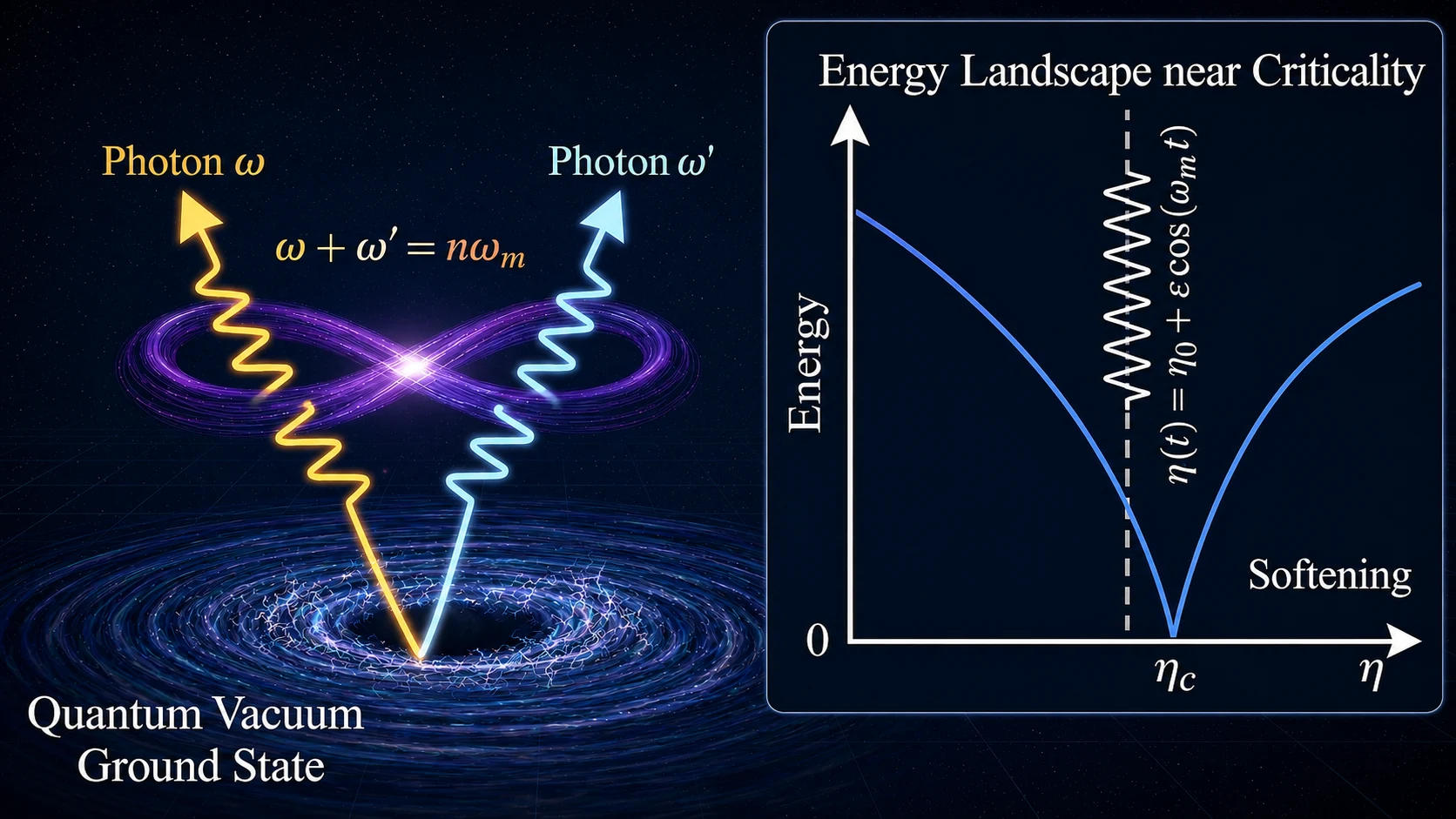
الفراغ الكمومي ليس خواءً، بل وتر مشدود بإحكام، تظهر فيه الجسيمات وتختفي باستمرار. التغيير المفاجئ للظروف - مثل إزاحة مرايا مرنان ميكروي - يجعل «الوتر» يصدر فوتونات حقيقية. بالقرب من الانتقال الطوري الكمومي، النقطة الحرجة حيث تتغير حالة المادة فجأة، يتضخم التأثير. حتى الاضطراب الضعيف يولد سيلاً من الفوتونات، تطير بسرعة الضوء. عادةً ما يُخمِد الاضطراب الحراري التأثيرات الكمومية، لكنه هنا يحفّز الوتر فقط، دون أن يعيق الإضاءة. هكذا ينشأ ضوء غير تقليدي، يستحيل تحقيقه بالمصادر العادية.
هذا يفتح الطريق أمام كواشف فائقة الحساسية ومُصْدِرات جديدة تعمل بالومضات الفراغية. التحليل الطيفي — تحليل الضوء بأطواله الموجية — يقرأ الحالات الكمومية كما تُقرأ النوتة الموسيقية لوتر يُعزف.
الملخص الأصلي
كما كتبه المؤلفون، بالإنجليزية arXiv:2604.10406
Equilibrium quantum phase transitions profoundly reshape the ground state of light-matter systems; yet, the resulting quantum correlations, such as squeezing and entanglement, remain experimentally inaccessible since they involve virtual ground state excitations. We investigate how a nonadiabatic modulation of a Hamiltonian parameter can convert these virtual excitations into real photons, enabling quantum vacuum radiation. We show that proximity to the critical point strongly enhances the emitted photon flux and the non-classical nature of the emitted radiation, even when thermal fluctuations are expected to dominate. In addition, higher-order processes become relevant even for small modulation amplitudes, and we develop a framework that systematically incorporates them. Our results reveal that criticality can act as an efficient amplifier of vacuum fluctuations, offering new routes to probe and exploit quantum critical ground states.
تقلبات الفراغ الكمومي حقيقية لدرجة أن قوة تجاذب طفيفة تنشأ بين مرآتين متقاربتين - وهو ما يُعرف بتأثير كازيمير.