إعادة صهر الصخور الأولى في الفضاء سريع
يُفتح صندوق عائلي قديم يحوي كنوزًا، فنجد بداخله حليًا كان يُظن أنها معاصرة للجدة الكبرى. ولكن فجأة يتبين أن الذهب أُعيد صهره، والأحجار قُصّت من جديد، وأن ذلك حدث في وقت متأخر جدًا عما كان يُعتقد. قصة مشابهة حدثت مع أقدم الجسيمات في النيازك — وهي الشوائب الغنية بالكالسيوم والألومنيوم، أو CAI. عمرها حوالي 4.567 مليار سنة، وتُعتبر أول الأجسام الصلبة التي تكثّفت في السحابة الكوكبية الأولية.
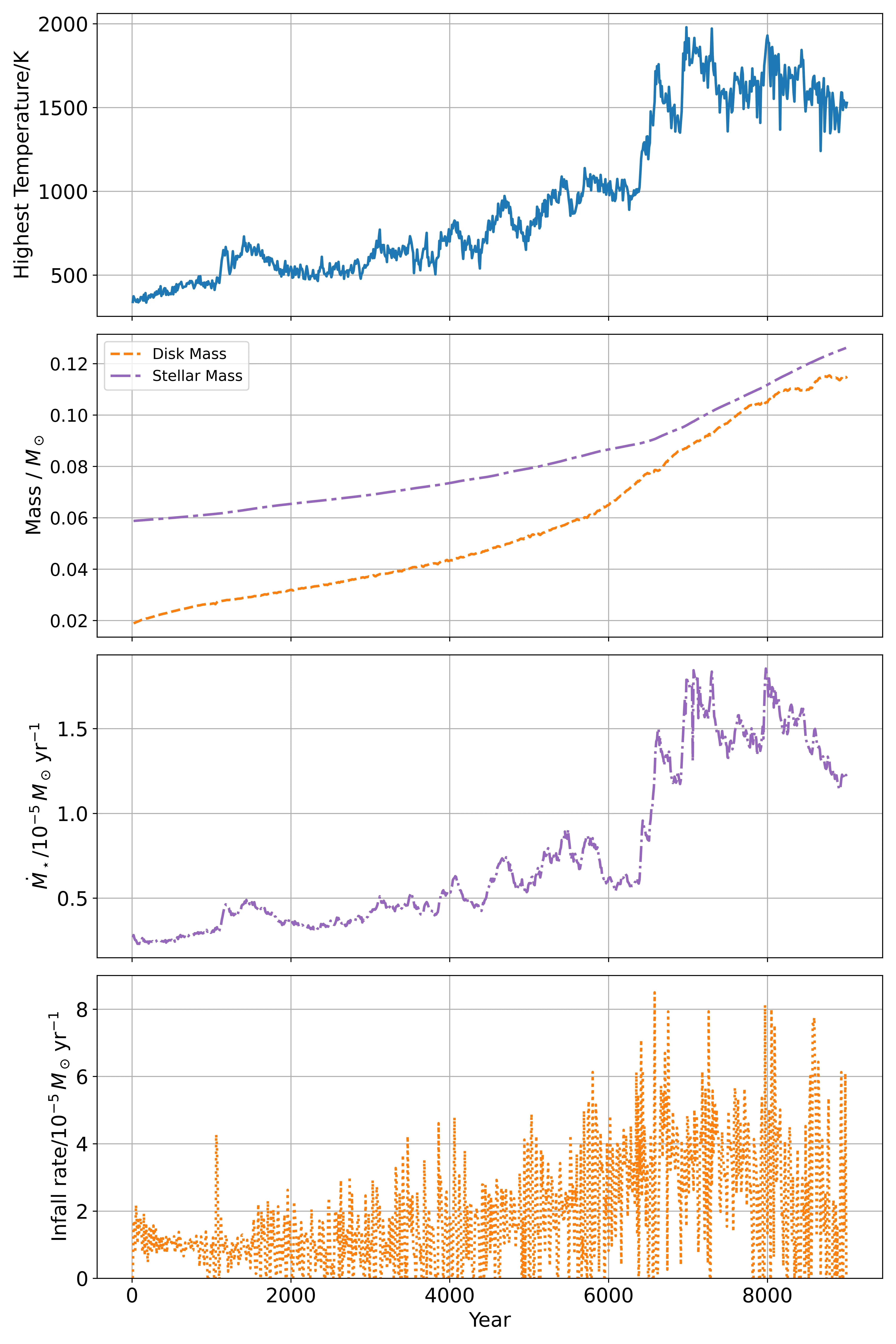
لوقت طويل، اعتُقد أن هذه الجسيمات شهود عيان لم تُمسّ على الإطلاق. لكن دراسة جديدة، مبنية على محاكاة حاسوبية، ترسم صورة مختلفة. عندما كانت سحابة جزيئية عملاقة تنضغط وتلد عنقودًا نجميًا، كانت تيارات من الغاز والغبار تتدفق نحو النجوم الأولية المتشكلة. هذه التيارات، مثل أنهار سماوية، كانت تصطدم بأجنّة الأنظمة النجمية. في المحاكاة عالية الدقة، يُرى القرص المحيط بالنجم الفتيّ ينحني وتعلوه تموجات من موجات حلزونية — تمامًا كالماء في كوب إذا دُفع فجأة.
ثم، مع التبريد، وُلدت جسيمات صلبة جديدة من هذا الغاز. يتبين إذن أن CAI الموجودة في النيازك اليوم ليست بدائية إطلاقًا. إنها بقايا "أُعيد صهرها"، ولم تحتفظ إلا بذاكرة آخر حلقة كبيرة من سقوط المادة على القرص. والأكثر إثارة للاهتمام أن هذه الدورة بأكملها — التبخر، والاختلاط، والتكثف الجديد — كانت تتم خلال 100 ألف سنة فقط. بمقاييس الكون، هذه لحظة. وهكذا، لا تحكي لنا النيازك عن فجر هادئ للنظام الشمسي، بل عن شبابه المضطرب والمشتعل.
الملخص الأصلي
كما كتبه المؤلفون، بالإنجليزية arXiv:2604.21322
Calcium-aluminum-rich inclusions (CAIs) in carbonaceous chondritic meteorites are the oldest relics in the solar system. Notably, their radiogenic age feature a brief (100 kyr) condensation episode. In contrast, the reservoirs of the short-lived isotopes in CAIs, presumably supernovae or asymptotic giant stars, pollutes star-forming regions in giant molecular cloud complexes (GMC) over much longer (Myr) duration. Through a series of numerical simulations, we show here the possibility that, within an extended region (2$$\sim$$3 AU), nearly all ``pre-solar'' CAI-loaded grains in the infall clouds were sublimated and re-condensed during the early ($$ \lesssim 10^5$$ yr) infall and formation of class-0 disks. We adopt a set of initial conditions from a previous hydrodynamic simulation of the collapse of GMC and the formation of young stellar clusters. We analyze the evolution of the disk's thermal distribution and dynamical structure resulting from the interaction between circumstellar disks and infalling gas. Our follow-up simulations, with much higher resolution, show significant and rapid changes in the disk orientation and morphology due to the dynamic infall of external streamers. Warps and global spiral density waves commonly appear. They lead to intense dissipation which heats the gas to sufficiently high temperature to sublimate prior-generation CAIs. This solid-to-gas phase transition is followed by subsequent cooling and re-condensation. The CAI contained in the meteorites today could be the relics of the last episode of major infall onto class 0 disks.
درجة حرارة تبخر CAI تبلغ حوالي ضعف درجة حرارة الفرن العالي — حوالي 1700°م. للمقارنة: حمم البركان تكون "سائلة" بالفعل عند 1200°م.