لماذا المجرات المبكرة ساطعة جدًا: سر الغبار الشفاف سريع
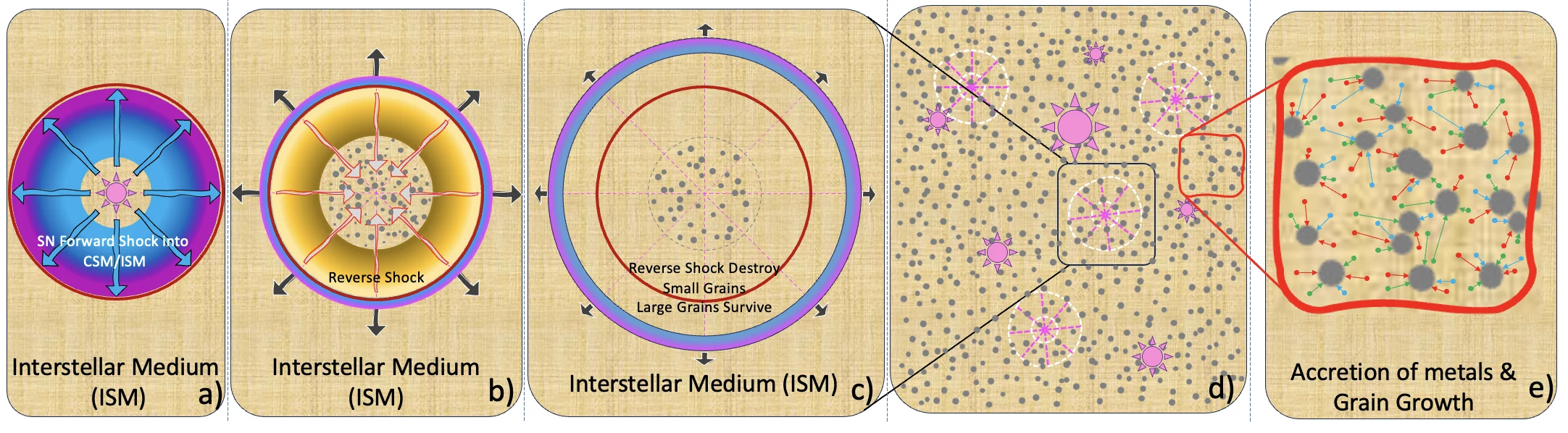
اكتشف تلسكوب جيمس ويب العديد من المجرات الساطعة في الكون الفتي. لم يمتص الغبار الكوني ضوءها فوق البنفسجي تقريبًا – على عكس التوقعات السابقة. السر هو أنه في فجر الكون، نشأ الغبار من انفجارات المستعرات العظمى وكان شفافًا، مثل زجاج النوافذ النظيف.
عندما تنضج المجرات، تلتصق حبيبات الغبار ببعضها وتنمو، محولة هذا الحاجز الشفاف إلى ستائر كثيفة تكتم الضوء. لهذا السبب تتألق المجرات القديمة بهذا السطوع – كان ضوؤها يمر بحرية عبر الغبار الصافي. بمرور الوقت، يصبح نفس الغبار معتمًا، وهو ما يفسر الأرصاد بالكامل دون الحاجة إلى فرضيات غريبة.
الملخص الأصلي
كما كتبه المؤلفون، بالإنجليزية arXiv:2605.09829
Recent JWST observations suggest that galaxies at z > 9 may be dominated by low-opacity SNe-produced dust before efficient ISM grain growth is established. This transition in dust origin and opacity could explain both the prevalence of galaxies with extremely low dust attenuation and the excess of UV-bright galaxies relative to most pre-JWST predictions. We investigate whether this transition, combined with evolving star-formation efficiency, can reproduce these observed properties. We develop a physically motivated attenuation framework combining (i) extinction laws for reverse-shock-processed SNe dust, (ii) metallicity- and dust-to-metal-dependent opacity scalings, and (iii) porous radiative-transfer geometries allowing partial UV-photon leakage. Unlike outflow-driven scenarios requiring large-scale gas evacuation, our approach preserves gas reservoirs while reducing effective UV opacity through dust composition and geometry. We introduce extinction-based, gas-based, and hybrid attenuation prescriptions linking SNe-dominated and ISM grain-growth dust regimes. We find that the observed A_FUV-M_star relation at z > 9 is best reproduced for an intrinsic FUV dust opacity kappa_UV(dust)=10^3 - 10^4 cm2/g, characteristic of low-opacity SNe dust, naturally producing very low attenuation even in gas-rich galaxies. This regime reproduces galaxies with extremely low dust attenuation (GELDAs), which dominate observed samples at z > 9. Applied to intrinsic UV luminosity function models, our SNe-dominated and hybrid prescriptions mainly suppress the brightest galaxies, bringing predictions into agreement with JWST measurements without requiring extreme star-formation efficiencies or dust-free interstellar media. Our results suggest that the UV-bright galaxy excess at z > 9 reflects a transition in dust origin and opacity during the earliest phases of galaxy evolution.
حبيبات الغبار من المستعرات العظمى أقصر بمئات المرات من موجة الأشعة فوق البنفسجية: ينزلق الضوء من خلالها كما ينزلق الماء من خلال منخل واسع، دون أن يواجه مقاومة.