ثقب أسود على شكل مغزل: الظل يتغير شكله سريع
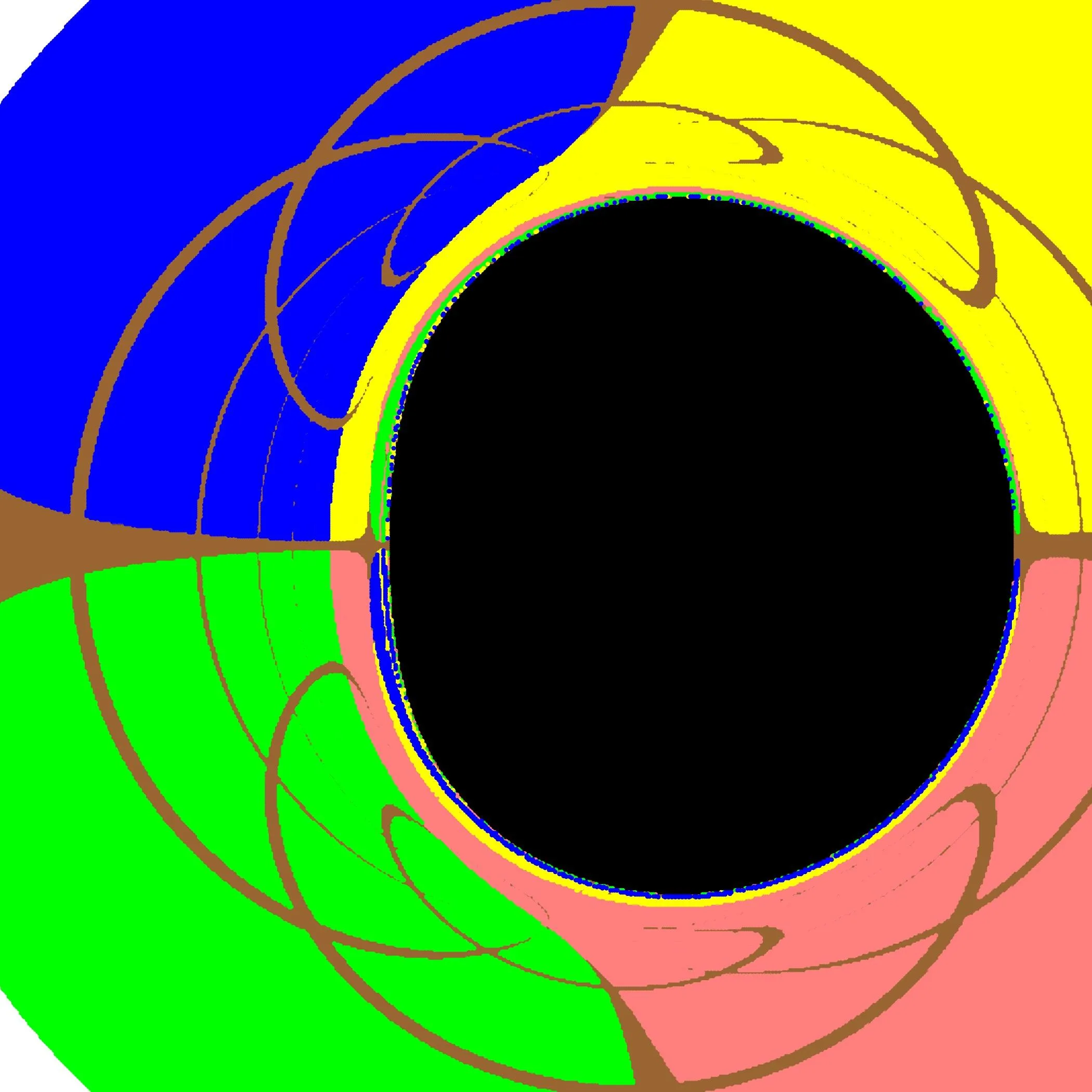
في مركز الاهتمام ثقب أسود ذو شكل غير عادي. هندسته تذكرنا بالمغزل: إلى الدوران المعتاد أضيف استطالة خفيفة. المعامل B يقيس هذا التشوه.
حركة الجسيمات تتغير. بالنسبة للأجسام الضخمة، المدار الدائري المستقر الداخلي (ISCO) يزاح، ويظهر مدار مستقر خارجي (OSCO) — لم يكن موجوداً من قبل. أشعة الضوء (الفوتونات) تتصرف بشكل مختلف: مساراتها أمكن تقسيمها إلى أجزاء تقريبياً فقط، في الرتبة الأولى من B². هذا سمح ببناء منطقة الفوتونات وظل الثقب الأسود.
التحقق العددي أكد: الظل يختلف فعلاً عن ظل كير. الانحرافات صغيرة لكنها ملحوظة — كما لو أن شكلاً مألوفاً استطال قليلاً في اتجاه واحد.
الملخص الأصلي
كما كتبه المؤلفون، بالإنجليزية arXiv:2607.10533
Recently, a new exact Ricci-flat rotating black-hole solution was constructed in four-dimensional general relativity, in which an additional parameter $$B$$ characterizes a spindle deformation of the Kerr geometry. We study geodesic motion and black-hole shadows in this spacetime. The Hamilton-Jacobi equation is not exactly separable for either timelike or null geodesics. Remarkably, however, at the leading nontrivial order, $${\cal O}(B^2)$$, null but not timelike geodesics become separable. In the timelike sector, the spindle deformation shifts the innermost stable circular orbit and can give rise to an outermost stable circular orbit. In the null sector, exploiting the perturbatively separated equations, we analytically determine the photon region, equatorial photon orbits, and black-hole shadow, and compare the resulting predictions with direct ray tracing in the exact spacetime. The numerical results validate the perturbative treatment and quantify the deviations from Kerr.
معامل التشوه B صغير جداً لدرجة أن الظل بالعين المجردة لا يكاد يختلف عن ظل كير — لكن القياسات الدقيقة يمكنها التقاط الفرق.