مجرة تطلق رياحًا ساخنة سريع
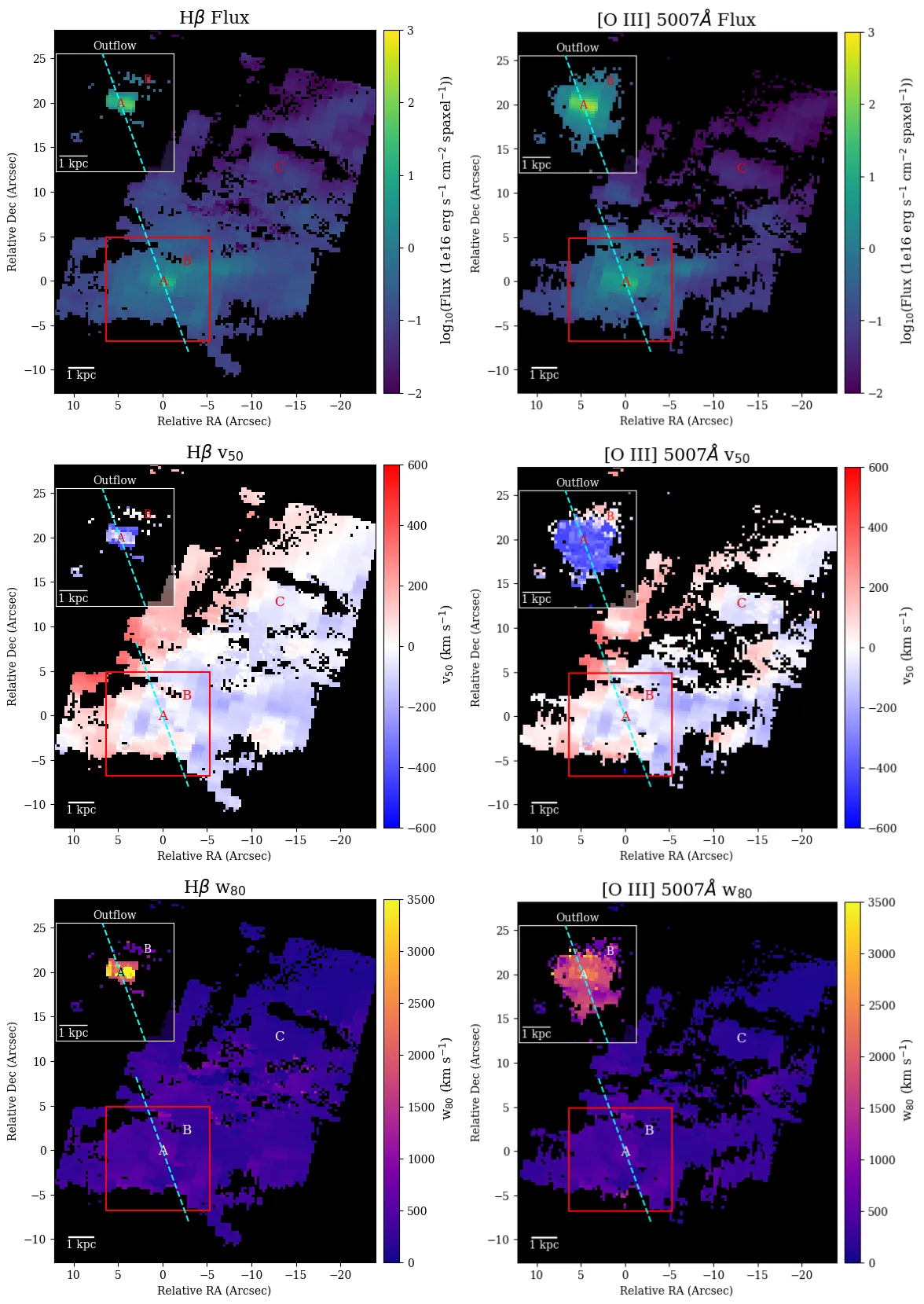
في مركز عنقود المجرات في كوكبة برشاوس تعيش مجرة NGC 1275. من نواتها تهبّ رياح من الغاز المحمّى — وقد تمكن علماء الفلك لأول مرة من رؤيتها بالتفصيل.
هذه الرياح تُلاحَظ من خلال توهّج الهيدروجين والأكسجين. تصل سرعتها إلى 570 كيلومترًا في الثانية — أسرع من رصاصة. في السنة الواحدة، تقذف المجرة حوالي 2.7 كتلة شمسية. وفي الوقت نفسه، يسقط نحو المركز نفس الكمية من الغاز البارد. يبدو أن المجرة توازن نفسها بنفسها: بقدر ما يدخل من المادة، يخرج.
بجانب الرياح، يعمل أيضًا النفاث — تيار ضيق من الجسيمات ينطلق من محيط الثقب الأسود. حيث يمر النفاث، يتوهج الغاز بشكل مختلف. لكن كلا من الرياح والنفاث يؤثران فقط ضمن نطاق ألفي سنة ضوئية من المركز. أبعد من ذلك، يضمحل تأثيرهما.
هكذا تُظهر المجرة في عنقود برشاوس كيف يدير الثقب الأسود والغاز المحيط به حوارًا لا نهاية له: أحدهما ينفخ، والآخر يسقط.
الملخص الأصلي
كما كتبه المؤلفون، بالإنجليزية arXiv:2608.08331v1
We present new Keck Cosmic Web Imager observations of the central few kiloparsecs of NGC 1275, the brightest cluster galaxy of the Perseus Cluster. These integral field spectroscopic data reveal a warm-ionized outflow traced by H$$\beta$$ and the [O III] doublet extending out to $$\sim2.5$$ kpc from the nucleus. The warm-ionized outflow has an [O III]-derived $$v_{50}$$ of up to $$\sim570$$ km/s, $$w_{80}$$ of up to $$3780$$ km/s, and H$$\beta$$-derived outflowing mass of $$(2.7 \pm 0.3)\times 10^6$$ M$$_\odot$$. Our H$$\beta$$-derived warm-ionized outflowing mass rate of 2.7$$\pm$$0.7 M$$_\odot$$ yr$$^{-1}$$ is comparable to the estimated cold molecular disk accretion rate of 1$$-$$10 M$$_\odot$$ yr$$^{-1}$$, which could be a sign of self-regulation between the pc-scale cold gas feeding the active galactic nucleus (AGN) and the warm wind accelerated out to kpc scales. In the host galaxy, we detect an enhancement in the [O III] / H$$\beta$$ ratio in the direction of the receding jet, which may imply jet interaction with the host interstellar medium. The outflow component also shows a clear enhancement of [O III] / H$$\beta$$ that positively correlates with $$w_{80}$$ and $$v_{50}$$, indicative of AGN influence and/or fast shocks. Both the outflow and host galaxy [O III] / H$$\beta$$ ratio decrease with increasing distance from the center, showing that the influence of the AGN is confined to the central $$\sim2$$ kpc. These results are the first resolved measurements of a kpc-scale ionized wind in NGC 1275 and provide a view into how both jets and winds contribute to the feedback cycles in complex cool core cluster systems.
تصل سرعة الرياح من نواة NGC 1275 إلى 570 كم/ث — في ساعة واحدة، يغطي هذا التدفق المسافة من الأرض إلى القمر.