الغبار في المجرات: كتل بدلًا من الضباب سريع
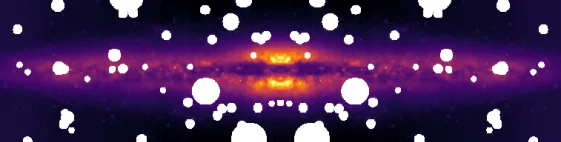
ضوء المجرة البعيدة يصل إلينا عبر غبارها الخاص. هذا الغبار ليس ضبابًا متجانسًا، بل سحبًا ممزقة تشبه خصلات القطن. النماذج القديمة اعتبرته ضبابًا موحدًا، وعندها لم تكن المجرة متوازنة الطاقة: الكثير من الضوء كان يختفي في الأشعة فوق البنفسجية، والقليل جدًا كان يعود في الأشعة تحت الحمراء.
تصرف علماء الفلك مثل طاهٍ يضع مكعبات البطاطس في الحساء بدلًا من حبة كاملة. كل سحابة غبار كثيفة استبدلوها بحبيبة غبار افتراضية "شبه حبيبة" بنفس الخصائص — كيف تمتص الضوء، وكيف تبعثره، وكيف تتوهج عند تسخينها. أضافوا هذه الشبه حبيبات إلى نموذج الغبار المعتاد. أصبح منحنى الامتصاص أكثر انبساطًا: توقف الغبار عن امتصاص الضوء الأزرق بنفس الشره.
طبقوا النموذج على سبع مجرات بميول مختلفة. اتضح أن الغبار المتكتل يسمح بمرور ضوء أكثر مما كان يُعتقد: انخفضت العتامة البصرية القصوى في المرشح الأزرق بمقدار 1.3–2.8 مرة. بقيت مجرتان معتمتين في المركز، ومجرتان معتدلتين، وثلاث مجرات شفافة.
الكتل تغير الصورة: نحتاج إلى غبار أقل لتفسير نفس الامتصاص. إذن، تقديرات كتلة الغبار في المجرات ربما تكون مبالغًا فيها. والضوء القادم من النجوم البعيدة يصل إلينا بسهولة أكبر مما كنا نعتقد سابقًا.
الملخص الأصلي
كما كتبه المؤلفون، بالإنجليزية arXiv:2608.14023v1
We attempt to resolve the long-standing energy balance problem encountered by Radiative Transfer (RT) models, particularly in edge-on galaxies by incorporating a treatment for the clumpy structure of the Interstellar Medium (ISM). A subgrid approach is adopted, treating the quiescent dust clouds as pseudo-dust grains, with equivalent optical and thermal emission properties. Deriving key quantities such as the absorption, scattering and extinction cross-sections enables the virtualisation of the macroscopic clump into a microscopic pseudo-grain that can be included alongside the existing dust model constituents. The addition of the pseudo-grain results in a flatter extinction curve. A library of clump emission spectral energy distributions (SEDs) is constructed for radiation fields of various colours and intensities. The new clumpy model is applied to the edge-on galaxy NGC 891 and, for the first time, is able to achieve a good energy balance, simultaneously fitting both the submm and Near Infrared (NIR) data. The clumpy model is further applied to a small sample of seven galaxies of various inclinations, and the results are compared with those from the purely diffuse models. The clumpy models are characterised by a reduction in dust opacity, and therefore attenuation, compared to their purely diffuse counterparts. Thus, the maximum face-on optical depth in the $$B$$-band, $${\mathrm max}(\tau^{\mathrm f}_{\mathrm B})$$, derived from the clumpy models is found to be lower by factors ranging from 1.3 to 2.8. Of the seven galaxies, two are found to be optically thick in their centres, two are found to be moderately optically thick, and three are found to be optically thin.
في مجرة NGC 891، يتجمع الغبار في سحب تشبه في شكلها "أليافًا" عملاقة — تُرى في الصور كعروق داكنة تعبر قرص المجرة.
في رواية "الغبار" لتشارلز بيلغرينو، يصبح الغبار البينجمي تهديدًا لسفينة الفضاء — فالبنية المتكتلة للغبار تجعل الاصطدامات أكثر خطورة.