Gravitational Lens from Spins ⚡ экспресс
Original: "Emergent curved space and gravitational lensing in quantum materials"
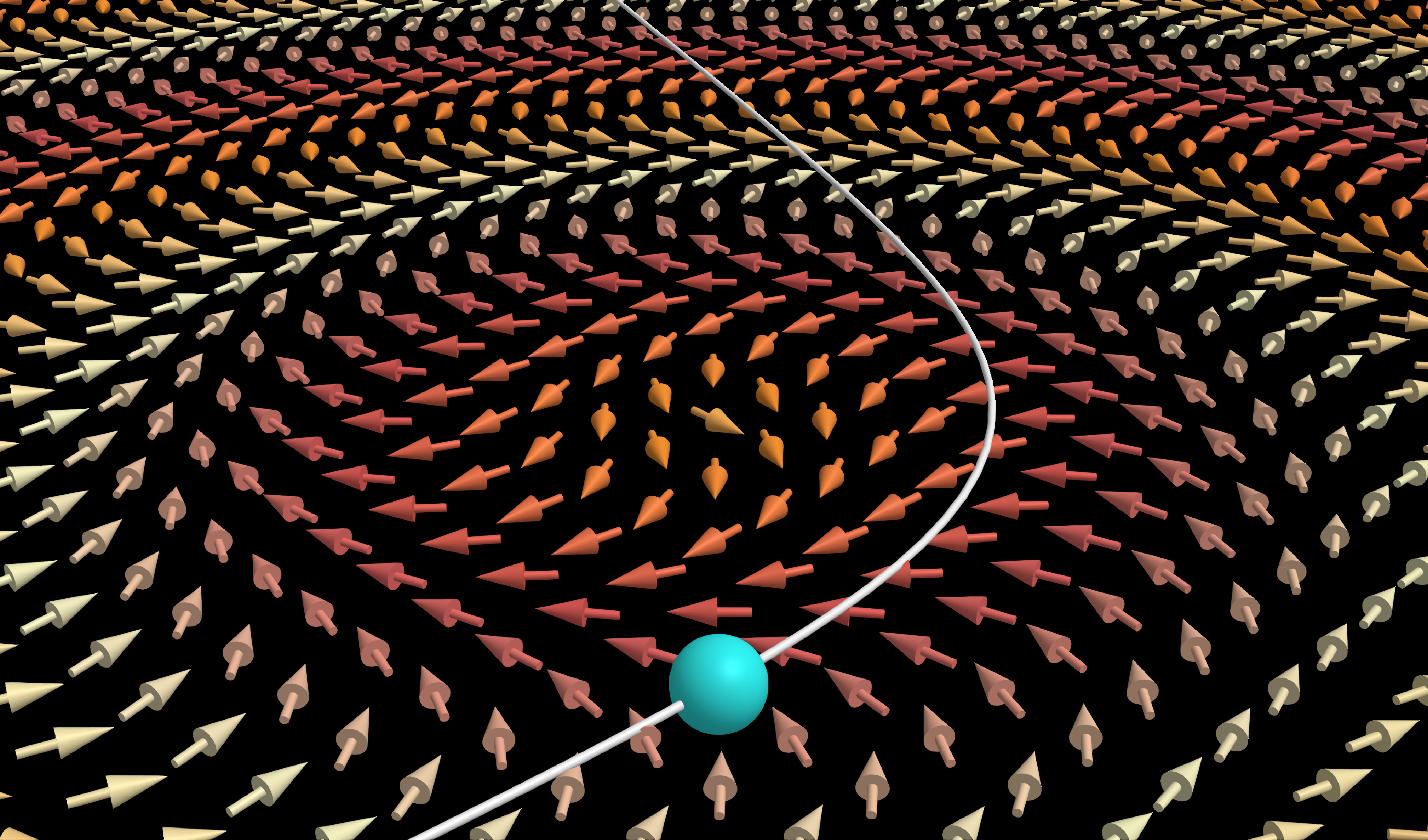
In a quantum material, electrons bend their path as if under invisible gravity, even though there is no mass present.
Links in the knowledge graph 1
In a tiny magnet, electrons skirt around invisible obstacles, like light near a black hole. The secret lies in the orderly dance of spins, which creates the illusion of curved space. Such 'electron lenses' promise ultra-precise sensors and new ways to study gravity without space telescopes.
🎯 Gravitational lensing was predicted by [scientist:Albert Einstein]Einstein[/scientist] in 1912, but the first observation occurred only in 1979: astronomers saw a distant quasar split into two images due to a massive galaxy.
🎬 The idea of controlled bending of particle paths echoes warp drives from science fiction, where space contracts in front of a ship.