Electronic Gravitational Lensing in Quantum Materials ✛
Context
The idea that an electron in a spin texture feels an effective magnetic field has been known for a long time and underlies the topological Hall effect. However, at finite binding energy between the electron and the localized spin, higher-order corrections appear that are usually discarded. This work shows that these corrections do not reduce to a scalar potential or a magnetic field: they modify the very metric of the space in which the electron moves. Alongside this work on the archive are studies of emergent gravity in condensed matter, from quantum foam to magnetic monopoles in black holes, but they all rely on different mechanisms: lattice deformations, nontrivial band structure, or external fields. Here, curvature arises purely from the quantum coupling of the electron spin to the background texture.
Methods
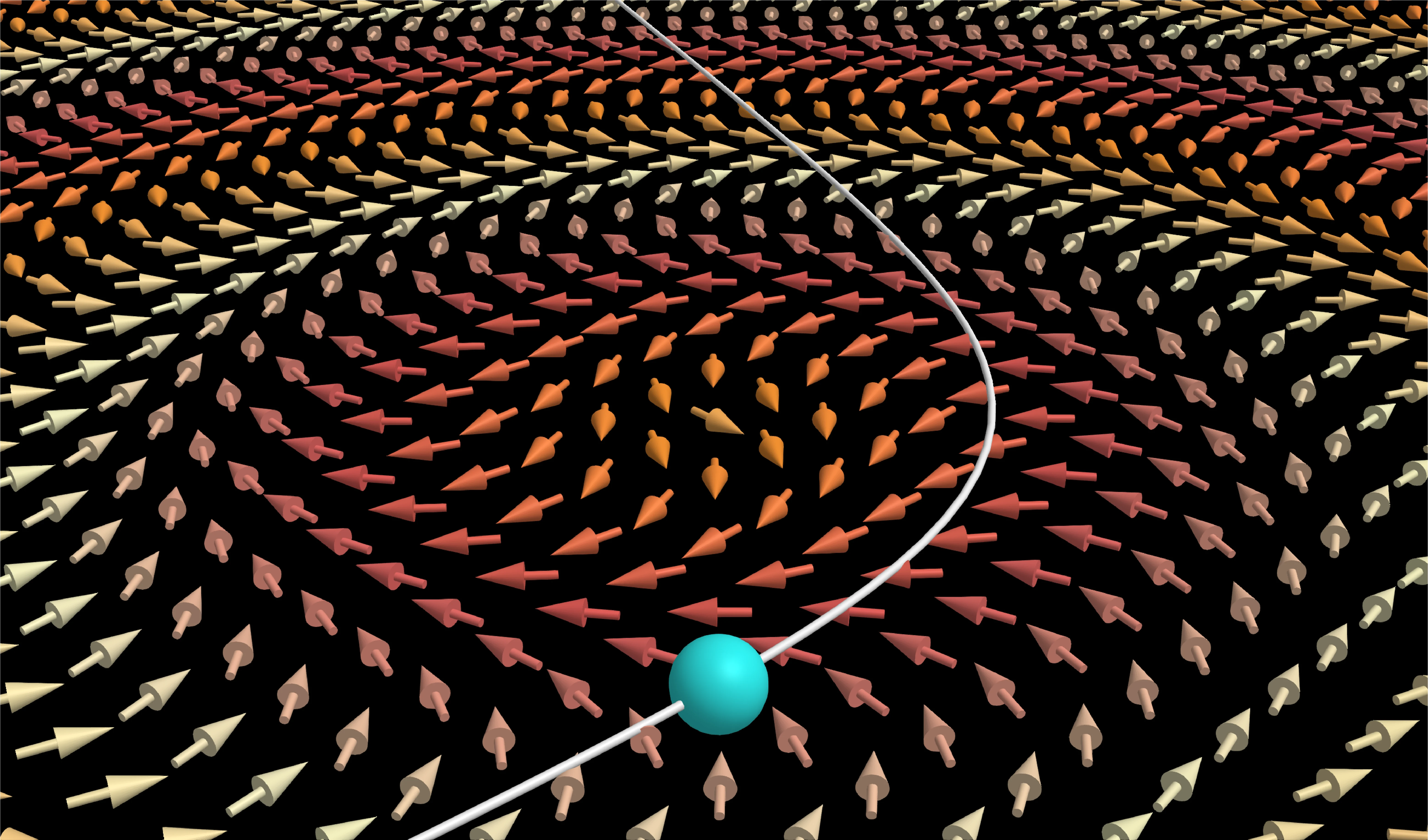
The authors considered the Hamiltonian of an electron strongly coupled to localized spins and applied a unitary transformation that rotates the electron spin along the local direction of the spin texture. Then, using the Schrieffer–Wolff transformation, they eliminated the high-energy branch of the spectrum and obtained a low-energy effective Hamiltonian to first order in the inverse coupling constant. In this Hamiltonian, a term quadratic in momentum appeared, with an effective metric depending on the quantum metric of the spin state. To analyze electron motion, classical equations of motion were derived, which reduced to the geodesic equation in curved space. As simple examples, they considered a spiral texture, a ferromagnet–helicoid transition, and a radial spiral, for which geodesics were found analytically.
Results
The main result: an electron in a smooth spin texture does not move in a straight line but along a geodesic of an effective curved space. For the transition between ferromagnetic and helicoidal regions, the ratio of tangents of the angles of incidence and refraction equals sqrt(1 + (π $l_C$ / $λ_s$)^2), where $l_C$ is the Compton length associated with the binding energy and $λ_s$ is the texture period. Unlike Snell's law, there is no total internal reflection here. For a radial spiral, the geodesics correspond to straight lines on a cone, and the deflection angle is determined by the cone's angle deficit. The key difference from scattering on a potential: the effect does not vanish for fast electrons but rather strengthens, since the force is proportional to the square of the velocity. Numerically, for typical parameters ($l_C$ ~ 1–10 nm, $λ_s$ ~ 10–100 nm), the deflection angle when passing through a region of size $λ_s$ is of order ($l_C$/$λ_s$)^2, which is within experimental observability.
Implications
The work shows that emergent gravity in quantum materials does not require exotic conditions: strong spin-orbit coupling and a nontrivial spin texture suffice. This distinguishes it from neighboring approaches where curvature was introduced via lattice deformation or special band structure design. Here, curvature is a direct consequence of the quantum nature of spin, and it can be as diverse as the spin textures themselves. Moreover, the effect does not require breaking time-reversal symmetry, unlike emergent magnetic fields, and can be observed in coplanar textures.
Future development
A natural extension is the search for analogs of strong gravitational effects, such as event horizons or black holes, in systems with large values of $l_C$/$λ_s$. Dynamics of spin textures could lead to time-dependent metrics and analogs of gravitational waves. Experimental confirmation of the predicted lensing is also possible in magnetic materials with known textures, for example in helicoidal magnets with domain walls.
Impact
The results may affect the understanding of transport properties in spintronics and magnonics, where spin textures are already used to control electrons. Furthermore, they open the way to laboratory modeling of general relativity effects in condensed matter.
Next steps
The immediate next steps are to search for materials with suitable parameters (large l_C/λ_s ratio) and to develop experimental schemes for observing the deflection of electron beams. It is also important to account for electron-electron interactions and the influence of temperature on the stability of spin textures.
Key open problems
In condensed matter physics, the question of fully accounting for quantum corrections in the adiabatic motion of electrons in inhomogeneous magnetic structures remains open. This work shows that first-order corrections in the inverse binding energy do not reduce to known potentials and require a geometric description. This connects the problem to the broader issue of quantum geometry in solids and its role in transport phenomena.
The knowledge machine's view
This section is addressed to the author of the paper and their colleagues. Neighbouring works were found by meaning-based search across our archive, not by word overlap. We do not review: we show the field around the work.
What the work does
The authors examined the strong coupling of an electron to localized spins and, via the Schrieffer–Wolff transformation, derived an effective Hamiltonian with a metric that depends on the quantum metric of the spin state. The electron's motion reduces to geodesics in curved space, leading to electron lensing without magnetic fields. For several spin textures, the geodesics are found analytically, and it is shown that the effect strengthens with increasing electron velocity.
Where its strength is
A strong point is the identification of a purely quantum mechanism of emergent gravity that requires no external fields or lattice distortions, along with a clear demonstration of the effect on simple analytical examples.
Where it could go next
- It might be interesting to compare the obtained effective metric with the behavior of gravitons in curved space, as considered in a neighboring work, to see how quantum corrections to the spin texture affect the propagation of collective excitations.based on: Gravitons: A Double Twist in a Curved World arXiv:2605.19817
- Nearby lies an analysis of how gravity can affect the polarization of light; perhaps an analogous approach could be used to examine the influence of effective curvature on the spin polarization of electrons in your system.based on: How Gravitational Waves Twist Light arXiv:2601.07179v1
- In the archive there is a discussion of graviton–photon interactions, where subtle effects in curved space are examined; one could check whether similar effects might appear in electron–photon processes in your quantum materials.based on: Why the Graviton Dance Leaves No Shadow in Photon Light arXiv:2607.15964v1
Worth trying
- Check whether an analogue of lensing arises for spin waves in the same textures.
- Consider the possibility of experimentally observing the deflection of an electron beam in helical magnets with known parameters.
- Assess the influence of the quantum metric of the spin state on transport in topological materials.
Why this may matter
If the effect is confirmed experimentally, it would open up a new class of phenomena where the quantum geometry of spin states directly controls electron trajectories, which could be exploited in electron optics and spintronics.
Nearby works in our archive
- A Loop That Travels on Its Own and Dictates Energysimilarity 0.57
- Gravitons: A Double Twist in a Curved Worldsimilarity 0.56
- A Spin That Never Diessimilarity 0.56
- How Gravity Repaints Gravitational Wavessimilarity 0.56
- How Gravitational Waves Twist Lightsimilarity 0.55
- Electron Spin: A Dance in Chiral Quantum Dotssimilarity 0.55
- Why the Graviton Dance Leaves No Shadow in Photon Lightsimilarity 0.55
The archive is sparse around this work: the closest review is only 0.57, against a usual 0.64. It looks like few have drilled nearby.
The radial spiral considered in the paper realizes the geometry of a cone, the same curvature that a point mass creates in (2+1)-dimensional general relativity. Thus, a simple magnetic vortex can serve as a tabletop model of a gravitational field in a flat world.
The idea of emergent gravity in condensed matter resonates with Greg Egan's novel 'Schild's Ladder', where physicists create an artificial universe with changeable laws. Here, on a smaller scale, spin textures allow 'switching on' gravitational lensing for electrons.
Key numbers
- Correction to the metric: (π l_C / λ_s)^2
- Ratio of tangents of angles at the ferromagnet–helicoid boundary: sqrt(1 + (π l_C / λ_s)^2)
- Typical length l_C: 1–10 nm
- Typical texture period λ_s: 10–100 nm