Gravitational Lens from Spins ✛
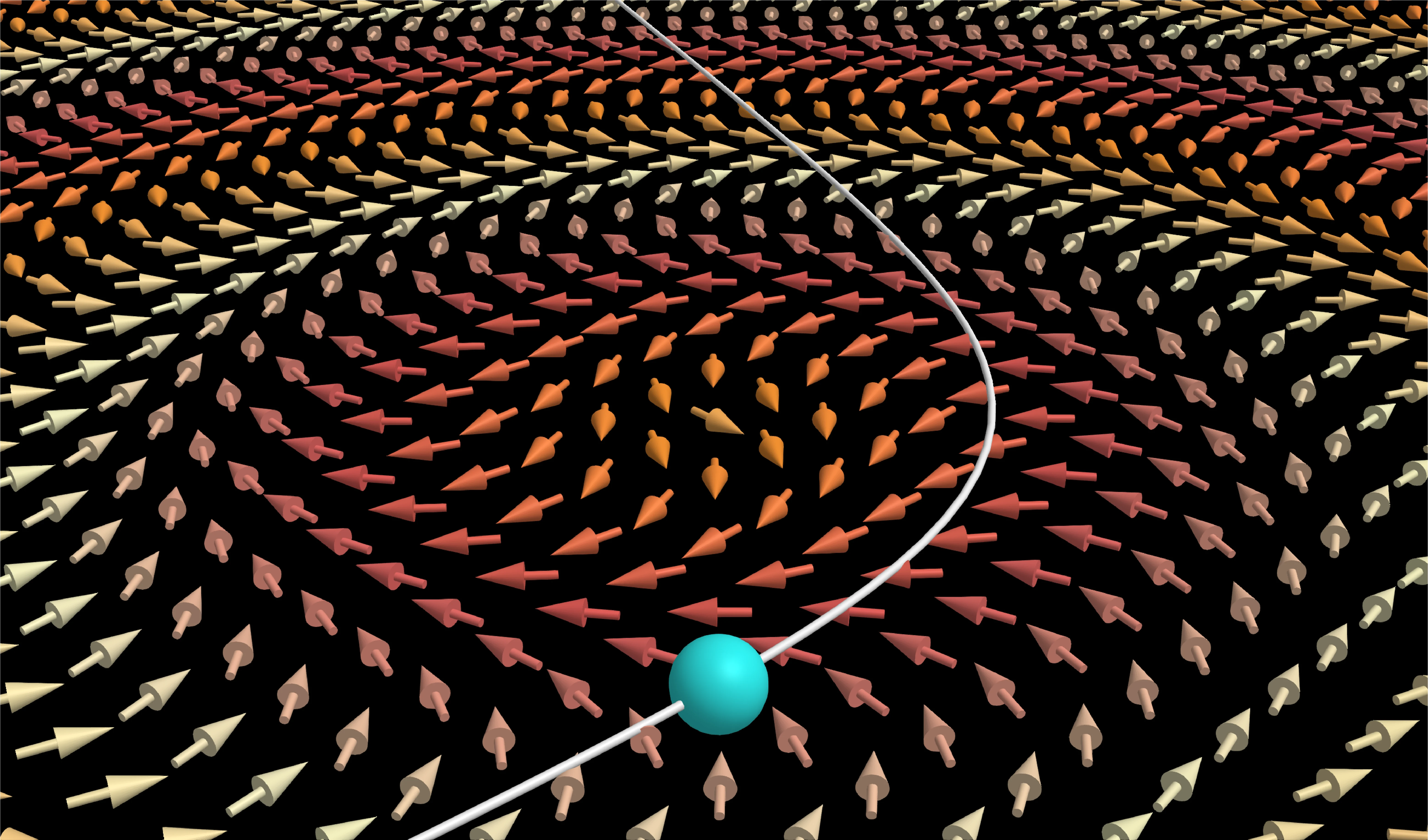
In some magnetic materials, electron spins — their intrinsic rotation — line up in an orderly pattern. Flying through such a pattern, an electron cannot instantly adjust its own spin to the surroundings. Its trajectory bends, as if it were rolling over an invisible curved landscape. Surprisingly, this requires neither an external magnet nor an electric field — just the collective dance of spins.
This miniature effect replicates the curvature of space by massive bodies, described by Einstein in the general theory of relativity. A beam of electrons passing through the material can focus — exactly like light from a distant star bending around a black hole. By changing the spin pattern, such an 'electron lens' can be controlled on the fly, paving the way for ultra-compact devices and laboratory models of gravitational phenomena.
Gravitational lensing was predicted by Einstein in 1912, but the first observation occurred only in 1979: astronomers saw a distant quasar split into two images due to a massive galaxy.
The idea of controlled bending of particle paths echoes warp drives from science fiction, where space contracts in front of a ship.