Electronic Gravitational Lensing in Quantum Materials ✛
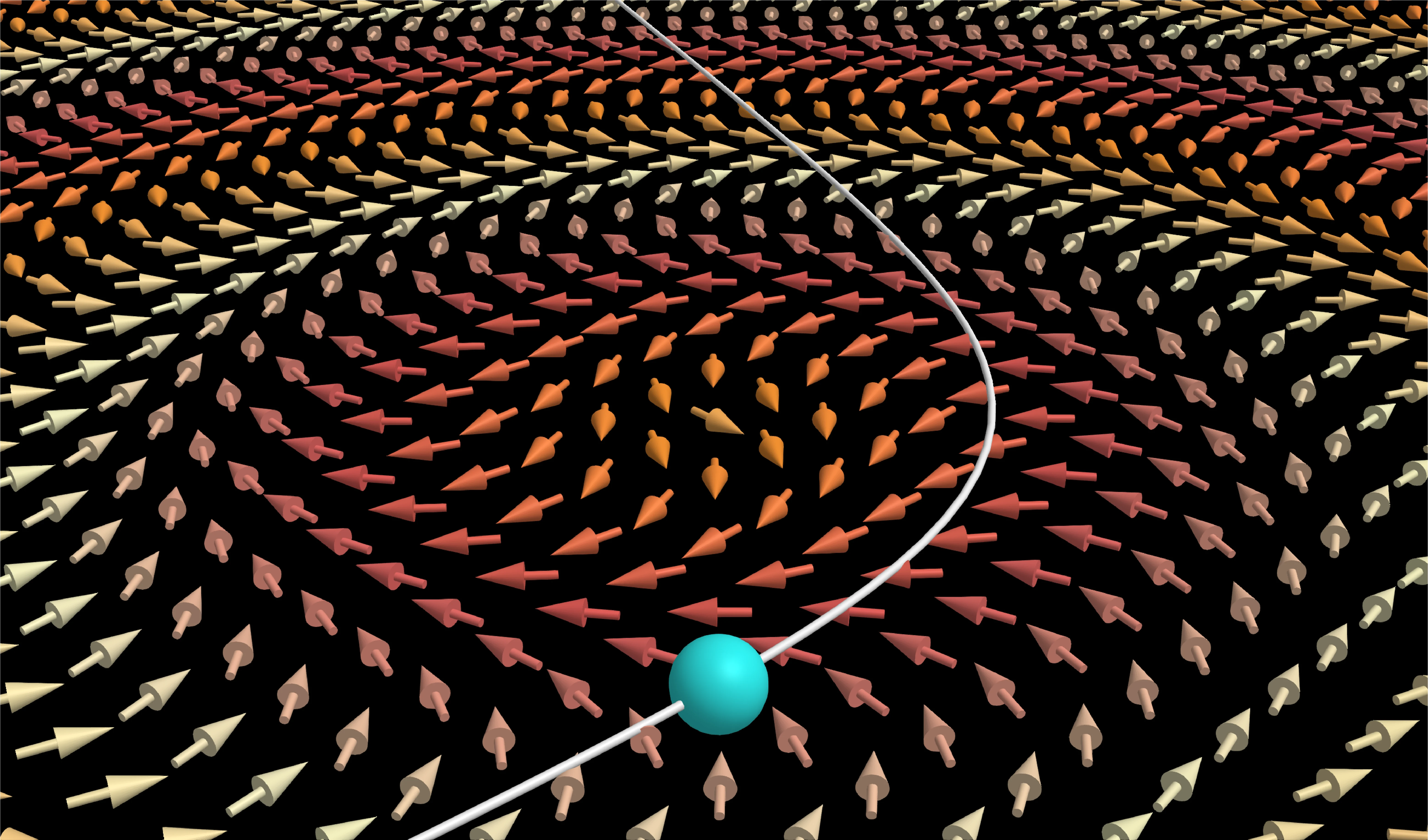
An electron gliding over invisible hills and valleys created by a spin texture: that is the picture behind a new chapter in condensed matter physics. In quantum materials where the direction of localized spins varies smoothly (a spin texture), an electron is no longer just a particle flying through the lattice. It finds itself in a world where space itself is curved, and this curvature is not a metaphor but an exact mathematical description.
The idea that an electron in a spin texture feels an effective magnetic field has been known for a long time and underlies the topological Hall effect. However, at finite coupling energy between the electron and the localized spin, higher-order corrections appear that are usually discarded. The authors of the new work showed that these corrections do not reduce to a scalar potential or a magnetic field. Instead, they modify the very metric of the space in which the electron moves. Using the Schrieffer–Wolff transformation (a method for eliminating high-energy states), they derived an effective Hamiltonian accurate to first order in the inverse coupling constant. It contains a term quadratic in momentum, with an effective metric that depends on the quantum metric of the spin state, a measure of distance between quantum states.
The numbers speak for themselves. The typical length $l_C$ (associated with the coupling energy) is 1–10 nm, and the typical texture period $λ_s$ is 10–100 nm. For the transition between ferromagnetic and helical regions, the ratio of the tangents of the angles of incidence and refraction equals sqrt(1 + (π $l_C$ / $λ_s$)^2). Unlike Snell's law, there is no total internal reflection here. For a radial spiral, the geodesics (shortest lines in curved space) correspond to straight lines on a cone, and the deflection angle is determined by the cone's deficit angle. The deflection angle when passing through a region of size $λ_s$ is on the order of ($l_C$/$λ_s$)^2, a value within experimental observability.
This work opens the door to a world where the laboratory bench becomes a testing ground for ideas from general relativity. Emergent gravity in quantum materials does not require exotic conditions: strong spin–orbit coupling and a nontrivial spin texture suffice. Unlike neighboring approaches, where curvature was introduced through lattice deformation or special band-structure design, here curvature is a direct consequence of the quantum nature of spin. And it can be as diverse as the spin textures themselves. Moreover, the effect does not require breaking time-reversal symmetry, unlike emergent magnetic fields, and can be observed in coplanar textures.
A natural next step is to search for analogs of strong gravitational effects, such as event horizons or black holes, in systems with large values of $l_C$/$λ_s$. The dynamics of spin textures could lead to time-dependent metrics and analogs of gravitational waves. Experimental confirmation of the predicted lensing might be possible in magnetic materials with known textures, for example in helical magnets with domain walls. The results could impact our understanding of transport properties in spintronics and magnonics, where spin textures are already used to control electrons. Immediate next steps include searching for materials with suitable parameters (large $l_C$/$λ_s$ ratio) and developing experimental schemes to observe the deflection of electron beams. It is also important to account for electron–electron interactions and the influence of temperature on the stability of spin textures.
The radial spiral considered in the article realizes the geometry of a cone, the same curvature that a point mass creates in (2+1)-dimensional general relativity. A simple magnetic vortex can serve as a tabletop model of a gravitational field in a flat world.
The idea of emergent gravity in condensed matter echoes Greg Egan's novel 'Schild's Ladder', where physicists create an artificial universe with alterable laws. Here, on a smaller scale, spin textures allow one to 'switch on' gravitational lensing for electrons.