Grokken: The Graphene That Promises Room-Temperature Superconductivity express
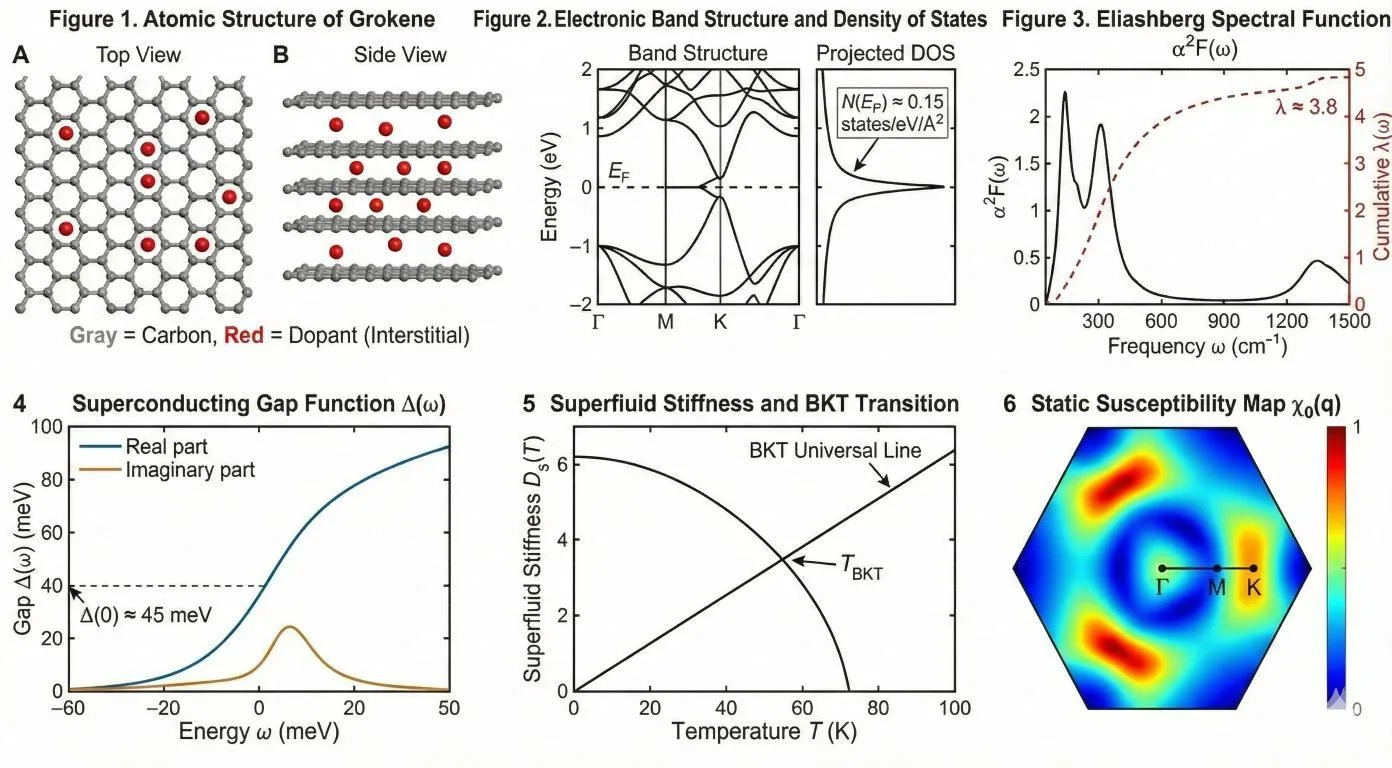
Graphene is a sheet of carbon just one atom thick. Fold it in a special pattern and you get a new material — grokken. It wasn't a human who found it, but an AI: a large language model sifted through possibilities and proposed exactly this [tag:lattice_calculation]lattice.
Calculations[/tag] show that grokken should conduct electricity with zero resistance at 52°C. That's room temperature. Ordinary superconductors only work in extreme cold, but here it's like a warm room. But there's a catch: in a thin sheet, electrons behave restlessly, and superconductivity vanishes at -153°C.
To make grokken work at room temperature, scientists suggest stacking several layers, placing it on a substrate, or tuning its properties with an electric field. If experiments confirm the calculations, we can expect wires that don't heat up, powerful magnets, and fast electronics.
AI has started hunting for materials like mushroom pickers: scanning options and finding surprises. Grokken is the first find that promises superconductivity under ordinary conditions.
Original abstract
as written by the authors arXiv:2601.00931
We introduce Grokene, a novel two-dimensional superlattice derived from graphene, which was identified through an AI-guided materials discovery workflow utilizing a large language model. Grokene is predicted to exhibit ambient-pressure, room-temperature superconductivity, with computational simulations revealing a high electron-phonon coupling constant and a substantial logarithmic-averaged phonon frequency (~1650 K), leading to a mean-field critical temperature of approximately 325 K. Full isotropic Eliashberg solutions further support a critical temperature around 310 K, underscoring its strong potential for room-temperature superconductivity. However, the strict two-dimensional nature of Grokene introduces phase fluctuations, limiting the observable superconducting transition to a Berezinskii-Kosterlitz-Thouless (BKT) temperature of about 120 K in monolayers. To elevate TBKT toward room temperature, strategies such as few-layer stacking, substrate or gate engineering, and optimization of superlattice structure and doping levels are proposed. Our integrated workflow, combining AI-driven materials discovery with advanced many-body theories (DFPT/EPW, Eliashberg, and RPA), provides a systematic and reproducible framework for exploring novel superconductors. We suggest that experimental synthesis and comprehensive characterization of Grokene will be essential to assess these computational predictions and to explore routes toward practical superconductivity under ambient pressure.
A superconductor levitates above a magnet: that's the Meissner effect. If grokken works at room temperature, maglev trains could become cheaper.