Scientist

Klaus von Klitzing

1943– · condensed matter physics, quantum physics, metrology
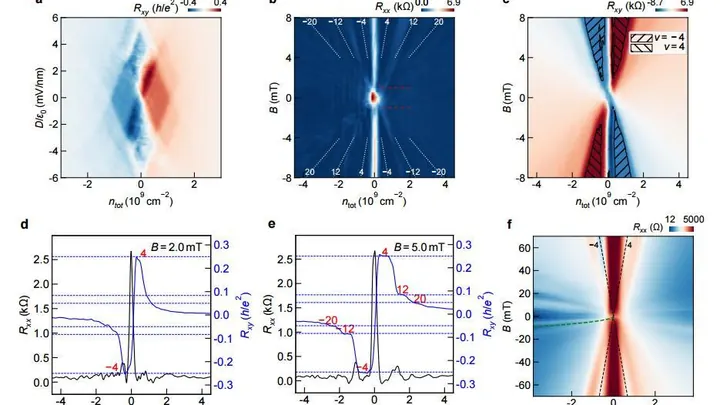
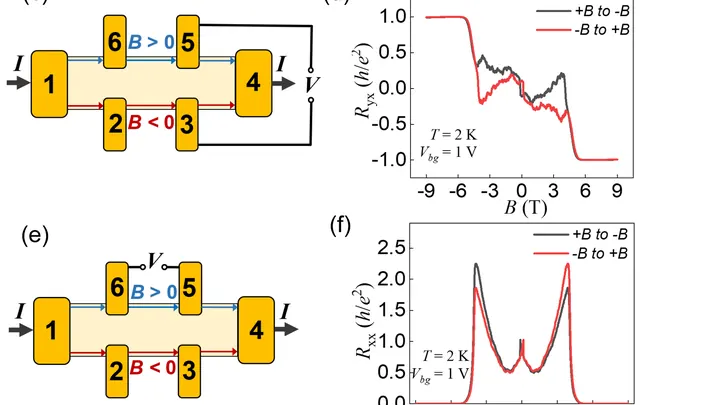
German physicist, Nobel laureate for the discovery of the integer quantum Hall effect. This phenomenon demonstrated the quantization of electrical resistance in two-dimensional electron systems at low temperatures and strong magnetic fields, which became fundamental for metrology and the understanding of quantum states of matter. His work underlies modern quantum resistance standards.

Biography

Klaus von Klitzing was born on 28 June 1943 in Schrotta, Germany (now Poland). He studied physics at the Technical University of Braunschweig and received his doctorate from the University of Würzburg. He worked at the Physikalisch-Technische Bundesanstalt (PTB) and at the Max Planck Institute for Solid State Research, where he later became director. In 1980, while conducting experiments with silicon MOSFETs, he discovered the quantization of the Hall resistance. For this discovery he was awarded the Nobel Prize in Physics in 1985. He continues to be active in research and teaching.

Key discoveries

💡 The discovery of the quantum Hall effect happened by chance during a lunch break: von Klitzing decided to measure the resistance of a sample at a very low temperature and was amazed by the step-like behavior of the graph.
Concepts
electromagnetismquantum measurement
Laws
quantum Hall effect
Scientists
James Clerk MaxwellShuji NakamuraJohn Stewart BellWilhelm WienAlbert A. MichelsonSerge HarocheDavid BohmCharles Bennett

Related articles

Strongly Correlated2011-12-252 minarXiv:1112.5783express
The Magnetic Knot That Refuses to Come Undone
A crowd in a square. At first, everyone spins to their own rhythm, but suddenly the music changes, and they all start moving in sync, as one. That's roughly how electrons behave in some metals: they either cling to magnetic impurities or break away and form a collective order.
Quantum Physics2025-11-191 minarXiv:2511.15492express
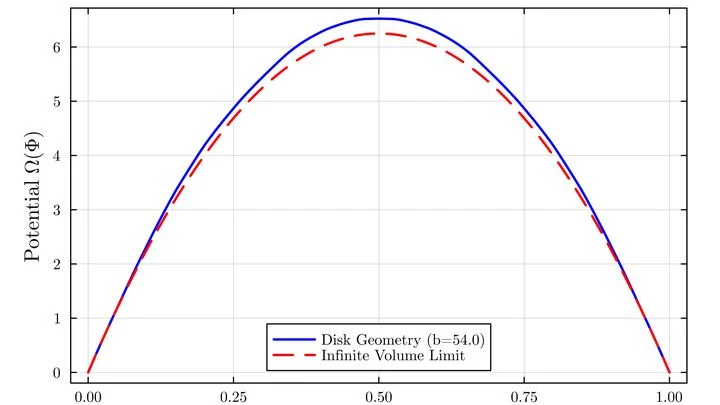
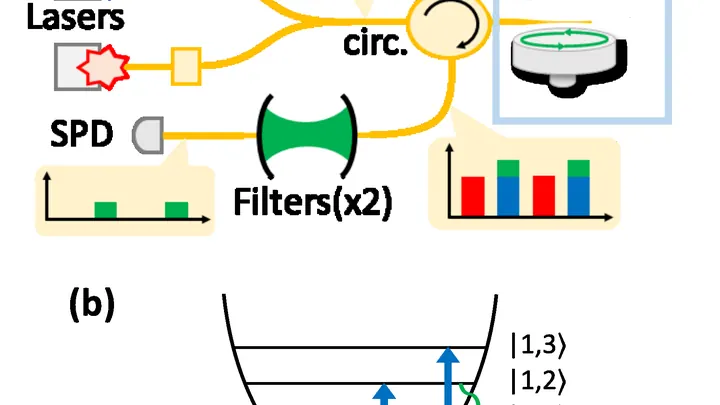
A Shivering Disk Cooled to Quantum Stillness
Cooled nearly to absolute zero with liquid helium, the semiconductor disk reached such a low level of entropy that its thermal trembling became less than one phonon — a quantum of sound.
General Relativity2025-12-181 minarXiv:2512.17959express
Heat from the void: how to catch the Unruh effect
The void is deceptive. William Unruh showed that an accelerating observer perceives the vacuum as hot. The effect resembles the particle birth near black holes, predicted by Stephen Hawking, but instead of spacetime curvature, acceleration is at work.
Strongly Correlated2026-01-141 minarXiv:2601.09847express
Metal Locks Magnetic Flux
Metals are full of free electrons: they dart between atoms like a swarm of bees around a hive. If you poke such a metal with a thin magnetic filament, the electrons start to feel its field. A new calculation shows they don't just go around the field; they trap it inside, like a cork sealing water in a bottle.
Electron in a Magnetic Field: Measuring Its Mass at Minus 273 Degrees
The electron is a tiny particle, but inside a crystal it behaves as if it had a different mass. Physicists call this the effective mass. To measure it, they make electrons run in circles in a magnetic field, like a speed skater on an ice rink who is kept from leaving the orbit.
Mesoscale2026-01-221 minarXiv:2601.16015express
Graphene Sandwich Accelerates Electrons
Graphene is a carbon sheet just one atom thick, a fantastic conductor. But its surface is crinkly, like a wrinkled tablecloth that hasn't been ironed. Scientists built a 'sandwich': two of these sheets pressed together with a non-conductive spacer in between. They iron out each other's folds, like two halves of a sandwich making the surface perfectly even.
Mesoscale2026-02-091 minarXiv:2602.08468express
Fractional Charge from a Quantum Well
In a thin sandwich of gallium arsenide, electrons don't behave like individual balls but like a single quantum liquid. If the layer is made just 70 nanometers thick, this liquid separates into two nearly independent flows, like oil on water.
Quantum Physics2026-02-162 minarXiv:2602.14437express
Magnetic Resonance for Electrons
Electrons in a conductor behave like a crowd on an escalator: each one moves on its own, but together they create a flow. If you make them circle around a ring, their angular momentum (a measure of rotation) can couple to a magnetic field, like gears in a clock.
Mesoscale2026-02-242 minarXiv:2602.20884express
The Wire That Refuses to Trap Electrons
A thin wire made of a special material, a topological insulator, behaves like a city street: the interior is empty, and all traffic runs along the edges. Electrons in such a wire move only along the surface, like pedestrians on a sidewalk, never stepping onto the roadway.
Superconductivity2026-02-261 minarXiv:2602.22788express
Oscillations in a Wireless Superconductor
An ordinary superconductor loses resistance when cooled, and current flows through it without loss. But in ultrathin films, things are different: the material fluctuates between normal and superconducting states, and in this transition zone, strange resistance waves emerge. Resistance rises and falls as if someone were turning a volume knob.
Mesoscale2026-03-041 minarXiv:2603.03927express
Indestructible current: how quantum edges bypass obstacles
Certain materials, when placed in a strong magnetic field at low temperatures, exhibit a surprising property: their interior stops conducting, becoming an insulator, while along the very edge of the sample electricity runs like a river along a channel, always in one direction.
Mesoscale2026-03-051 minarXiv:2603.05341express
The Quantum 'Cook': Superfluidity of the Quantum Hall Effect
The quantum Hall effect has long been suspected of superfluidity — the ability to flow without friction. Imagine a cook following a recipe: for each unit of magnetic flux, he must add exactly a certain number of electrons.
Materials2026-03-151 minarXiv:2603.14192express
Magic Twist Angle Sparks Giant Effect
Two layers of a magnetic material, rotated relative to each other by fractions of a degree, like two slightly offset screens on a window. In their normal state, they don't produce anything special, but at a certain twist angle, an unexpected effect emerges.
Superconductivity2026-03-182 minarXiv:2603.17235express
Corrugated metal surface makes electrons meander
When cooled strongly, a uranium-telluride crystal stops resisting current. Before that happens, at a slightly higher temperature, its resistance can still be measured — and it tells about the shape of the invisible paths along which electrons run.
Materials2026-03-192 minarXiv:2603.18906express
Magnetic Islands Inside a Crystal
A crystal does not grow as a single whole but like a city of neighborhoods — grains. In each neighborhood, atoms are arranged in their own way, and the boundaries between them are like streets.
Mesoscale2026-03-221 minarXiv:2603.21346express
Electron liquid heats up and thickens
A thin semiconductor layer at low temperatures behaves like a pot of honey: electrons flow not as individual particles but as a thick liquid. If you run an alternating current through such a layer, the resistance responds with a smooth curve.
Quantum Gases2026-03-232 minarXiv:2603.22173express
Half a Quantum: The Dance of Atoms at the Boundary of Worlds
In the quantum world, there are rules that seem to be broken. One of them is the conservation law: if in classical physics symmetry guarantees the conservation of charge, then in the quantum description this guarantee can disappear. This phenomenon is called a quantum anomaly.
Materials2026-04-022 minarXiv:2604.01908express
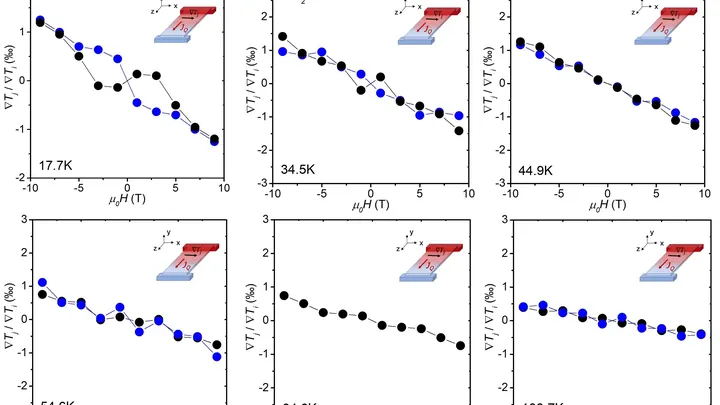
Heat bends sideways under a magnet
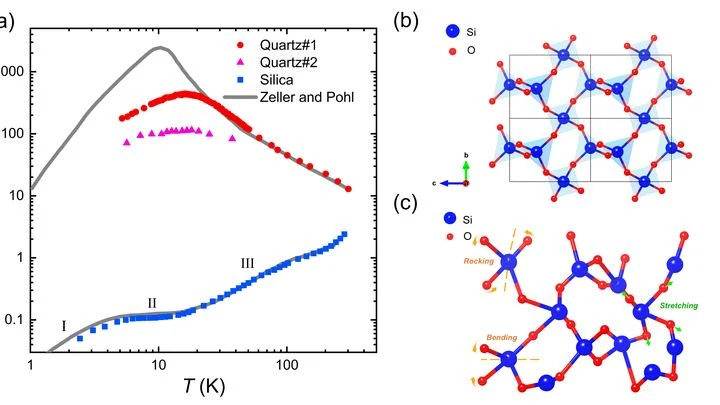
If you push heat through a piece of quartz, it usually goes straight, like water through a pipe. But switch on a magnetic field, and the flow veers slightly sideways, as if the pipe suddenly grew a side branch.
Mesoscale2026-04-021 minarXiv:2604.02123express
Cold from a Quantum Tunnel
A piece of metal heated at one end produces a weak electric current: this has been known for nearly two hundred years. But what if, instead of a simple metal, you take a layered "sandwich": a superconductor, a thin insulator, and a flat layer of electrons?
Materials2026-04-031 minarXiv:2604.02630express
When Electrons Collapse to a Point
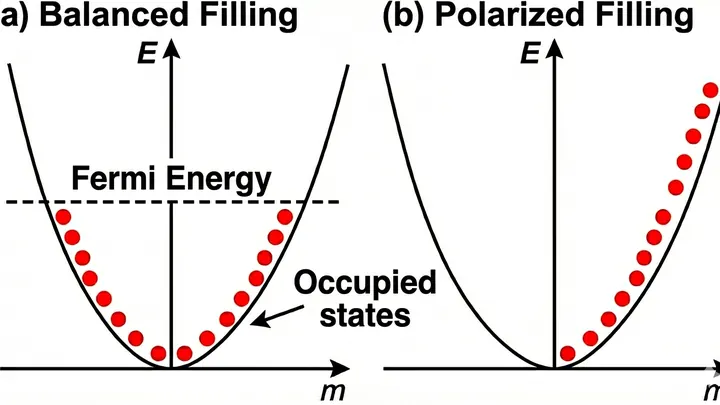
In the crystal HfTe5, electrons behave almost like light: their mass is so small that they obey the laws of relativity. If you place such a crystal in a strong magnetic field, the electrons start to circle in tiny orbits. Their energy then changes not smoothly but in steps, like floors in a building.
Superconductivity2026-04-031 minarXiv:2604.02843express
The Mystery of Two Gaps in a New Superconductor
Electrons in a crystal sometimes behave like a stadium crowd doing the wave: areas of higher density alternate with nearly empty ones. This wave blocks the free flow of charges — under normal conditions, the material is not superconducting. But apply pressure, and the wave vanishes, letting electrons move without resistance.
Materials2026-04-031 minarXiv:2604.03183express
Heat Flows Sideways in Magnets Without Magnetism
Two sets of swings, rocking in opposite directions, don’t tilt the platform. Yet their motion creates invisible vortices that push a ball sideways. Alternagnets behave just like that: the atomic magnetic arrows are perfectly balanced, but a hidden symmetry bends the heat flow.
Materials2026-04-041 minarXiv:2604.03644express
Heat Goes Sideways Under a Magnetic Field
In an insulating crystal, heat usually flows from the hot end to the cold end. But when you switch on a magnetic field, part of the heat flow veers sideways, like water running down a slope that drifts to the side when the wind pushes it. This behavior is called the thermal Hall effect.
Materials2026-04-072 minarXiv:2604.06083express
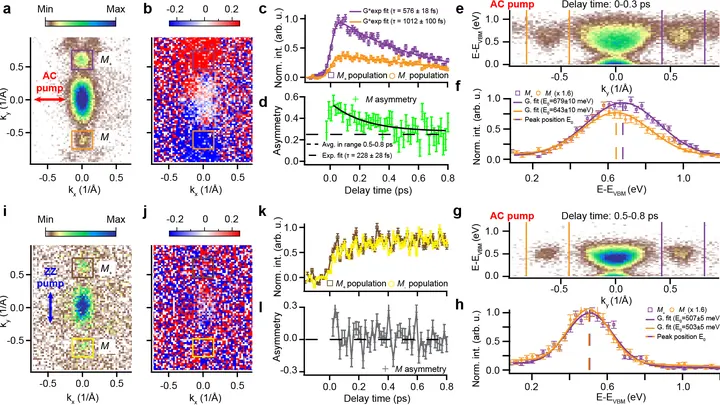
Light That Makes Current Out of Nothing
An ordinary sheet of black phosphorus looks like a layered cake of atoms. If you shine a regular lamp on it, nothing special happens: the electrons sit still, like spectators in a dark theater. But a short laser flash lasting millionths of a billionth of a second shakes up that theater.
Mesoscale2026-04-182 minarXiv:2604.16927express
A Horizon Inside a Crystal
In the quantum world, electrons can behave like waves. If you create the right conditions for them, these waves start to feel something akin to gravity. In crystals known as Weyl semimetals, electrons move as if they were massless, and their energy depends on direction, like a tilted cone.
Strongly Correlated2026-04-182 minarXiv:2604.17103express
Order That Doesn't Interfere: Topology in a Thin Film
A mosaic floor made of many small tiles, each turned in a different direction. It seems that any pattern trying to cross such a floor would get scrambled and vanish. That's how people usually think about disorder in crystals: if atoms aren't arranged in a perfect lattice, delicate quantum effects should fall apart.
Strongly Correlated2026-04-212 minarXiv:2604.19870express
Quantum Jitters Heat Up a Crystal
Hundreds of people on a dance floor stand at equal distances from each other — strict order, like in a crystal lattice. Slow music is thermal vibrations, making dancers sway slightly. If the music gets louder and faster, order collapses: everyone mixes. That's how thermal motion destroys ordered states of electrons in solids.
Materials2026-04-231 minarXiv:2604.21802express
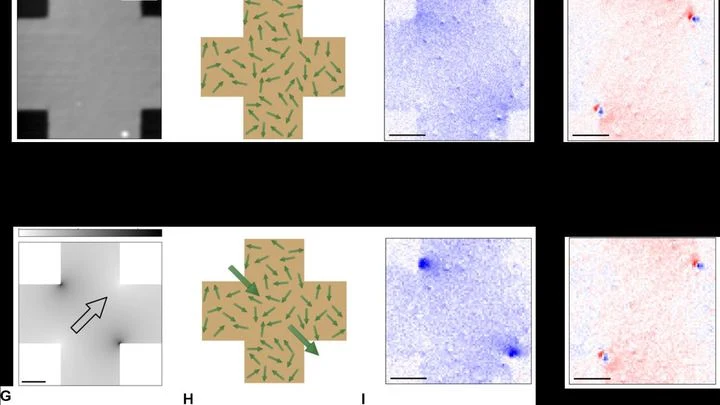
Hidden Magnet Polarity Brought to Light
In a tiny magnet, information is encoded not in which way the arrow points, but in how the directions of its atoms alternate. In antiferromagnets, these arrows cancel each other out, so the material appears non-magnetic from the outside. The data is there, but you can't read it the usual way: the state is like a note written in invisible ink.
Mesoscale2026-04-252 minarXiv:2604.23279express
Superconductivity2026-04-252 minarXiv:2604.23378express
The Crystal That Won't Be Thrown Off Course
A crystal is like a city: if the streets are crooked, traffic jams. In a crystal, the streets are atomic rows, and the traffic is the flow of electrons. Any tiny imperfection, impurity, or atomic displacement makes electrons scatter. Scientists from several labs have learned to grow crystals so that the "streets" are almost perfectly straight. The method is called horizontal vapor transport.
Materials2026-05-082 minarXiv:2605.07904express
A Magnetic Pattern That Rewrites the Rules of Electricity
If you toss a handful of coins onto a table, they land in a jumble. But in some crystals, atoms arrange themselves into a pattern reminiscent of a woven basket — the kagome lattice. In the metal MgMn₆Sn₆, manganese atoms form such a lattice, and at room temperature they act like tiny magnetic needles.
Mesoscale2026-05-092 minarXiv:2605.08643express
When Two Currents Merge into One
Sunlight hits a silicon wafer, and a current flows in the circuit. That's the familiar work of a solar cell: light knocks out electrons, and a p–n junction (the boundary between two layers with different conductivities) forces them to move in one direction. But in some crystals, current arises differently — without any junctions, purely from the material's internal structure.
Mesoscale2026-05-172 minarXiv:2605.17335express
The Edge of an Insulator Conducts Electricity Like a Metal
Two thin layers of a semiconductor were twisted relative to each other by 2.29 degrees, like two sheets of transparent paper with printed grids. Where the lines nearly align, a large pattern of dark and bright spots emerges. Electrons in this pattern behave very differently from those in a regular crystal.
Superconductivity2026-05-172 minarXiv:2605.17520express
Helper Electrons: How a Double Layer Boosts Superconductivity
A bridge made of two rows of planks bends under the feet of pedestrians, and each step gets a boost from the elastic motion of the deck. A similar principle underlies superconductivity: electrons glide without resistance because the atomic lattice itself adapts to them. In nickel-based materials, this picture has long been elusive.
Superconductivity2026-05-172 minarXiv:2605.17667express
The Current That Takes Its Time
Electric current in a wire is like a crowd of people hurrying down a corridor. Usually, each person bumps into walls and loses speed almost instantly: that's electrical resistance.
Superconductivity2026-05-232 minarXiv:2605.24522express
A Quantum Leap for Electric Current
In a water supply system, water sometimes flows not as a continuous stream but in separate identical portions, as if the tap opens and closes, letting through exactly one drop each time. This is roughly how electric current behaves in superconducting contacts called Josephson junctions.
Materials2026-05-242 minarXiv:2605.25241express
Magnetic Patterns at the Atomic Level
Two magnets on a table either attract or repel — depending on how their poles are oriented. Inside each piece hide tiny regions where all the magnetic arrows point in the same direction. These regions are called domains, and their arrangement determines how the material behaves in an electrical circuit. In altermagnets, a new class of materials, domains are trickier.
Superconductivity2026-06-172 minarXiv:2606.18683express
Superconductivity That Switches On with Heat
Usually, superconductivity is a story about cold. The lower the temperature, the easier it is for electrons to pair up and flow without resistance. But in a new study, physicists grew thin films of nickelates doped with europium and saw the opposite picture.
Superconductivity2026-06-192 minarXiv:2606.21166express
How the Geometry of Electron Orbits Gives Rise to Superconductivity
In a long corridor, a crowd of people tries to keep as far apart as possible. In a spacious hall, they would simply spread out, but here the walls squeeze them so tightly that they have to move single file, coordinating every step. Electrons in graphene layers twisted by a tiny angle behave in a similar way.
Strongly Correlated2026-06-192 minarXiv:2606.21648express
Quantum Geometry Lurks in the Current Jump
Toss a handful of phosphorus into silicon, and at a certain impurity concentration the material suddenly starts conducting electricity. This is a metal-insulator phase transition, and it happens abruptly. But what exactly changes in the electron wave functions when an insulator becomes a metal?