Scientist

Rudolf Clausius

1822–1888 · Thermodynamics, Statistical mechanics
A German physicist and mathematician who formulated the second law of thermodynamics and introduced the concept of entropy. His work laid the foundation of thermodynamics and influenced the development of physics and chemistry.

Biography

Studied at the Universities of Berlin and Halle-Wittenberg. Taught at the Swiss Federal Institute of Technology Zurich and the University of Bonn. Collaborated with Helmholtz, Joule, and Thomson. Awards: Copley Medal, Poncelet Prize.

Key discoveries

💡 Clausius served in the Crimean War, but his main battles were on paper — he debated with Thomson and Maxwell about the nature of heat.
"He stated that the energy of the universe is constant and its entropy tends to a maximum."
Concepts
Phase transition
Laws
second law of thermodynamicsfirst law of thermodynamics
Scientists
Steven WeinbergAndré-Marie AmpèreIlya PrigogineLars OnsagerGustav KirchhoffRobert HermanJosiah Willard GibbsRoy Kerr

Related articles

Twilight of Time: Why the Arrow Fades but Time Endures
When entropy reaches its maximum, the play is over. The curtain falls, the actors leave, the scenery freezes. But the stage remains. So it is with time: the heat death of the universe erases the direction 'past—future', but not time itself.
Hourglass of Entropy: How Cold Atoms Keep Time
In the lab, time usually ticks on the wall: hands, digits, a frequency standard. But for the Universe, there are no external clocks. The Wheeler–DeWitt equation, the main law of quantum gravity, contains no time at all, and all fundamental theories lack an inbuilt arrow of time.
Quantum Physics2025-10-311 minarXiv:2510.27511express
Chaos Without Disorder: Why Entropy Doesn't Grow
Hundreds of cooks in a kitchen — total chaos. Usually disorder grows. In quantum physics, the measure of such disorder is called entropy John von Neumann. For a many-particle system, entropy typically increases with their number. But scientists have found an exception. The secret lies in a strict rule: two cooks cannot enter the same aisle at the same time.
Quantum Physics2025-11-061 minarXiv:2511.04028express
Heat in Reverse: When Hot Freezes from Cold
Water always flows downhill, and heat from hot to cold. That's what энтропия dictates. But the quantum world finds loopholes. Physicists made light particles interact with hot and cold environments in an uncertain sequence — like a flipped coin that hasn't landed yet.
Quantum Physics2025-11-061 minarXiv:2511.04354express
Quantum Mpemba Effect: Controlled Cooling
Everything tends toward equilibrium: tea cools, a pendulum swings to rest. The measure of this movement is entropy — growing disorder. But sometimes hot water freezes before warm. The Mpemba effect isn't just a curiosity: it shows up in the quantum world too. Scientists have devised a way to control this paradox.
General Relativity2025-12-031 minarXiv:2512.03380express
Time is not a river, but a one-way street
Time is a one-way road: events race forward with no U-turn allowed. The arrow of direction is governed by entropy — a measure of disorder, which only grows in the Universe, like a traffic jam at rush hour. You can clear one intersection, but the overall congestion only gets worse.
Quantum Physics2025-12-151 minarXiv:2512.13509express
Quantum Mpemba Effect: Chaos Orders Itself Faster
Hot water sometimes freezes faster than cold — this is the Mpemba effect. In the quantum world, it’s even more astonishing: a system bubbling with disorder (with high entropy) can settle incredibly faster than one that is almost calm. The solution lies in islands of silence within any system — regions untouched by the destructive noise of the environment.
Quantum Physics2026-01-011 minarXiv:2601.00198express
Quantum Physics2026-01-092 minarXiv:2601.05514express
A Wire Heats Up from Knowledge
Run a current through a wire, and the wire heats up. Anyone who has ever touched a phone charger knows this. Physicists call this heating Joule heating, after James Joule, who in the mid-19th century measured how much heat electricity produces. Since then, the formula has been simple: the greater the resistance and the current, the hotter the wire.
General Relativity2026-01-111 minarXiv:2601.07007express
The Universe Falls Silent Smoothly, Not with a Bang
Scientists proposed a model in which the mysterious force (dark energy) possesses something like inertia: it needs time to respond, like a heavy pendulum. Because of this, the expansion of the Universe doesn’t accelerate forever, but instead decays, like a pendulum in thick honey.
General Relativity2026-02-271 minarXiv:2602.24019express
Freezing Ice and Expanding Space
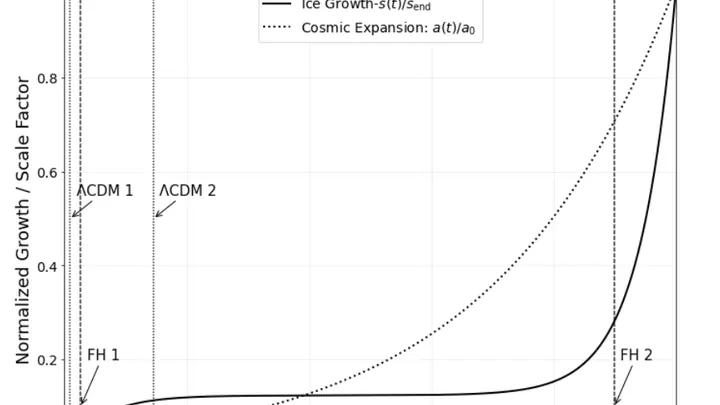
In winter, a lake freezes over, and this simple process turns out to be a living model of an expanding universe. Ice thickness grows according to the same mathematical law as the distances between distant galaxies. The secret lies in the movement of water beneath the ice crust.
Quantum Gases2026-03-071 minarXiv:2603.07121express
Order from Chaos: How Heat Gives Birth to a Crystal
Water in a pot, when heated, doesn't boil: it turns into ice. That's roughly how ultracold atoms behave in an optical lattice — a light-based crystalline grid that holds atoms in place. Scientists simulated this system on a computer to understand how order changes as temperature rises.
Statistical Mech2026-03-121 minarXiv:2603.11788express
The Quantum Mpemba Paradox: Why Hotter Cools Faster
Hot tea normally takes longer to cool than warm tea, but water sometimes breaks this rule: back in the 1960s, schoolboy Erasto Mpemba noticed that hot ice cream freezes faster than cold. This paradox has moved into the quantum world: a collection of particles can settle down faster if it was initially more excited.
Why Bacteria Swirl in a Shared Dance
When a crowd of bacteria (mostly composed of carbon) gathers in a droplet of water, a synchronized round dance begins: millions of tiny ones glide along giant ellipses, like dancers on a ballroom floor. Without a conductor, complex patterns emerge from simple movements.
Dynamical Systems2026-04-111 minarXiv:2604.10225express
Which Phases of Matter Are Real, and Which Are a Mirage
Water can be ice, liquid, or steam. Physicists call these states phases. In theory, each phase has its own measure — a way to describe how likely it is. But not every measure you can imagine occurs in nature. Some phases are real, while others are just mathematical illusions. Scientists have found a simple criterion that separates reality from mirage.
Squeezing Chaos Into a Single Number
Try packing a suitcase for a trip when you have no idea what you will need. If there is a lot of stuff and it is all different, you will spend ages rearranging it and still have no clue how neatly everything fits. That is roughly how physicists long looked at entropy, the measure of disorder, in systems that never settle down: bacterial swarms, granular materials, swarms of active particles.
Quantum Physics2026-05-162 minarXiv:2605.17196express
Maxwell's Demon and the Quantum Guardian of Heat
In 1867, James Clerk Maxwell proposed an image that still stirs physicists today. Two compartments of gas are separated by a door. Molecules dart about chaotically: fast and slow. A tiny gatekeeper opens the door only for fast ones, letting them through to one side, and slow ones to the other. The hot compartment gets hotter, the cold one colder.
Quantum Physics2026-05-191 minarXiv:2605.19917express
Self-Running Quantum Clocks
Two quantum particles are linked by an invisible thread: one loses energy, the other gains it, but the total remains unchanged. If you watch only the first, its oscillations don't fade — the rhythm is steady, like that of a cosmic pulsar, even though it seems that entropy and chaos are increasing.
Statistical Mech2026-05-262 minarXiv:2605.27635express
How to Measure Chaos in a System Without Knowing Its Rules
A busy intersection without traffic lights. Cars drive, brake, and change lanes, and from the outside, it looks like complete chaos. But if you watch for a while, you can notice a rhythm: the flow thickens and thins. In physics, this rhythm of disorder is called entropy: it shows how far a system is from calm equilibrium, like water in a boiling kettle.
Cosmology2026-05-273 minarXiv:2605.28797express
Cosmic Friction: How Disorder Fixes the Universe
A blacksmith forges a sword. With each hammer blow, the red-hot metal flattens, but the hammer, the anvil, and the surrounding air all warm up slightly. Part of the impact energy is irreversibly lost as heat — a trade-off familiar to anyone who has ever driven a nail, and it turns out to be the key to the biggest mysteries of the cosmos.
Information Theory2026-05-281 minarXiv:2605.30331express
The Mystery of Disorder: Why Entropy Follows Strict Rules
Entropy is a measure of disorder. Two shuffled decks of cards, dumped into one pile, won’t become more chaotic than the sum of their individual disorders. This is the rule of subadditivity: the whole is no more chaotic than its parts.
General Relativity2026-05-291 minarXiv:2606.00178express
Tunnels from Entropy: A New Key to Wormholes
Spacetime is like a giant sheet of paper. Fold it, and distant corners come together. Poke a pencil through, and you get a wormhole, a short tunnel through the folds. But the paper wants to spring back flat, snapping the passage shut. To keep it open, you need a rare “gasket”—matter with negative energy.
Quantum Physics2026-06-041 minarXiv:2606.06653express
The Quantum Mpemba Paradox: Asymmetry Accelerates Order
Hot water sometimes freezes before cold: this is the Mpemba effect. In the quantum realm, a similar paradox appears: the more the equilibrium is disrupted, the faster it recovers. It's like fleeing from disorder (entropy) in reverse: the system rushes toward order, and a large initial imbalance only helps.
Statistical Mech2026-06-142 minarXiv:2606.15557express
Liquid Glass and a Narrow Neck
A hot liquid flows easily: molecules dart around, collide, and quickly find new spots. But cool it below its freezing point, and everything changes. Motion nearly freezes, and viscosity skyrockets. The key question isn't that particles are lazy, but where they can even go. The authors combined two established ideas.
General Relativity2026-06-152 minarXiv:2606.16757express
A Black Hole Grows, and Entropy Keeps Track of Order
A black hole is like a perfect vacuum cleaner: anything that crosses its horizon vanishes without a trace. But this vacuum cleaner has a strange feature: its "dust bag" grows, and by the size of the bag you can tell how much has been sucked in. In black hole physics, this size is linked to entropy entropy — a measure of hidden information about what fell inside.
Mesoscale2026-06-263 minarXiv:2606.27788
When Maxwell's Demon Conducts the Quantum Choir
The old question of Maxwell’s demon, can an intelligent being circumvent the second law of thermodynamics and pump heat from cold to hot, gains new resonance in the quantum world.
Quantum Physics2026-06-272 minarXiv:2606.28660express
eess.SY2026-07-151 minarXiv:2607.14245express
How Entropy Helps Robots Find Paths Faster
A search party combs a foggy field. At first, people spread out wide: a high 'temperature' of search means a great variety of attempts. Upon finding a trace, they close in. But the speed of convergence is critical — narrow the circle too early, and the best find stays aside. The coordinator assesses the spread of searchers and commands when to speed up or slow down.
Thermal Split: How Uneven Heating Divides a Mixture
In a glass of water, oil gathers into droplets: that's equilibrium separation dictated by chemistry. But there are systems where order arises not from rest but from a constant flow of energy.
Optics2026-07-252 minarXiv:2607.22990express
How to Make Heat Flow Backward in Milliseconds
Hot tea cools down, and ice cream melts — heat always flows from warm to cold, and this law seemed unbreakable. But in the quantum world, even familiar rules can be rewritten. Physicists placed a tiny mechanical resonator (a vibrating bridge the size of a microbe) in an optical cavity between two mirrors.
Entropy as a computer's compass
Picture a swarm of 200 particles that keep jostling, aligning their velocities, and pushing toward a common goal. This swarm isn't just darting around in space: it's learning to predict chaos. An external signal, something like the unpredictable behavior of weather, is fed in through a single driver particle, and the rest have to guess where it will move next.
General Relativity2026-07-313 minarXiv:2608.00297express
The Universe Isn't Chasing Entropy Records
Imagine a factory capable of producing a million parts per hour, yet it only makes a hundred. That's roughly how our Universe behaves when viewed through the lens of entropy — a measure of disorder that, according to physics, must only increase. The main "machines" of this factory are supermassive black holes.
General Relativity2026-08-082 minarXiv:2608.08302express
The Universe's Horizon as a Heat Engine
Stare long enough into the night sky, and sooner or later your gaze hits a blackness beyond which nothing is visible. This is not just a distant fence: it is the edge of the universe accessible to us, the cosmic horizon. Light from more distant stars simply hasn't had time to reach us.