Room-temperature superconductivity is the hypothetical ability of a material to conduct electricity with zero resistance at temperatures we encounter in everyday life, roughly 20–25°C (68–77°F). Since the discovery of superconductivity in 1911, it has only been observed at extremely low temperatures, requiring expensive liquid helium or nitrogen cooling. Achieving it at room temperature would transform energy transmission, magnetic levitation, and medical imaging, eliminating the energy losses that plague current power grids and enabling technologies that are currently impractical.
History
The concept gained prominence after the 1986 discovery of high-temperature cuprate superconductors, which work at liquid nitrogen temperatures but still far below room temperature. Recent experiments on hydrogen sulfide and lanthanum hydride under extreme pressures have shown superconductivity at temperatures up to about −23°C, approaching but not reaching room temperature.
How it works
In conventional superconductors, electrons form pairs (Cooper pairs) through interactions with lattice vibrations (phonons), and these pairs condense into a quantum state that flows without resistance. The challenge is that thermal vibrations at higher temperatures break these fragile pairs. Room-temperature superconductivity would require a much stronger pairing mechanism, possibly involving hydrogen-rich compounds under extreme pressure, where hydrogen's light mass allows high-frequency phonons that bind electrons more tightly.
In practice
If realized, it would enable lossless power grids, ultra-efficient maglev trains, compact MRI machines, and quantum computers without the need for cryogenic cooling.
Fun fact
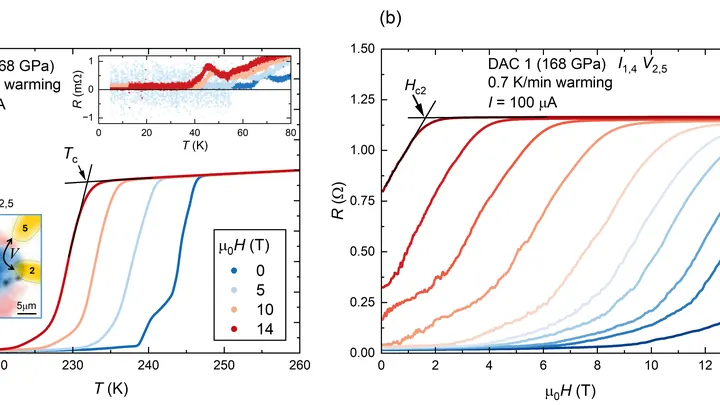
The highest confirmed superconducting temperature so far is about 250 K (−23°C) in lanthanum hydride, but it requires a pressure of about 170 gigapascals — nearly two million times atmospheric pressure.
Picture a fireplace poker shoved into a blast furnace. Ordinary steel would soften and sag within minutes. Nickel-based superalloys, which make up turbine blades in jet engines, work up to 1300 °C, but beyond that they give in too. Now look at this new niobium-based alloy: at 1500 °C it retains strength comparable to cold aluminum.
The secret lies in its internal architecture.
A transparent film of bismuth tungstate sits on a substrate and does not conduct electricity. Three minutes in a cloud of nitrogen plasma, and it turns black, with resistance dropping by a factor of a billion.
A tiny black hole flies through a hydrogen cloud and stretches atoms like taffy. That is what a superconductor looks like when it traps a persistent current: a material in which electricity flows without losses turns into a miniature permanent magnet.
One universal interpreter for all dialects of sodium. Liquid sodium in a reactor behaves differently: near the pipe wall it is dense and fast, near the boiling surface it is rarefied and slow. Previously, each state required its own set of calculations, as if hiring a new translator for every phrase.
Inside a diamond anvil cell, squeezing a sample with a force millions of times greater than atmospheric pressure, a thin film of lanthanum meets hydrogen. The hydrogen comes from ammonia borane — a powder that, when heated, releases its hydrogen like a sponge releasing water.
An ordinary wire heats up when current flows through it — some energy is wasted. A superconductor lacks this flaw: electricity flows through it without loss, like water through a perfectly smooth pipe. The trouble is that most superconductors require either very low temperatures or colossal pressures, like those found in the depths of planets.
Hot water after a shower, warm air from ventilation, the heated walls of an engine — all this is heat below 100°C. Usually, it dissipates without doing any useful work. Now it can be captured and turned into electricity.
Inside the new device is a wire made of a nickel-titanium alloy. This material remembers its shape: when heated, it contracts; when cooled, it returns to its original shape.
A microchip the size of a fingernail gives off as much heat as a small light bulb. Getting rid of that heat is like trying to cool a cup of hot tea with a teaspoon: the insulating material around transistors is usually a poor heat conductor.
The universe is constantly sending us signals, but many are too faint to notice. Relic neutrinos, particles left over from the Big Bang, pass through Earth by the billions every second, yet catching even one is a feat on the edge of possibility. We need a detector that can sense energy a thousand times smaller than what it takes to move a speck of dust.
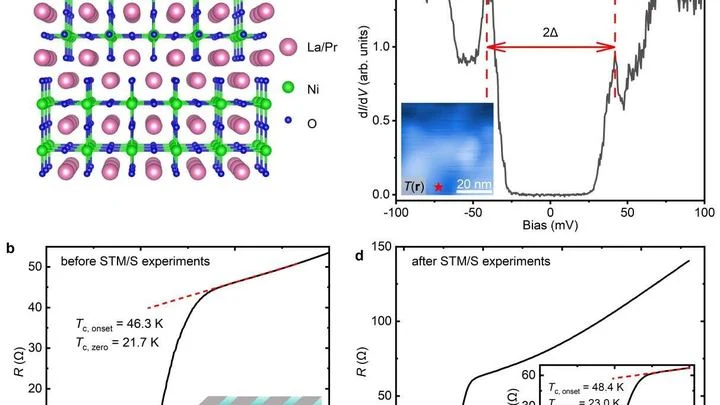
A tiny sandwich of oxides, grown layer by layer, becomes perfectly conducting at about minus 200 degrees Celsius. This is not a magic trick but a new chapter in the search for high-temperature superconductors.
A thin film of a special crystal (for instance, molybdenum disulfide) sits on a microscope stage. The temperature is just above the point where the material becomes a superconductor.
Superconductivity and magnetic field are age-old foes: the field barges in like a whirlwind, tearing apart the delicate pairing of Cooper pairs, destroying order.
Heat is all around us: from a car's exhaust pipe to the casing of a running laptop. Thermoelectric materials could turn that waste heat into electricity.
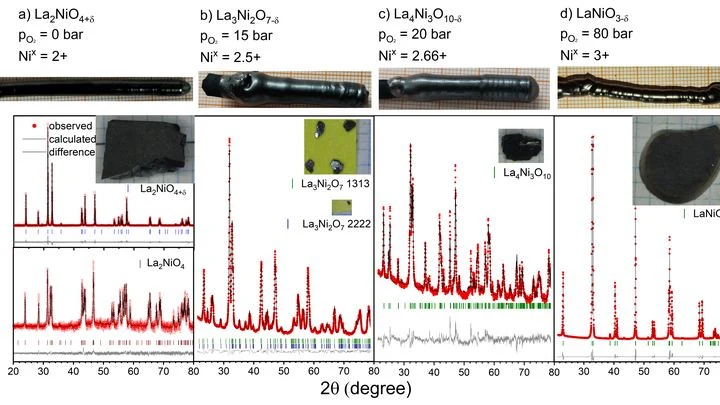
The nickelate family consists of layered crystals, like a stack of pancakes: nickel and oxygen layers alternate with lanthanum spacers. Two years ago, superconductivity was discovered in them — the ability to conduct electricity without resistance when cooled.
In a pool, water usually spreads in circles from a thrown stone. But if you direct the flow strictly along the rim, it will run only along the edge. Something similar has been noticed in pieces of the superconducting crystal FeTe0.55Se0.45.
A well-coordinated orchestra of electrons in a superconductor is easily thrown off rhythm. Thermal jolts destroy the fragile order, and resistance returns. For decades, scientists have sought ways to strengthen this ensemble — mostly by changing the material's composition or compressing it to unimaginable pressures.
A packed stadium: fans mill about chaotically, creating jostling and resistance. That's how electrons behave in an ordinary conductor. In superconductivity, they pair up and move in sync, like spectators holding hands and calmly leaving the stands, without losing energy.
A tiny ball weighing a fraction of a milligram, suspended in a magnetic field and cooled to near absolute zero, oscillates for 110 hours without stopping: this is record isolation. The energy loss is so small that the system's entropy barely increases, making any external influence noticeable.
A superconductor does not let a magnetic field penetrate its interior. But if the field is strong enough, it does get in — not as a continuous flux, but as individual vortex filaments, like tiny tornadoes. Inside each filament, superconductivity is destroyed, and around it flows a persistent current.
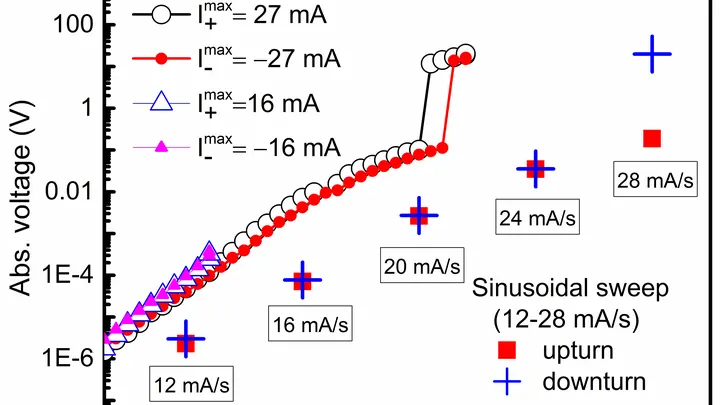
An ordinary flash drive in your pocket gets warm even when it's just sitting there. Now imagine memory that, in the cold, uses almost nothing, like a thermos that never cools down. A superconductor carries current without loss at liquid-helium temperatures, but it couldn't store data. The new cell changes that.
A crowd on a narrow street moves slowly because people bump into each other. In silicon, heat is carried by similar 'shoves'—atomic vibrations called phonons. If you cut tiny holes in a silicon film, phonons will bump into them like pedestrians into lampposts, and heat will flow worse.
A crystal that promised to conduct electricity without loss at room temperature turned out to be like a house of cards: touch it and it falls apart. Two compounds (one with silver, one with gold) were considered superconductor candidates, but tests showed that neither can withstand even ordinary conditions.
In the silver variant, the lattice simply collapses.
A superconductor is a material that, when strongly cooled, loses its electrical resistance: current flows through it without losses. Scientists took a layered crystal of PdTe2, similar to a stack of sheets of paper, and cooled it to temperatures below 1.8 kelvin (that's about -271°C).
A red-hot piece of metal in a furnace is like a frying pan on the stove: the hotter it gets, the faster heat travels to your hand if you touch it. But at temperatures where the metal is close to melting, measuring that speed is very tricky: sensors don't make good contact, heat escapes into the air, and the glowing sample confuses the instruments.
This new method sidesteps those obstacles.
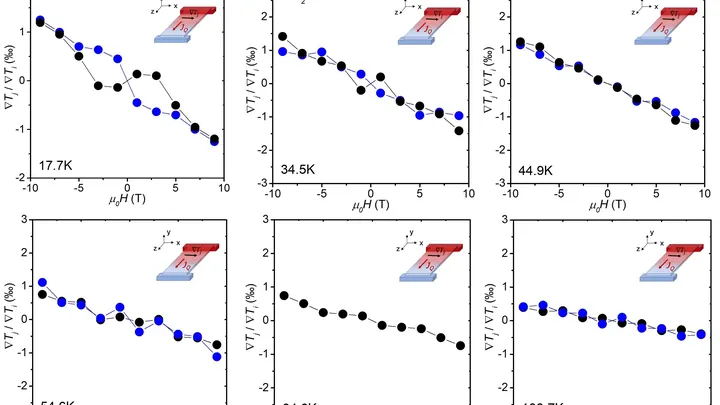
In an insulating crystal, heat usually flows from the hot end to the cold end. But when you switch on a magnetic field, part of the heat flow veers sideways, like water running down a slope that drifts to the side when the wind pushes it. This behavior is called the thermal Hall effect.
Electrons in a crystal sometimes behave like a stadium crowd doing the wave: areas of higher density alternate with nearly empty ones. This wave blocks the free flow of charges — under normal conditions, the material is not superconducting. But apply pressure, and the wave vanishes, letting electrons move without resistance.
Two identical cars roll off the same assembly line. Body, wheels, steering — everything matches. Only one has a regular gasoline engine, while the other has a hybrid engine that can be tuned to the road. And the hybrid stalls after a couple of kilometers, while the gasoline one runs for tens.
An alloy of palladium and tellurium with a small amount of gold added behaves like a wire that loses its resistance when cooled. At ambient pressure, the three samples with different gold contents had superconducting transition temperatures of 2.7, 4.1, and 4.6 kelvin — colder than a freezer, roughly like deep space.
Turning light gases like hydrogen and nitrogen into metal is a long-standing dream of physicists. In a new experiment, nitrogen was compressed to 130–140 gigapascals (pressure equivalent to 14 million kilograms pressing on a fingernail) and heated to 3000°C.
An ordinary conductor carries current equally in both directions, like a door that swings both inward and outward. A diode, by contrast, is a door with a self-closing hinge: it opens easily one way but pushes back the other.
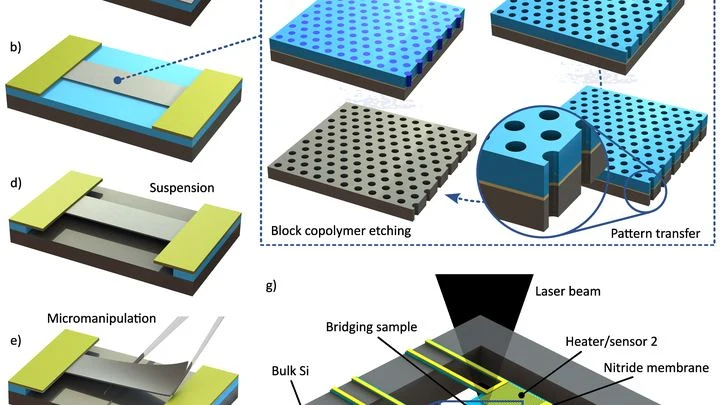
A stack of thin plates made of different materials lies on a table. If you heat it from below, heat will rise, but will it spread sideways just as quickly? In layered semiconductors, the answer is no: heat runs faster along the layers than across them. This is like water in a stack of paper: it spreads easily along the sheets but seeps through the stack with difficulty.
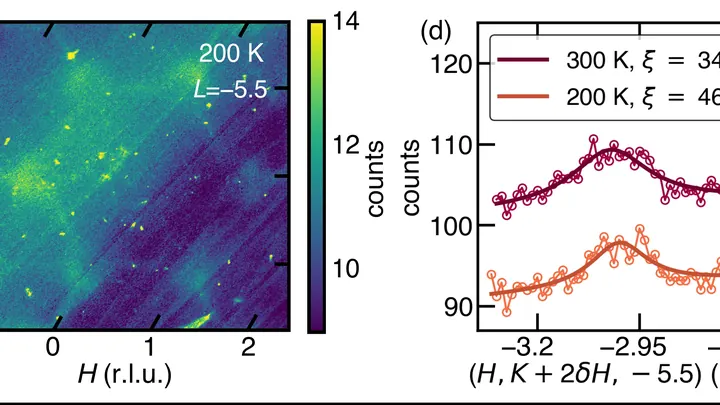
In some crystals, electrons line up into a wave, like ripples on the surface of water, but made of charge. Usually, such a wave exists only in extreme cold. But in this experiment, scientists saw that traces of the wave persist even at room temperature.
An X-ray beam strikes a piece of superconductor, and the material warms up ever so slightly. That heating, by billionths of a degree, is the only trace the light leaves behind. The new detector catches exactly that, like a sensitive thermometer pressed against cold metal.
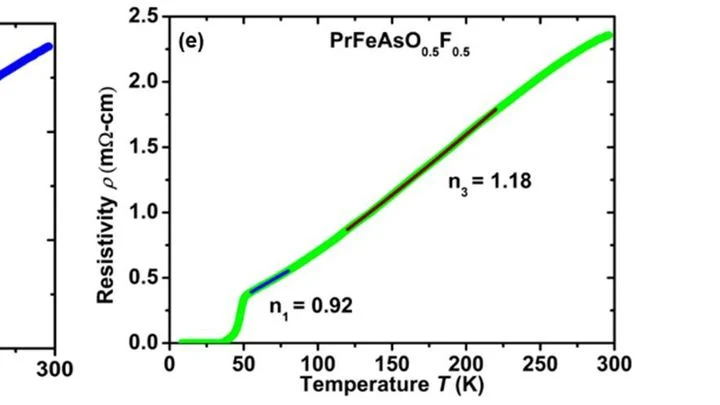
Iron is a magnet, not a resistance-free conductor. But if you add a bit of fluorine to an alloy of iron, arsenic, and oxygen, the picture changes. Scientists took the compound PrFeAsO and gradually replaced oxygen with fluorine.
In the crystal lattice of iron selenide, iron and selenium atoms alternate like bricks in a wall. But sometimes extra iron atoms sneak into the voids between them, like uninvited guests squeezing into the gaps between bricks.
A distant red object usually means one thing: we're seeing a dust veil over a scorching disk falling into a black hole. But when the James Webb split its light into shades, a shadow appeared inside — just like steam from boiling water intercepts rays.
A calcium ion in a magnetic trap resembles a tiny ball that constantly trembles from heat. To make it freeze, physicists usually hit it with lasers from several sides. But in the new experiment, a single beam aimed along the trap's axis sufficed.
First, the ion is cooled the usual way — the laser slightly slows its motion, like a headwind slowing a runner.
A tiny magnet made of layers of sulfur, chromium, and bromine sits on a microscope stage. Inside it, like unexpected guests, sit erbium atoms — a rare-earth metal. These atoms can glow when hit with a laser, and their light tells us what's happening around them.
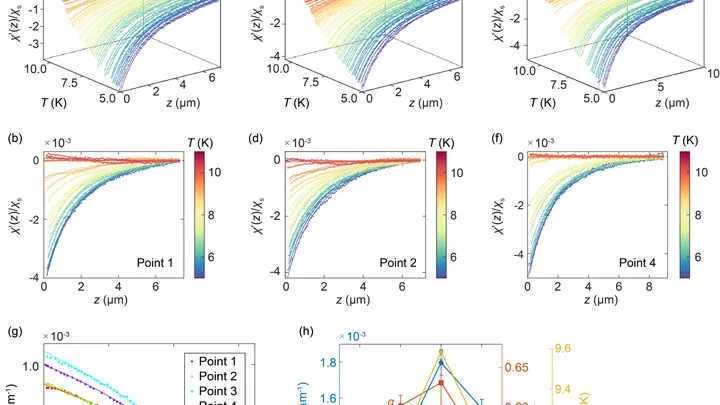
A superconductor is like a city where electrons stop jostling and start moving in pairs, like people strolling arm in arm. In neodymium-strontium nickelate (Nd₀.₈Sr₀.₂NiO₂), this 'parade' kicks in at around 10 kelvin (minus 263 degrees Celsius), but not uniformly.
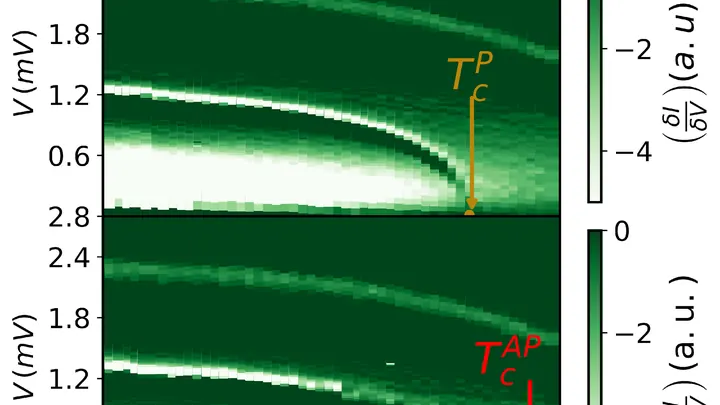
Ordinary computer memory constantly consumes energy to avoid forgetting what's stored. A superconductor could store data without loss, but it's hard to make it switch.
In the new work, a superconductor is sandwiched between two magnetic insulators.