An electric field is an invisible force around charged objects. Like water around a magnet creating circles, the electric field draws lines along which a charge will move. When you touch synthetic clothing and hear a crackle, you are feeling the electric field.
History
Michael Faraday in 1831 introduced the concept of lines of force to visualize electric and magnetic interactions. James Clerk Maxwell in 1864 generalized the discoveries into equations, predicting electromagnetic waves. Hendrik Lorentz introduced the concept of the electromagnetic field as a separate entity and the Lorentz force for moving charges. Henri Poincaré studied the symmetries of Maxwell's equations and pointed out relativistic effects. The development of quantum electrodynamics in the works of Dirac and others built a bridge to the microworld.
How it works
The electric field E is defined by the force per unit test charge and obeys superposition. Maxwell's equation ∇·E = ρ/ε₀ (Gauss's law) relates the field to charge density. For electrostatics, the field is conservative, and the potential φ satisfies Poisson's equation. In dynamics, the electric field is also generated by a changing magnetic field (Faraday's law). In the relativistic formulation, the electromagnetic tensor F^{μν} combines the fields E and B. The quantum limit is described by Feynman diagrams with the photon as the U(1) gauge boson. Coulomb's law for a point charge gives E = k q / r².
Fun fact
Lightning is a giant discharge that occurs due to the huge difference in electric fields between clouds and the ground.
In some crystals, electrons are not spread uniformly but arrange themselves into a strict checkerboard: one cell has more electrons, the neighboring cell has fewer. Such a pattern is called charge order, and for a long time it was considered something frozen, like a pattern on frosty glass.
In some crystals, electrons are not spread uniformly but arrange themselves into a strict checkerboard: one cell has more electrons, the neighboring cell has fewer. Such a pattern is called charge order, and for a long time it was considered something frozen, like a pattern on frosty glass.
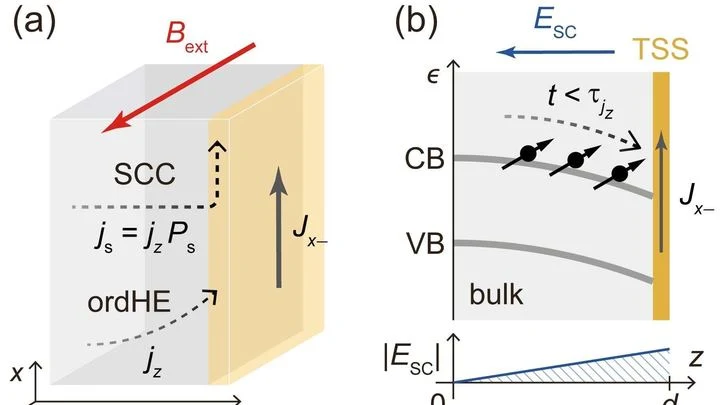
A magnetic field usually acts like a strict traffic cop: for heat to turn into electricity, it must stand across the road. If the field lies along the heat flow, the effect disappears, or so it was believed for decades.
Scientists took an ultra-thin film of a magnetic oxide — a material where electron spins are aligned in a plane, like compass needles on a table.
An electron beam is a stream of tiny particles carrying an electric charge. When such a beam hits a material, it doesn't just heat it or knock out atoms: it also gives the surface a slight push, like a jet of water pushing against your palm.
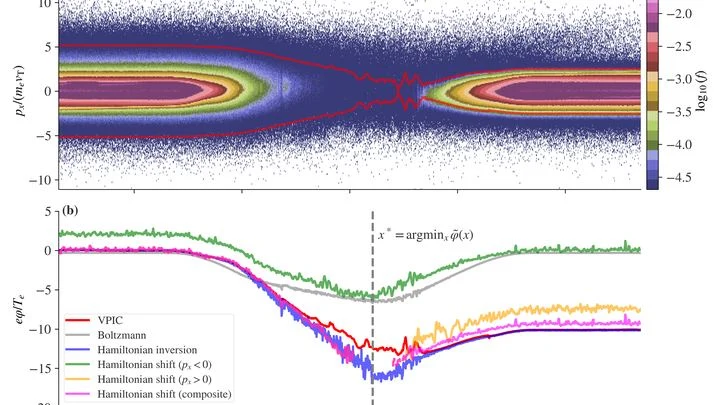
A black hole is not a vacuum cleaner. By itself, it doesn't pull everything in more strongly than an ordinary star of the same mass. But if there's a magnetic field nearby and charged particles flying around, an interesting game begins.
Electric charge is a slippery thing. You can measure how much there is in the entire universe or in a single particle, but try to point your finger and say, 'Right here, in this cubic centimeter, there is exactly this much charge right now,' and you hit a fundamental wall.
The issue is that total charge, which physicists denote by the letter Q, is nonlocal.
Electric charge is a slippery thing. You can measure how much there is in the entire universe or in a single particle, but try to point your finger and say, 'Right here, in this cubic centimeter, there is exactly this much charge right now,' and you hit a fundamental wall.
The issue is that total charge, which physicists denote by the letter Q, is nonlocal.
A magnetic mirror is a tube open at both ends. The magnetic field inside is arranged so that hot plasma doesn't leak out: at the ends, the field lines bunch up like a cork in a bottle. Plasma particles flying toward the exit are repelled by these "corks" and bounce back. But some still escape: that's the classic "loss cone" argument.
At intersections without traffic lights, people negotiate with glances. A self-driving car can't do that: it has to simultaneously decide whether to go or yield and plan its trajectory. Previously, these tasks were separated, making maneuvers jerky and dangerous.
Scientists have combined them using virtual force fields enveloping each car.
The power grid is often compared to a water supply: current flows like water under pressure. Electric vehicles here are powerful pumps, capable not only of pumping water (charging) but also pushing back when needed, evening out the pressure. The trouble is, solar panels generate energy in surges, like a pump that gulps and then blasts with double force.
Electric charge is not like a number chiseled in stone. In the vacuum around any charged particle, pairs of particles and antiparticles are constantly born and annihilated, like the foam in a glass of champagne. The bubbles screen the true charge, making it appear smaller or larger depending on how close we get.
A sheet of paper with square grid, one with diamond grid, and one with honeycomb — three different universes for an ant. Change the sheet, and the rules of movement change. That's roughly how electrons experience the crystal lattice: geometry dictates whether they become little magnets, superconductors, or something else. In ordinary materials, the lattice is as rigid as if engraved.
A superconductor is like an ideal highway with no traffic lights: electrons race along without hindrance. But apply a voltage, and the picture changes. In a new experiment, physicists found that an electric field penetrates the superconductor and creates a mixed regime inside.
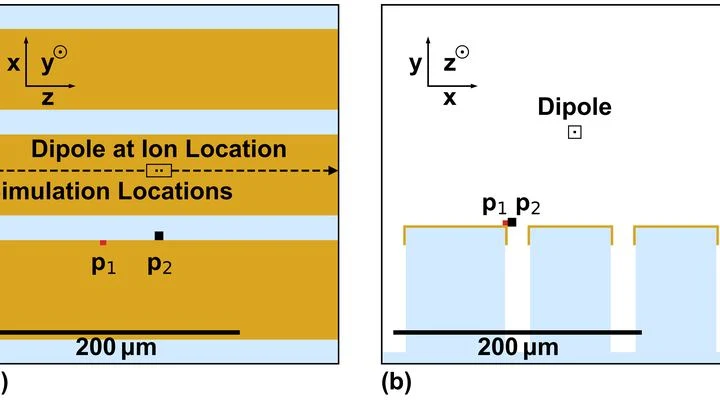
A quantum computer is like an orchestra where each ion is a musician and laser pulses are the conductor's baton. But if someone in the audience rustles, the delicate melody of quantum states goes off key.
When an electric charge moves with acceleration, it emits electromagnetic radiation, i.e., light — a familiar phenomenon in physics. However, researchers have found that when moving along a specially chosen trajectory, the radiation acquires unusual properties.
Heat a nail in a fire, and it will lengthen — everyone knows that. But heat only the tip and leave the other end cold, and the nail doesn't just get longer: it bends, because hot metal expands more than cold metal. It's this very bending, but at the atomic level, that physicists have turned into electricity.
A comb rubbed through your hair picks up scraps of paper. Physicists decided to apply this simple trick at the microscopic level — to control magnetic vortices called skyrmions. A skyrmion is like a tiny tornado in a sea of magnetization: at its center, compass arrows point up, while at the edges they twist downward.
A stone falls into a pond — near the shore, the ripples are barely visible, while the water churns at the point of impact. The electric field around a charge behaves similarly: close in, it's sharp and tangled, but at a distance it stretches into a smooth wave that carries energy away. Physicists call this distant region the radiation zone.
A black hole is like a whirlpool in a river: anything that falls in can never escape. But it also has an outer zone, the ergosphere, where space itself moves faster than light and drags any object along. Usually, the size of this zone is tightly linked to the hole's mass and spin rate.
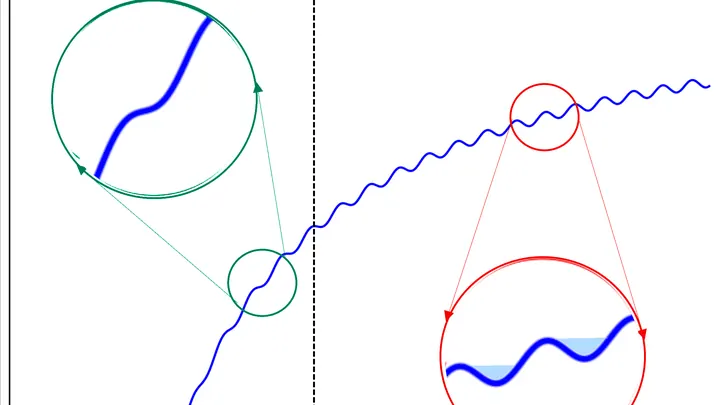
A palm hovering over a hot stove feels the heat even when the surrounding air seems cool. Something similar happens to electrons in the Aharonov–Bohm effect: the particle senses an electric voltage even though it enters a region where the field has already been switched off.
The Moon isn't just hanging in the sky: it leaves behind a long tail of disturbed solar wind. The stream of charged particles from the Sun flows around the rocky sphere, and behind it forms a zone where particles are almost absent. But this emptiness is not simple: electric fields arise in it that push apart the remaining electrons and ions.
In the cold heart of a pure crystal, electrons flow like a viscous fluid — an idea predicted by Lev Landau. But the vortices of this fluid remained invisible, like a painting inferred from the noise of a crowd. Now scientists have created a nanostring: a semiconductor tuning fork with a circular cavity.
A rug lies flat, but if you push it from the edge, wrinkles run across it. In a thin film of tantalum sulfide (1T-TaS2), wrinkles made of electrons, charge waves, freeze as if the rug were stuck to the floor. To move them, you need to apply force. Scientists have found a way to control this force using an electric field and a magnet.
In a thin layer of liquid crystal (a substance that flows like a liquid but has molecules arranged in order, as in a solid) vortices smaller than the thickness of a human hair are born. These vortices resemble tiny spinning tops: they can move without breaking apart and behave almost like real particles.
Inside a glass capsule the size of a pea, rubidium atoms float. A laser beam puts them into a special state — Rydberg — where the electron flies far from the nucleus, making the atom extraordinarily sensitive to external fields.
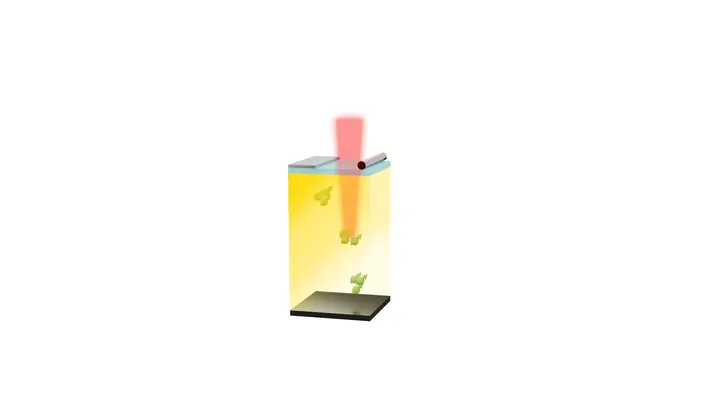
A power transistor made of silicon carbide operates under voltages thousands of times higher than what comes out of a wall outlet. If the field inside it becomes uneven, the device burns out. Previously, this field was invisible: it is too strong for ordinary sensors, and the device must remain under voltage.
According to ordinary mechanics, an electron in an atom should spiral into the nucleus and crash into it, like a surfer losing speed and falling off the board. But atoms live for billions of years. Because space isn’t empty. Even in absolute vacuum, an invisible electromagnetic sea ripples — the zero-point field. Its waves continuously nudge the electron.
When two different materials are pressed together and then pulled apart, a spark jumps between them. Anyone who has pulled off a wool sweater in the dark or gotten a shock from a doorknob knows the feeling. For a long time, it was thought that charges simply hop from one surface to another due to differences in material properties.
In an ordinary light bulb, light is born when an electron and a hole meet. In the new material, they are deliberately pushed apart, as if a turnstile were placed between them at a subway station. This turnstile is a built-in electric field that arises because sulfur and selenium atoms in the crystal are arranged asymmetrically: sulfur on top, selenium on the bottom.
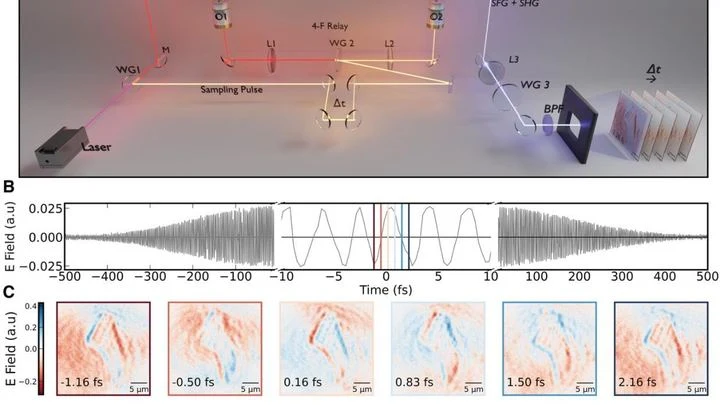
Light is not just a beam but a wave with an electric field that changes at a speed unimaginable to ordinary clocks. Until now, this field could only be measured at a single point, like taking temperature with a single thermometer. Now researchers have created a method that shows the entire field at once, like a thermal imager showing a heat map.
The nucleus of deuterium, or the deuteron, can be pictured as a microscopic spinning top. If its charge distribution is not perfectly symmetric, then in an external electric field this top experiences a minuscule tilt of its spin axis.
The Sun constantly emits a stream of charged particles — the solar wind. Among them are many electrons, some of which fly back toward the Sun. But observations show that fewer electrons return than expected.
A compass needle points north, but what if space itself has a hidden axis? Physicists have used Earth's magnetic field to test whether the universe's structure is truly the same in all directions.
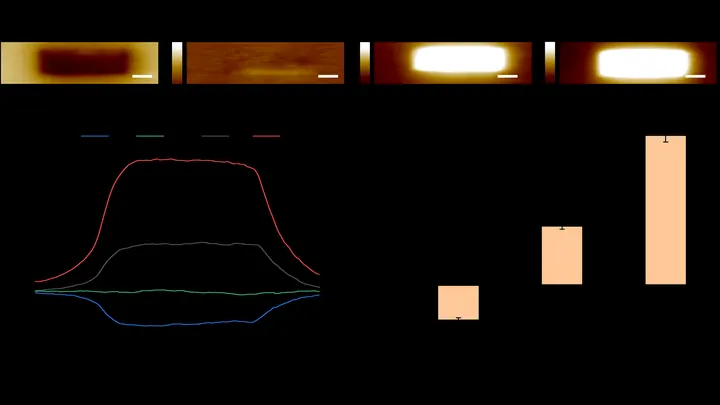
A flexible screen as thin as a human hair is glass you can bend. But this marvel has a quirk: touch it, and an invisible electric charge lingers on the surface. Like dust on polished furniture, it builds up and interferes with operation.
The electron is a tiny particle, but inside a crystal it behaves as if it had a different mass. Physicists call this the effective mass. To measure it, they make electrons run in circles in a magnetic field, like a speed skater on an ice rink who is kept from leaving the orbit.
A magnetic field is invisible, but you can make it 'glow'. To do that, take a tiny diamond with defects — places where a carbon atom is replaced by nitrogen and a neighboring lattice site is vacant. These defects, like sensitive compass needles, respond to the slightest changes in the magnetic field and emit light of varying brightness.
A thin film of a bismuth-selenium compound sits on a substrate. A laser pulse lasting a millionth of a billionth of a second strikes it. Nearby, a magnet is switched on, with a field weaker than that of a fridge magnet.
Two water droplets tremble in sync — because they're connected by a straw. So it is with entangled particles: their unity may be held together by a microscopic wormhole.
Gravity works like an invisible photographer. When a piece of metal falls, inside it, according to Albert Einstein and the electromagnetism of James Clerk Maxwell, an electric field is born — that's how spacetime curvature…