Grokken: The Graphene That Promises Room-Temperature Superconductivity express
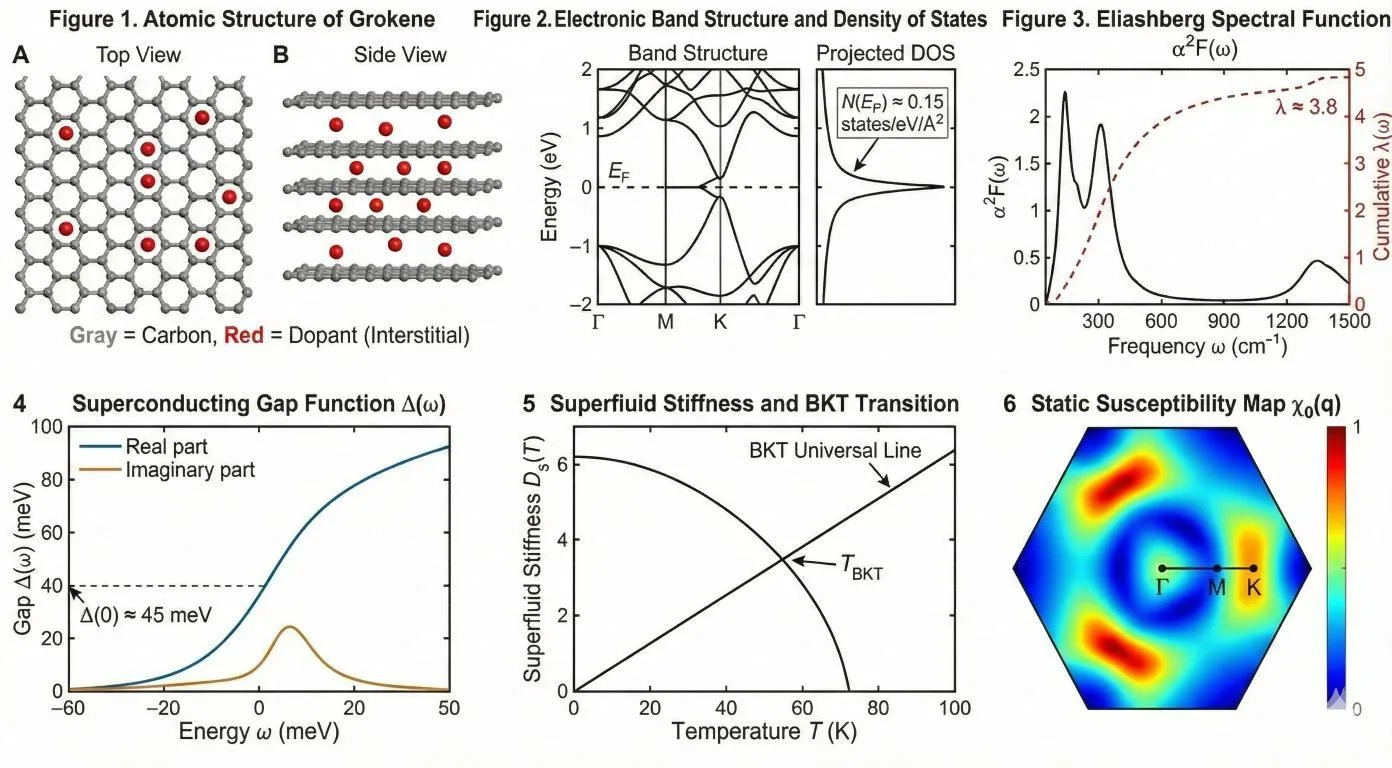
Graphene is a sheet of carbon just one atom thick. Fold it in a special pattern and you get a new material — grokken. It wasn't a human who found it, but an AI: a large language model sifted through possibilities and proposed exactly this [tag:lattice_calculation]lattice.
Calculations[/tag] show that grokken should conduct electricity with zero resistance at 52°C. That's room temperature. Ordinary superconductors only work in extreme cold, but here it's like a warm room. But there's a catch: in a thin sheet, electrons behave restlessly, and superconductivity vanishes at -153°C.
To make grokken work at room temperature, scientists suggest stacking several layers, placing it on a substrate, or tuning its properties with an electric field. If experiments confirm the calculations, we can expect wires that don't heat up, powerful magnets, and fast electronics.
AI has started hunting for materials like mushroom pickers: scanning options and finding surprises. Grokken is the first find that promises superconductivity under ordinary conditions.
A superconductor levitates above a magnet: that's the Meissner effect. If grokken works at room temperature, maglev trains could become cheaper.