Crack-Free Alloys: How to Pick a Composition That Won't Tear Under Heat express
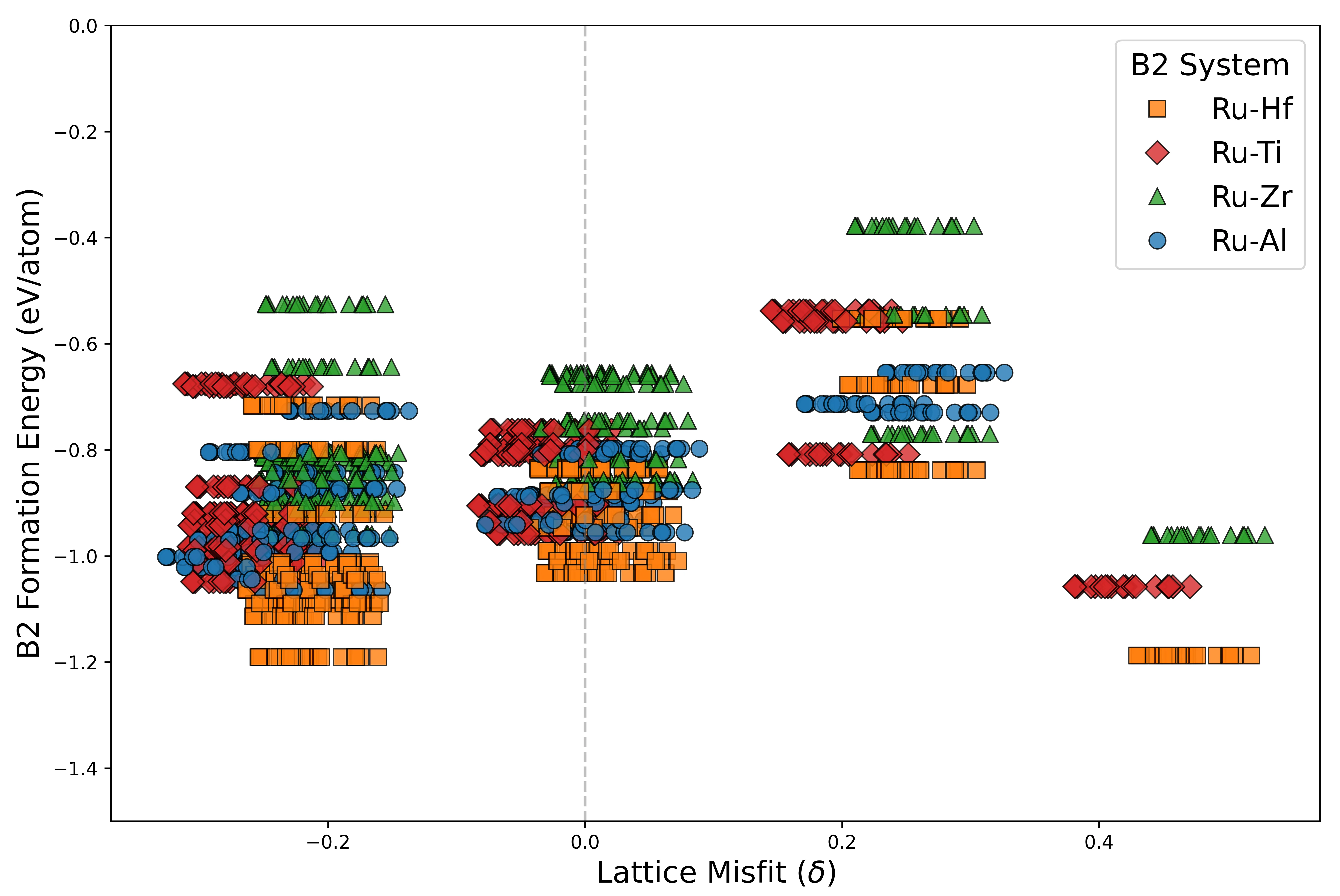
Bricks of different sizes laid in a single wall leave cracks in it. Atoms in superalloys behave much the same way: when two different metals form a common crystal lattice and their atoms differ slightly in size, stress appears inside the material. It accumulates and eventually destroys the alloy when heated.
Scientists studied compounds of ruthenium with other metals: they are considered the basis for future turbines and jet engines. Previously, the thinking was that the key was to make the alloy thermodynamically stable, meaning the atoms would naturally tend to stay in that order. But it turned out that even a very stable ruthenium-hafnium compound cannot withstand heating to the calculated temperature. The reason is that very mismatch in atomic lattice sizes.
Using computer modeling and machine learning, the scientists derived a simple rule: to remove stress, you need to add a third metal, such as aluminum or titanium. These additives act like shims between bricks of different sizes: they fill the gaps and even out the lattice. Then the alloy becomes like a wall of identical bricks: stress disappears, and the material withstands high temperatures without cracking.
This approach changes the very logic of creating superalloys. Instead of searching for one ideal compound, engineers can now select combinations of three or more metals, precisely calculating which additives will eliminate internal stress. This paves the way for more reliable components in aviation and energy.
Ruthenium is one of the rarest metals on Earth: there is about 100 times less of it in the Earth's crust than gold. At the same time, it is extremely resistant to corrosion and high temperatures, which is why it is considered for ultra-strong alloys.