Molybdenum is a chemical element (symbol Mo, atomic number 42) that, in its pure form, is a silvery-gray refractory metal with one of the highest melting points of all elements — about 2,623°C. Its primary fame comes from metallurgy: when added to steel and other alloys in small amounts, it dramatically improves strength, hardness, and resistance to heat and corrosion. This makes it a key ingredient in high-performance materials used in demanding environments, from jet engine components to oil-drilling equipment.
History
Molybdenum was isolated as a distinct element by Peter Jacob Hjelm in 1781, following earlier work by Carl Wilhelm Scheele who had identified it as a new substance. Its use in steel alloys became widespread in the early 20th century, particularly during World War I when it was used to produce high-strength armor plate.
How it works
Molybdenum atoms fit into the crystal lattice of iron and other metals, creating distortions that hinder the movement of dislocations — the line defects that allow metals to deform and crack under stress. This strengthening effect persists at high temperatures, where other alloying elements lose their effectiveness. Additionally, molybdenum promotes the formation of stable carbides, which further harden the material and prevent grain growth during heating.
In practice
Molybdenum is used in high-temperature alloys for jet engines, nuclear reactors, and industrial furnaces, as well as in stainless steels for chemical processing and in lubricant additives.
Fun fact
Molybdenum is essential for life — it is a cofactor for several enzymes in humans and other organisms, including those involved in nitrogen metabolism.
Picture a fireplace poker shoved into a blast furnace. Ordinary steel would soften and sag within minutes. Nickel-based superalloys, which make up turbine blades in jet engines, work up to 1300 °C, but beyond that they give in too. Now look at this new niobium-based alloy: at 1500 °C it retains strength comparable to cold aluminum.
The secret lies in its internal architecture.
No one has ever seen dark matter, but it should pass through detectors like wind through leaves. Sometimes, very rarely, a dark matter particle bumps into an atomic nucleus, and then the detector must catch that jolt. The trouble is that light dark matter particles can hardly move heavy nuclei: it's like trying to knock down a bowling pin by throwing a feather at it.
Catching a single molecule in a beam of light and nearly stopping its motion is like trying to hold a dandelion fluff in a gust of wind. A particle that's too hot slips out of the trap, so physicists first tame its thermal jitters with laser cooling.
The authors applied a technique called Sisyphus cooling to strontium hydroxide (SrOH) molecules.
Plutonium is a metal with attitude. One form shrinks when cooled, another swells. But at room temperature, the alloy behaves strangely: the ruler says one thing, X-rays say another. The ruler shows the sample barely grows, while X-rays see atoms in the crystal lattice moving further apart.
Diamond is the hardest natural material and usually does not conduct electricity. But if you add a few foreign atoms to its crystal lattice, it can become a semiconductor, like silicon in computer chips.
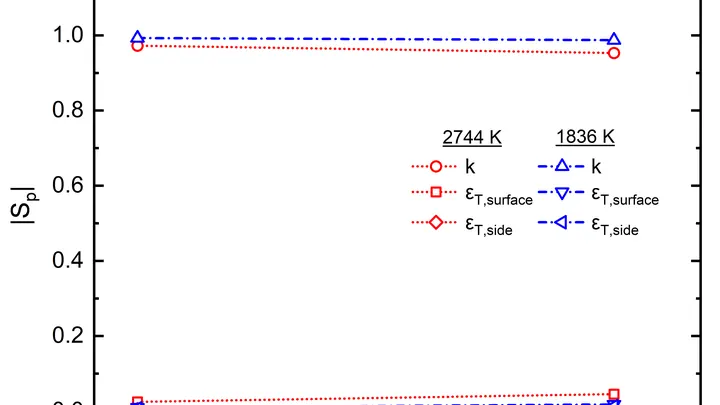
An aluminum pot on the stove melts at 660 degrees Celsius — everyone knows that. But what happens if you heat aluminum a hundred times hotter? The liquid starts to boil, and here's the puzzle: at what exact temperature does that happen?
A red-hot piece of metal in a furnace is like a frying pan on the stove: the hotter it gets, the faster heat travels to your hand if you touch it. But at temperatures where the metal is close to melting, measuring that speed is very tricky: sensors don't make good contact, heat escapes into the air, and the glowing sample confuses the instruments.
This new method sidesteps those obstacles.
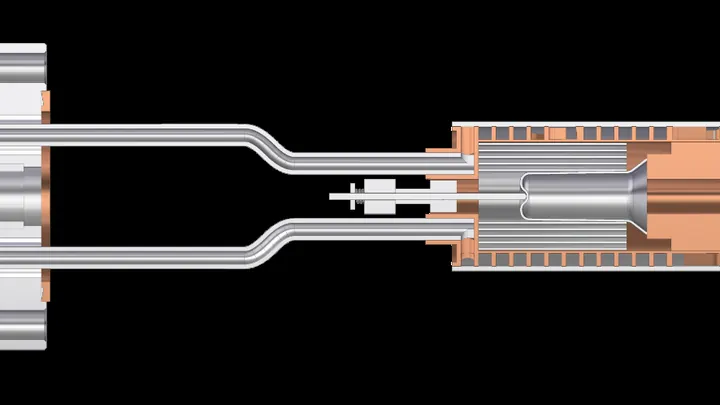
An ordinary aluminum pot on a stove doesn't emit molecules you can catch with light. But if you take aluminum and an aluminum salt, heat them together in a small oven, you get a stream of aluminum fluoride molecules, like steam from a kettle's spout, except instead of water droplets, tiny particles fly out.
Turning light gases like hydrogen and nitrogen into metal is a long-standing dream of physicists. In a new experiment, nitrogen was compressed to 130–140 gigapascals (pressure equivalent to 14 million kilograms pressing on a fingernail) and heated to 3000°C.
In an ordinary light bulb, light is born when an electron and a hole meet. In the new material, they are deliberately pushed apart, as if a turnstile were placed between them at a subway station. This turnstile is a built-in electric field that arises because sulfur and selenium atoms in the crystal are arranged asymmetrically: sulfur on top, selenium on the bottom.
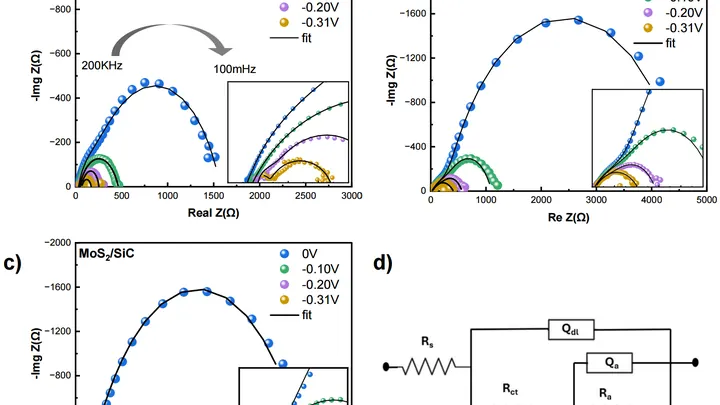
Hydrogen is a clean fuel: when it burns, it produces only water. But to extract it from water, you need to break the strong bond between hydrogen and oxygen. This is usually done with platinum, an expensive metal.
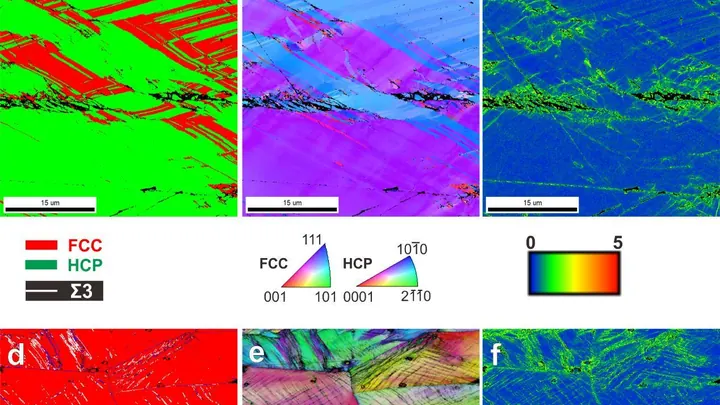
Metal is like a rope made of many strands: pull too hard and it snaps. Engineers have long sought a way to make it both strong and flexible at the same time. Typically, additives that increase strength make the metal brittle. But a team of materials scientists found a loophole: they added a small amount of nitrogen to the CrMnFeCoNi alloy, just one atom in a hundred, and got an unexpected result.
Bricks of different sizes laid in a single wall leave cracks in it. Atoms in superalloys behave much the same way: when two different metals form a common crystal lattice and their atoms differ slightly in size, stress appears inside the material. It accumulates and eventually destroys the alloy when heated.
Think of a reliable container instead of a fragile test tube: that's the shift from trapping chemically reactive radicals to holding stable molecules. Until now, magneto-optical traps have only worked with particles that are eager to react at the first collision.
The temperature in a room drops by a few degrees while the refrigerator runs without a single moving compressor. Inside, there is no Freon, but a piece of metal that is alternately magnetized and demagnetized.