Aluminum is a lightweight, silvery-white metallic element (atomic number 13) that is the most abundant metal in Earth's crust. In the context of the research titles, aluminum appears as a superconducting material in thin films — a surprising role, since pure aluminum is not a conventional superconductor at easily accessible temperatures. However, when deposited as an extremely thin film (a few nanometers thick), aluminum can exhibit superconductivity at temperatures below about 1.2 kelvin, making it useful for quantum devices. The titles mention aluminum in connection with quantum bits (qubits), magnetic vortices, and thin-film electronics, where its properties are carefully engineered.
History
Aluminum was first isolated as a pure metal by Hans Christian Ørsted in 1825, though it was known in compounds for centuries. Superconductivity in aluminum was discovered in 1933 by W. Meissner and R. Ochsenfeld, who observed that it expels magnetic fields below its critical temperature.
How it works
Superconductivity in aluminum arises from the formation of Cooper pairs — electrons that bind together through lattice vibrations (phonons) at low temperatures. In thin films, the reduced dimensionality and increased surface scattering alter the electron-phonon interaction, sometimes enhancing or suppressing the superconducting transition temperature. Aluminum's low atomic mass and simple electronic structure make it a clean testbed for studying these effects. In quantum circuits, aluminum films are patterned into tiny resonators and qubits, where their superconducting state allows lossless current flow and quantum coherence.
In practice
Aluminum thin films are used in superconducting qubits for quantum computers, in single-photon detectors, and in ultra-sensitive magnetometers (SQUIDs).
Fun fact
Aluminum was once more valuable than gold: in the mid-19th century, it was so difficult to refine that Napoleon III served his most honored guests with aluminum cutlery while others used gold.
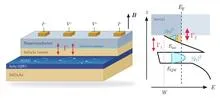
A thin layer of indium arsenide lies hidden under a superconducting film, like a voice beneath the noise of a crowd. In such a hybrid, current takes the path of least resistance and flows almost entirely through the metal, leaving the semiconductor inaudible to standard probes.
A metal made of five different atoms is like a soup with bits of carrot, peas, potato, onion, and meat floating in it. Each bit is its own element: chromium, vanadium, titanium, niobium, and tantalum. Such an alloy is called high-entropy: there is no single order, and the atoms are mixed almost randomly.
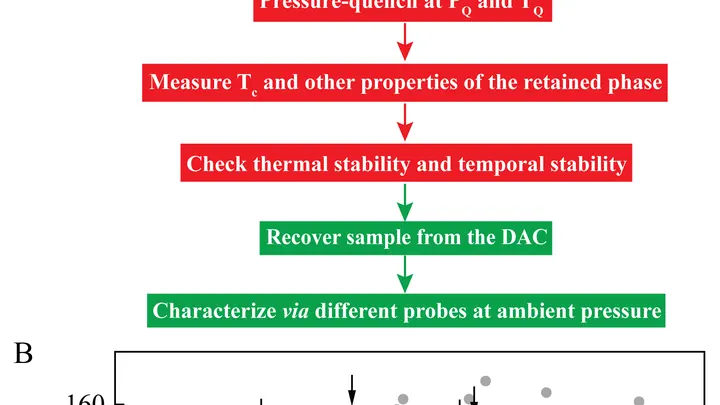
Inside a diamond anvil cell, squeezing a sample with a force millions of times greater than atmospheric pressure, a thin film of lanthanum meets hydrogen. The hydrogen comes from ammonia borane — a powder that, when heated, releases its hydrogen like a sponge releasing water.
A microchip the size of a fingernail gives off as much heat as a small light bulb. Getting rid of that heat is like trying to cool a cup of hot tea with a teaspoon: the insulating material around transistors is usually a poor heat conductor.
A ceramic plate as thin as a soap film, and through it flows current with zero resistance. That's the superconductivity achieved in nickelates, relatives of the famous cuprate superconductors. Previously, this required enormous pressure, comparable to that at the ocean floor.
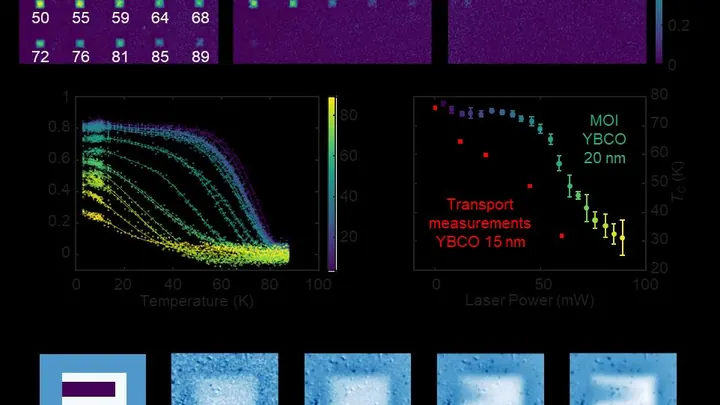
A thin film of yttrium barium copper oxide warms under a stream of infrared light, and suddenly stops dissipating energy. That's superconductivity: electrons pair up and move as a single quantum swarm. But in underdoped samples, the harmony breaks long before the pairs fall apart. The pairs are there, but the collective rhythm isn't.
A potter uses a sharp stylus to trace a pattern on a still-damp clay tile. One wrong move, and the line blurs, the tile cracks. Physicists work with films of the high-temperature superconductor YBCO (a compound of yttrium, barium, copper, and oxygen) in much the same way.
Electrons in a conductor are like a chaotic crowd: colliding, they lose energy, and resistance arises. In a superconductor, however, they move in unison, like partners in a well-coordinated dance, without touching each other. This state has reduced энтропией — meaning disorder.
Such behavior is rare for gold and copper.
Each electron is a tiny magnet. In a single-atom-thick layer of iron chloride, they all align in the same direction, like dancers in a perfectly synchronized routine. Nature usually avoids such order (that's high entropy), but quantum forces compel them to comply.
A bridge of aluminum just a few atoms thick is the heart of many quantum devices. Current flows through such a bridge without resistance, and it can be controlled with a magnetic field. These bridges are called Josephson junctions, after the British physicist who described their behavior.
Plutonium is a metal with attitude. One form shrinks when cooled, another swells. But at room temperature, the alloy behaves strangely: the ruler says one thing, X-rays say another. The ruler shows the sample barely grows, while X-rays see atoms in the crystal lattice moving further apart.
A film of aluminum nitride, as thin as a soap bubble, hangs above a mirror with a micrometer-sized air gap between them. When invisible infrared light with a wavelength of about 15 micrometers hits it, the film starts to vibrate in sync with the light, like a string that responds only to its own note.
A sheet of paper weighs almost nothing, but stack a hundred sheets and you get a noticeable pile. That's roughly what scientists did with a material that excels at converting one color of light into another, but only when it's just one atom thick. A single layer is like a single sheet: it works beautifully, but it's too thin to produce much light.
A mosaic floor made of many small tiles, each turned in a different direction. It seems that any pattern trying to cross such a floor would get scrambled and vanish. That's how people usually think about disorder in crystals: if atoms aren't arranged in a perfect lattice, delicate quantum effects should fall apart.
An aluminum pot on the stove melts at 660 degrees Celsius — everyone knows that. But what happens if you heat aluminum a hundred times hotter? The liquid starts to boil, and here's the puzzle: at what exact temperature does that happen?
A superconductor is a material through which current flows without loss, like water through a perfectly smooth pipe. But to make the pipe perfect, you have to cool it to very low temperatures. Physicists have long been looking for ways to make such a pipe at warmer temperatures, and one clue is the quantum critical point.
Inside copper-based superconductors, materials that carry current without loss at unexpectedly high temperatures, there is a hidden phase. It behaves like an ordinary metal, but it's invisible in standard measurements.
An ordinary aluminum pot on a stove doesn't emit molecules you can catch with light. But if you take aluminum and an aluminum salt, heat them together in a small oven, you get a stream of aluminum fluoride molecules, like steam from a kettle's spout, except instead of water droplets, tiny particles fly out.
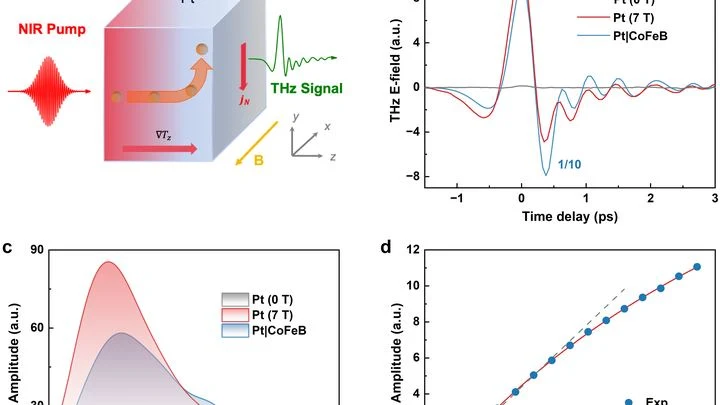
Usually, to generate terahertz waves (light between microwaves and infrared), researchers build a sandwich of different metals. One layer acts as the source, another as the receiver of charges. In such designs, platinum was assigned the role of a simple conductor. But it turns out it can work alone.
A film as thin as a spider's web, made of five metals, took the hit from a laser. Inside, the pressure soared to 55 gigapascals — imagine a hundred elephants balanced on your thumbnail. The alloy withstood it, compressing for a fraction of a nanosecond without breaking.
One gigapascal is a thousand megapascals.
A thin film of nickel oxide, tens of nanometers thick, is like a sheet of paper folded hundreds of times thinner. At room temperature, it conducts electricity, but cool it slightly and it becomes an insulator.
An ordinary kitchen thermometer shows the temperature at which mercury stops resisting electricity. For superconductors used in quantum computers, the critical temperature is like a quality passport: the higher, the better.
Superconductivity is the ability of a material to conduct electricity without losses. Ordinary wires heat up, and some energy is lost as heat, but a superconductor carries current with zero resistance.
The microchips inside smartphones and computers are getting denser: billions of transistors are packed onto a sliver of silicon the size of a fingernail. When they work, they give off heat like tiny stoves. If that heat isn't drawn away, the chip overheats, starts glitching, or fails outright.
In a metal crystal, atoms line up in neat rows like bricks in a wall. Knock out a single brick, and you're left with a void — what scientists call a vacancy. Under irradiation, these voids multiply and start merging into large holes, sapping the metal's strength. It's like holes in a brick wall joining up into a gaping breach.
A thin film of niobium and tin conducts electricity without resistance — until you make it really thin. Then it suddenly becomes an insulator. A team of physicists tested what happens when you add a bit more tin to the film than the formula calls for.
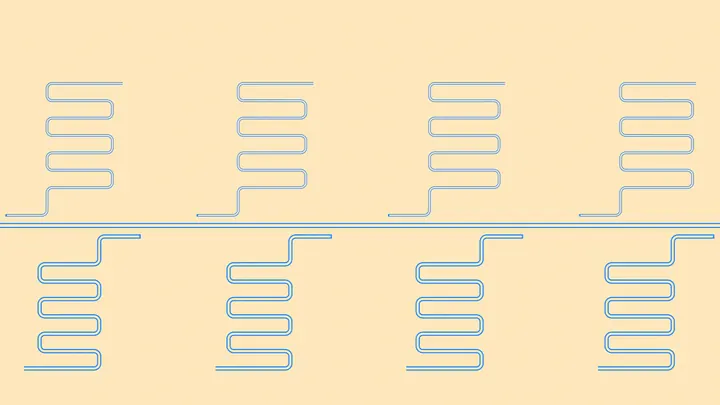
A quantum computer is like a musical instrument: even a tiny scratch on a string ruins the sound. Instead of strings, we have superconducting resonators — thin traces of titanium nitride on a silicon wafer.
A quantum bit is like a spinning top that must keep spinning steadily for a long time. In germanium, researchers have learned to set such tops spinning, but the floor around them is always trembling: electrical noise knocks the spin off course.
A crystal is like a perfectly laid mosaic of atoms. But growing such a mosaic is a tricky task: if the order slips even slightly, 'seams' appear — boundaries where rows of atoms don't align. For ordinary electronics, that's a minor issue, but for a quantum computer, it's a disaster.
An X-ray photon hits the detector like a pebble dropping into still water. The water is a thin film of aluminum and manganese, cooled to near absolute zero. The impact sends a heat wave rippling across the film, and by measuring its height, you can tell how much energy the photon carried.
In a thick metal, electrons are like a discordant orchestra: each instrument plays on its own, the overall sound is noise. But roll the metal into a film just a couple of atoms thick, and electrons suddenly begin to "play" in harmony, conducting current without dissonance. Even John Bardeen explained that in superconductors, electrons form pairs — duets that move unimpeded.
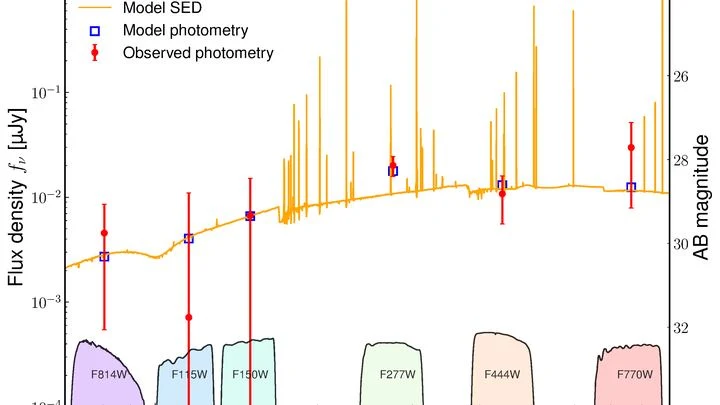
In the deep cosmos, more than 12 billion light-years away, the James Webb Space Telescope has spotted a galaxy that looks like a visitor from the dawn of creation. Its light has been traveling to us since the universe was only about two billion years old — a time when galaxies were growing especially vigorously, a period astronomers call the cosmic noon.
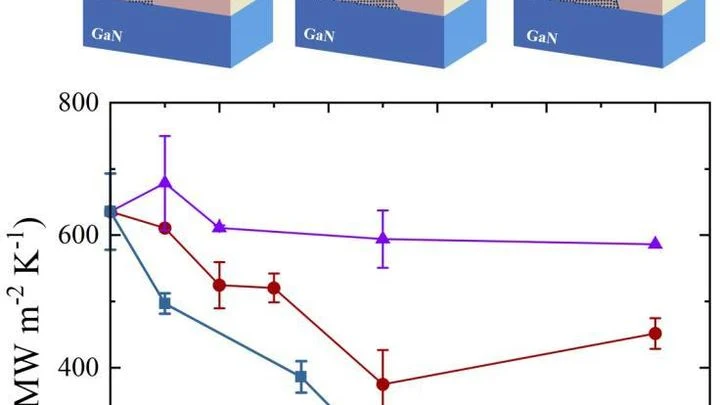
Inside a high-power transistor, heat escapes through junctions between different crystals, like water through narrow locks. For aluminum and gallium nitrides, key materials in power electronics, that lock is often a thin layer of their alloy. It is added deliberately or forms on its own during crystal growth.
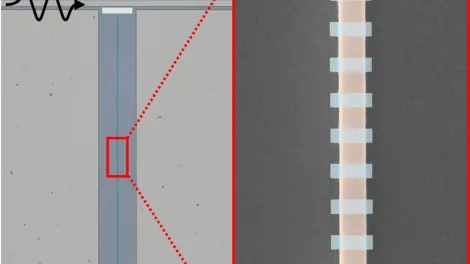
An ordinary wire at high frequencies is like a road full of potholes: the signal jumps, and some energy is lost as heat. A superconducting chain made of aluminum and indium arsenide (a semiconductor) turned out to be a smooth highway for microwaves.
A laser beam, like a fine chisel, burns oxygen out of a superconducting film. Where oxygen becomes scarce, the material stops conducting electricity without resistance. The researchers used this trick to draw patterns on the film that alter its properties.
The second interstellar guest, comet 3I/ATLAS, shines unusually due to rusting metal grains in its icy core. As it gets closer to the Sun, it behaves like an old tin can tossed into a fire: the heat melts the ice, water seeps into the metal, and vigorous corrosion begins.
Think of a reliable container instead of a fragile test tube: that's the shift from trapping chemically reactive radicals to holding stable molecules. Until now, magneto-optical traps have only worked with particles that are eager to react at the first collision.
Thirty nanometers is the distance over which a phonon sprinter hasn't yet had time to accelerate. In thin aluminum nitride films, thermal resistance remains almost unchanged up to this thickness: heat transport proceeds in the ballistic regime, where phonons (quanta of crystal lattice vibrations) fly…