Titanium is a chemical element with the symbol Ti and atomic number 22. It is a transition metal known for its high strength-to-weight ratio, corrosion resistance, and biocompatibility. In the context of cosmic rays, titanium is a relatively rare element, and its abundance relative to iron provides important clues about the nucleosynthesis processes in stars and the propagation of cosmic rays through the interstellar medium. The study of titanium in cosmic rays helps scientists understand the origins of these high-energy particles, which are believed to be accelerated in supernova remnants and other extreme astrophysical environments.
History
Titanium was discovered in 1791 by the British mineralogist William Gregor, who found it in the mineral ilmenite. It was later named 'titanium' by Martin Heinrich Klaproth in 1795, after the Titans of Greek mythology.
How it works
Titanium is produced in stars through nuclear fusion processes, particularly in the silicon-burning phase of massive stars, where lighter elements are fused into heavier ones. When these stars explode as supernovae, they eject titanium and other elements into space. Cosmic rays are then accelerated by shock waves in the supernova remnants, and their composition reflects the material they were accelerated from. The ratio of titanium to iron in cosmic rays can be compared to the solar system ratio to infer the age of cosmic rays and the effects of spallation, where cosmic rays fragment into lighter nuclei as they travel through the galaxy.
In practice
Titanium is widely used in aerospace engineering for aircraft frames and engines, in medical implants due to its biocompatibility, and in consumer products like watches and sports equipment. In astrophysics, its abundance in cosmic rays is used to model galactic cosmic-ray propagation.
Fun fact
Titanium is the only element that can be used to make a 'titanium ring' that is actually safe for people with metal allergies, as it is completely inert in the human body.
Imagine three witnesses who saw the same event. Two tell the same story, the third tells a different one. Whom do you believe? This is exactly the situation in astronomy when measuring carbon in the star J0815+4729, an ancient object with a record-low iron abundance (carbon is one of the key elements used to infer the properties of the…
A translator who has memorized all the lines in advance responds instantly — no need to listen to the whole conversation again. That's how the new model works: instead of running atoms through a computer for hours, it immediately outputs the crystal's free energy at any temperature and pressure.
Around young stars, flat clouds of gas and dust swirl: these are future planetary systems. Inside some of them, a void gapes: the dust and gas have been swept away, as if someone thinned out the middle of a vinyl record.
In nuclear physics, a puzzle has long been nagging: why among elements lighter than bismuth, only technetium (No. 43) and promethium (No. 61) have no stable isotope at all? All their neighbors in the periodic table can boast at least one long-lived variant, but these two seem to fall out of the general pattern.
Building a quantum network node is like teaching a dancer to balance on a carbon thread over an abyss. One leg must spring lightly from the wire, hurling photon-messengers into the external world. The other must grip the rope tightly, guarding precious quantum information.
Some 158 light-years away, around the dim star TOI-6894, a red dwarf, a planet moves leisurely. Its year lasts less than two Earth days, yet it is a cool world with an equilibrium temperature around 420 K, just a bit warmer than a sauna.
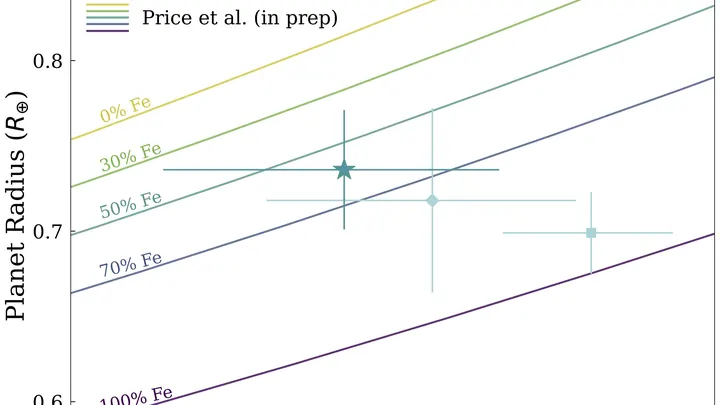
A cosmic sprinter on a short track: that's how you might describe planet GJ 367 b. It whips around its star in just 7.7 hours. This world is slightly smaller than Earth but has a personality: it was once thought to be nearly a solid ball of iron.
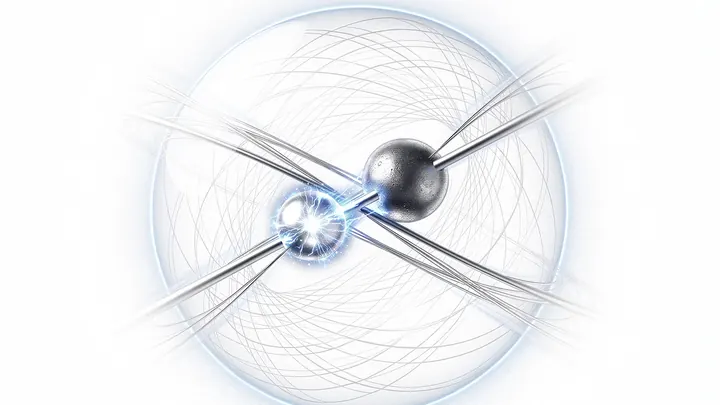
The world's most accurate pendulum isn't a steel rod: it's a tiny atomic nucleus. The isotope thorium-229 has a special excited state: to nudge the nucleus into it, you need surprisingly little energy — about what an ultraviolet laser delivers.
Two guitar strings are stretched on the same neck. They are almost identical, but one is slightly shorter — and they sound different. That's roughly how the two isomers of ethanimine work: molecules with the same set of atoms but rotated differently in space. Astronomers spotted this molecule in the dense clouds near the center of our Galaxy.
The most precise modern clocks count time by the oscillations of electrons in atoms. But their rhythm can be thrown off, like a mechanical watch's spring gets jolted by shaking. Physicists found a more reliable pendulum: the atomic nucleus.
In the dense gaseous cocoon around a young massive star, streams of matter collide as if in a giant chemical flask. One stream moves relative to us at about 11 kilometers per second, the other at about 5. The telescope at Onsala (Sweden) caught their radio voices and resolved them into hundreds of spectral lines — molecular fingerprints.
Light from a distant star, passing through the atmosphere of planet K2-18b, left unusual "fingerprints" in its spectrum. Astronomers spent 420 hours collecting this light with the James Webb Space Telescope and split it into colors, like a rainbow.
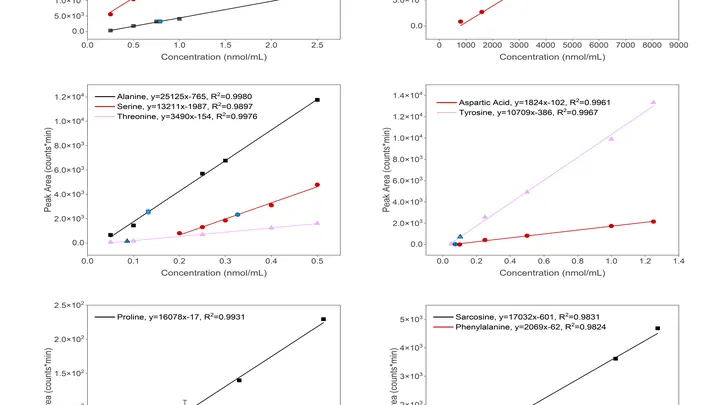
A chemical detective searches for life on other planets. Its tool is a mass spectrometer that identifies molecules by weight (the same device earthly forensic scientists use to analyze clues).
Titan, Saturn's largest moon, is wrapped in a thick orange haze. It's made of hydrocarbons and other organic molecules that are born when sunlight breaks apart methane and nitrogen in the upper atmosphere.
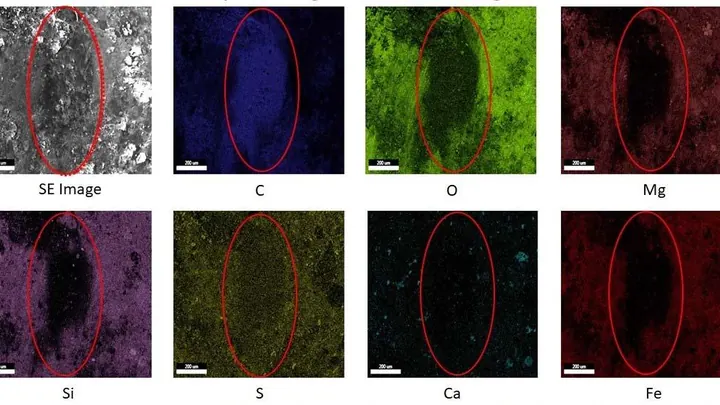
In 2017, a stone fell from the sky in the Indian village of Mukhundpura. It was a rare carbonaceous meteorite — a chunk of ancient cosmic material that preserves traces of the birth of the solar system. Locals quickly gathered the fragments, and they ended up in a laboratory.
A flashlight shines through fog, and its light changes color slightly. From that change, you can tell what the fog is made of. That's how astronomers study cold gas around X-ray sources: iron atoms in the gas absorb and re-emit X-rays at a very specific energy, like a fingerprint. But there's a catch: if you strip a few electrons from the atom, the line shifts.
A crystal one atom thick is like a sheet of paper you can write on with electricity. Such a material promises to become the foundation for tiny, fast microchips. But before putting it into production, you need to know exactly what it's made of. And that's where the usual formula falls apart.
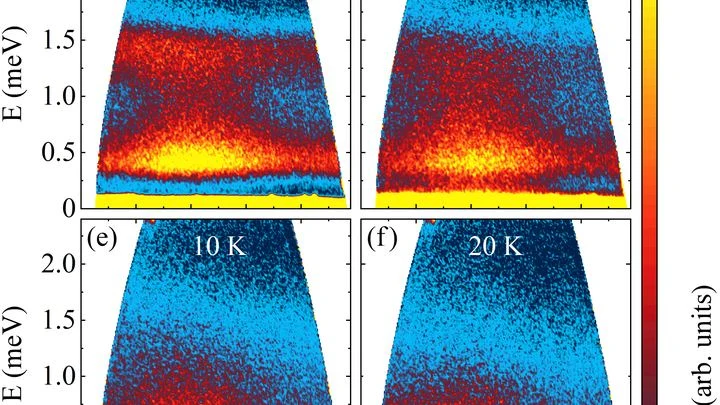
The tiny magnetic arrows inside a crystal of terbium-iridium oxide behave strangely: instead of lying along their preferred axis, they stand across it. This state fully forms when cooled to 1.5 Kelvin — colder than outer space.
Researchers probed the crystal with neutrons and observed how these flipped arrows oscillate and exchange energy.
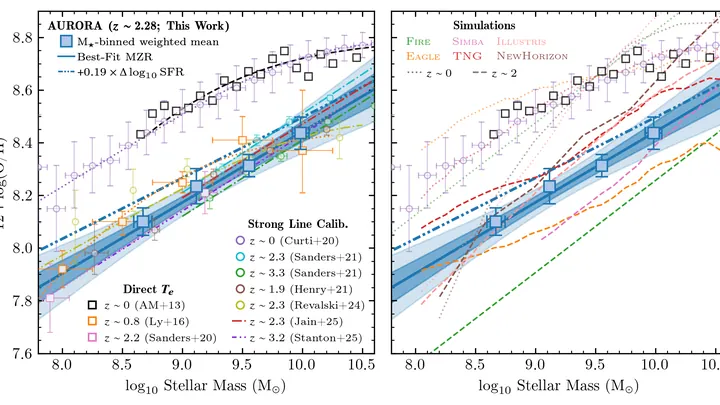
Galaxies are like giant kitchens where, in stellar cores, light atoms are fused into heavy ones — much like flour and water becoming bread. When a star dies, it spills its accumulated riches into the interstellar gas, seasoning it with 'spices': oxygen, carbon, iron.
The second interstellar guest, comet 3I/ATLAS, shines unusually due to rusting metal grains in its icy core. As it gets closer to the Sun, it behaves like an old tin can tossed into a fire: the heat melts the ice, water seeps into the metal, and vigorous corrosion begins.
In the stream of charged particles flying toward us from the depths of the Galaxy, iron turned out to be the odd one out. The ATIC-2 instrument, lifted on a balloon over Antarctica, compared how the fraction of nuclei from sulfur to chromium relative to iron changes with energy.
In the stream of cosmic rays, particles flying toward us from the depths of the Galaxy, titanium is rare. Its nuclei are almost indistinguishable from iron: both are heavy, and both leave similar tracks in detectors.