Scientist

William Lawrence Bragg

1890–1971 · X-ray crystallography, Solid state physics, Structural biology
One of the founders of X-ray crystallography, formulated Bragg's law, which allowed the atomic structure of crystals to be 'seen'; the youngest Nobel laureate in physics.

Biography

Born in Adelaide, Australia. Graduated from the University of Adelaide and Trinity College, Cambridge. In 1912, together with his father William Henry Bragg, he developed the method of X-ray diffraction to determine crystal structures. In 1915, at the age of 25, he received the Nobel Prize (jointly with his father). Later he worked in Manchester and Cambridge, heading the Cavendish Laboratory, where under his leadership the structures of proteins were discovered.

Key discoveries

💡 Bragg still remains the youngest Nobel laureate in physics in history. He learned of the award on the frontline of World War I, where he served in the British artillery; later his method enabled the unraveling of the structure of DNA.
"He considered the principal task of science to be not the collection of new facts, but the discovery of new ways of thinking about them."
Concepts
carbonwave-particle duality
Laws
Bragg's law
Scientists
Robert HookeFred HoyleMargaret BurbidgeLouis de BroglieArthur ComptonLeo EsakiNiels BohrChristiaan Huygens

Related articles

Optics2009-01-292 minarXiv:0901.4623
How to Squeeze Light Through a Needle's Eye and Keep It from Spreading
Shine a flashlight through a narrow slit, and the beam doesn't stay a thin stripe; it spreads out sideways. Light has a habit of bending around obstacles, and because of that, the smallest spot you can get with an ordinary lens is no smaller than half a wavelength.
Southern Ocean Fronts: Where They Really Are
The river that circles Antarctica does not flow in a single channel: it sometimes splits into branches, sometimes merges into one stream. That is what the fronts of the Southern Ocean look like on maps built from satellite data on sea surface height. Previously, these fronts were sought along lines of equal water level, and they seemed to creep slowly southward.
Where Does the Boundary Lie: Algorithm Finds Groups by Gaps in Data
Imagine a border river that separates two countries. On one bank live one group of people, on the other, another. The boundary between them is not always obvious: in some places the river is wide and calm, in others narrow and turbulent. But it is exactly where the current changes abruptly that the border becomes most noticeable.
Materials2024-12-032 minarXiv:2412.02813
Where the Electron Lives: Topology of the Band Structure in Real Space
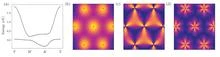
Electronic charge is a tumbleweed that moves camp depending on energy. In tungsten selenide (WSe₂) crystals, this is seen with utmost clarity: at a bias of −1.4 V, near the K point of the Brillouin zone, the maxima of tunneling current sit in the centers of hexagons, where there are no atoms.
Galaxies2025-08-053 minarXiv:2508.03569
Mismatched Fingerprints
The galaxy NGC 1560 is a modest island of stars and gas ten million light-years away. Its rotation curve, first measured in 1991, became an icon for those seeking an alternative to dark matter. The plot of rotation speed versus radius shows bends that seem to exactly mirror the bends in the distribution of ordinary matter.
Chameleon Crystal: How Six Ions Mimic Molecular Isomerization
Six barium ions lined up in a flat hexagon inside a Paul trap, a device that holds charged particles with oscillating electric fields. But a slight change in the shape of the trapping potential made the crystal rearrange: one ion moved to the center, and the other five formed a ring around it.
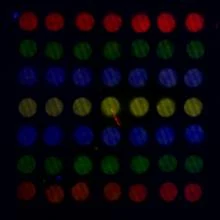
Diamond Chip with 49 Sites: A Quantum Sensor for DNA
On a two-by-two-millimeter diamond plate, an entire orchestra of forty-nine violins fits. Each string is tuned to its own note, its own DNA fragment. When the right melody enters the hall, the string responds, and the conductor hears a clean sound. That conductor is a quantum sensor hidden within the diamond itself.
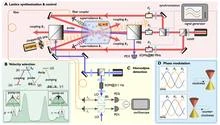
Honeycombs of Light: Topology at Room Temperature
Topological phases usually hide inside cryostats. Superconducting circuits, ultracold atoms, laser pulses: all of them shield quantum order from thermal noise.
Optics2025-10-252 minarXiv:2510.22176express
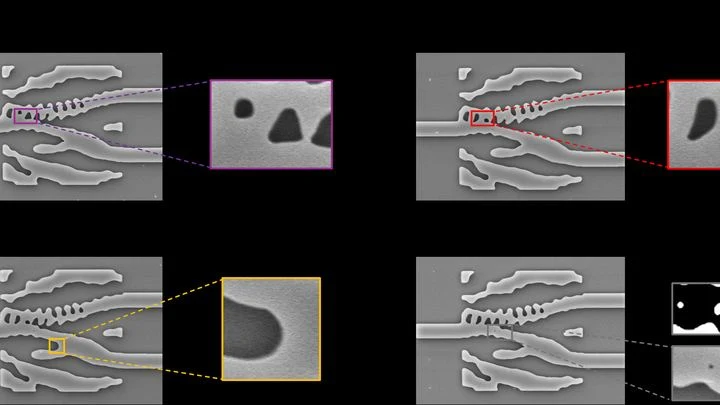
Light Chip: A Sensitivity Map in the Photonics Maze
Modern computer algorithms design photonic integrated circuits — light chips capable of separating signals by frequency (color) for spectroscopy. Unlike traditional engineering, light paths in these chips are not straight waveguides but chaotic, almost organic mazes.
Quantum Physics2025-11-111 minarXiv:2511.07785express
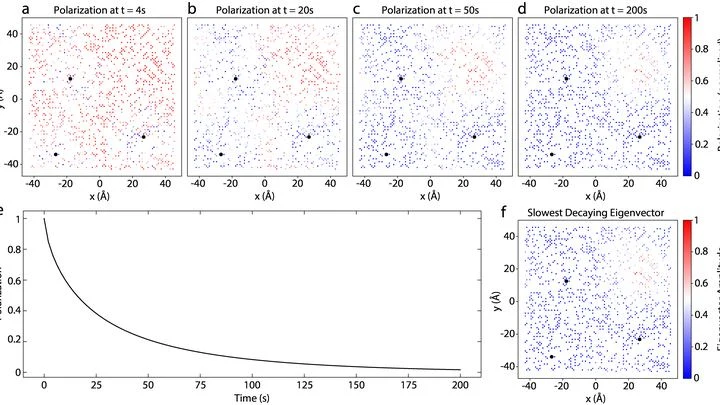
Disorder as an Ally: Quantum Memory in Diamond
In the everyday world, order preserves and disorder destroys. But in quantum computing, this logic is turned on its head. Consider a diamond: carbon atoms with their nuclei and electrons behave like tiny magnets capable of storing a quantum "whisper"—information encoded in the orientation of their spins.
Atomic Physics2025-11-171 minarXiv:2511.13017express
Thorium Nuclear Clocks: A Quantum Metronome for Time
Conventional atomic clocks are essentially optical counters: they rely on spectroscopy — a method for measuring the frequency of radiation with high precision as electrons jump between energy levels.
Quantum Physics2025-12-181 minarXiv:2512.16097express
Time crystals without chaos
Time crystals pulse in time, like a perpetual metronome that never needs winding. The idea was proposed by Frank Wilczek almost ten years ago. Previously, to keep such a metronome from losing its beat, disorder was deliberately introduced into the system — a paradox, but chaos helped the rhythm.
Materials2026-01-011 minarXiv:2601.00261express
Stress in Diamond Becomes Visible
Diamond crystals harbor invisible cracks — dislocations. These are places where rows of atoms are shifted, like a sheet of paper pulled halfway out of a stack. Stress builds up around these spots, affecting how the material breaks, bends, or conducts electricity.
Why a Pile of Odd-Shaped Particles Doesn't Collapse
Pour a handful of dry sand: it will spread into a neat cone. Now grab a box of star-shaped pasta: the pile will stand almost vertical. Why? It's all about particle shape. Physicists built cylindrical piles from particles of different geometries — from smooth spheres to 'polypods' with several arms, like a sea star.
Getting the Most Out of Every Photon
A fluorescence microscope is like a photographer shooting in the dark: the more frames, the better the view, but each frame costs photons. In a living cell, the supply is limited, otherwise the light would simply kill the sample. So scientists proposed not to increase the number of photons, but to choose more wisely when to catch them.
Optics2026-01-022 minarXiv:2601.00552express
X-ray Without a Camera: How to Film a Spinning Engine
An X-ray image is like a photograph taken in the dark with a very short flash: anything that moves comes out blurred. Conventional X-ray detectors are large arrays of millions of pixels, and by the time they read out one frame, the next is already missed. For a spinning turbine or a beating heart, such sluggishness is a death sentence. A team of researchers sidestepped this problem by ditching the array altogether.
Chemical Physics2026-01-031 minarXiv:2601.01135express
Ion Transistor in a Nanopore
In a narrow slit between two plates, ions don't behave like free particles but like a crowd in a packed bus: pressed tightly together, they form dense clusters. This very property, the ability of ions to bunch up in extremely confined spaces, underpins a new mechanism for controlling ion transport. Researchers studied ion behavior in two-dimensional nanochannels just a few atoms wide.
Disordered Systems2026-01-031 minarXiv:2601.01243express
Electricity in Disordered Materials: Electron Hopping
In disordered materials, such as organic semiconductors or inks made from two-dimensional materials, electrons don't move smoothly like water through a pipe. Instead, they hop from one spot to another, like a ball bouncing across a rough surface. This kind of motion is called hopping transport.
Fluid Dynamics2026-01-031 minarXiv:2601.01258express
How Bottom Friction Reshapes Vortices in Shallow Water
Water in a puddle after rain swirls differently than in a deep lake. A thin layer of fluid feels the bottom, and that changes the nature of its vortices. Scientists created such a layer in the lab: they poured in an electrolyte, ran a current and a magnetic field, and the fluid began to move.
Applied Physics2026-01-032 minarXiv:2601.01267express
Getting Genes into Living Cells Without Damaging Them
Primary human cells, taken straight from the body, are the most honest material for studying diseases and testing drugs. But getting foreign genetic material into them is tricky: cells don't like intruders. Standard methods either damage the cell or work unevenly, especially when the sample is heterogeneous — which it almost always is. The new platform tackles this with a vortex flow.
Materials2026-01-041 minarXiv:2601.01326express
Crack-Free Alloys: How to Pick a Composition That Won't Tear Under Heat
Bricks of different sizes laid in a single wall leave cracks in it. Atoms in superalloys behave much the same way: when two different metals form a common crystal lattice and their atoms differ slightly in size, stress appears inside the material. It accumulates and eventually destroys the alloy when heated.
Strongly Correlated2026-01-042 minarXiv:2601.01531express
How Electronic Ice Melts
Electrons in a conductor usually behave like a gas: they dart around chaotically, collide, and don't hold formation. But if you spread them far apart and cool them down, their mutual repulsion can force them into place, like attendees in an overcrowded hall who settle into every other seat.
Optics2026-01-042 minarXiv:2601.01667express
Light from Within: How to See 12 Centimeters Deep into the Body
Light is a great tool for studying tissues, but it fades fast deep inside the body. Within a few millimeters, photons scatter so much that you can't make out anything. Scientists came up with a workaround: instead of shining light from outside, deliver a tiny light source right inside. The challenge is how to power that source without wires.
HEP Experiment2026-01-061 minarXiv:2601.03405express
An Electron Flashing in the Air
In a dark room, you might notice a faint blue glow around some radiation sources. This is Cherenkov light: it appears when a charged particle travels through a medium faster than light can propagate in it. The result is a light shock wave, similar to the sonic boom from a supersonic jet, but made of photons.
Chemical Physics2026-01-082 minarXiv:2601.04621express
The Quantum Puzzle of Nitrogen
In every handful of fertile soil, there are bacteria that do something no factory can: they take nitrogen straight from the air and turn it into fertilizer. The secret lies in the enzyme nitrogenase, and its working core, a cluster of iron and molybdenum atoms, looks like a tiny factory floor. Chemists have long tried to understand how this factory works from the inside.
Atomic Physics2026-01-081 minarXiv:2601.04883express
Five Ions in a Trap Swap Places Like an Upside-Down Pyramid
Five charged calcium atoms hover in a trap, held by electric fields. Laser cooling saps their excess energy, and they line up into a tiny pyramid with a square base. But this pyramid doesn't stay put: every now and then it flips over, as if someone tosses it into the air and catches it upside down.
Biological Physics2026-01-091 minarXiv:2601.05438express
The Chameleon Virus: How Proteins Choose Their Size
The same set of parts can assemble into different shapes, just as magnetic beads can form a small cube or a large sphere. That's how hepatitis B virus proteins behave: they build two capsids of different sizes. One is made of 90 protein pairs, the other of 120. Both are stable and appear both in living cells and in the test tube.
Applied Physics2026-01-091 minarXiv:2601.05448express
Light Instead of Microphones: A New Way to See Inside the Body
A laser hits tissue, and the tissue responds with a barely audible click — a sound wave. Sensors pick it up, and from that, an image of what's inside is built. That's how photoacoustic imaging works: light reaches deep, and sound carries the picture out. In the new scheme, there are no sensors. Instead, several thin light beams are sent through the area where the wave has passed.
Biological Physics2026-01-091 minarXiv:2601.05907express
Waves That Keep Their Formation
Inside a fertilized frog egg, waves ripple, like ripples on water, but made of proteins that command cell division. These waves travel millimeters, even though the egg itself is less than a millimeter across. Previously, it wasn't understood why they didn't fall out of sync. It turns out the waves clear their own path.
Materials2026-01-101 minarXiv:2601.06365express
How Crystal Domains Grow
A thin film of perovskite slowly changes its crystal structure. Atoms rearrange like passengers in a crowded train car gradually finding more comfortable spots. This process took several hours, and throughout, researchers tracked it with X-rays. It turned out that the rearrangement proceeds at two different rates.
Optics2026-01-101 minarXiv:2601.06448express
Peering into Tight Spots: A Fiber Thinner Than a Hair
Light passing through a thin glass fiber scatters into countless tiny speckles, like ripples on water from a thrown stone. Physicists call this graininess speckle noise. Because of it, images from an ultra-thin endoscope come out blurry, as if you're looking through fogged-up glass. The researchers devised a program that removes this ripple.
HEP Lattice2026-01-101 minarXiv:2601.06582express
Peering Inside the Proton with an Electron Beam
An electron beam strikes a proton like a billiard ball hitting another ball. But between them is no empty space: the particles exchange virtual photons and Z bosons, like players passing a ball behind their backs. This exchange slightly alters the scattering trajectory, and hidden within it is a hint of new physics.
Optics2026-01-101 minarXiv:2601.06614express
A Whole Object in a Single Flash
As light passes through a patterned plate, it folds inside a transparent liquid into a three-dimensional pattern. Where the light is brighter, the resin hardens. After 7.5 seconds, a finished part is lifted out of the liquid — complete with cavities, channels, and tiny protrusions. A regular 3D printer prints point by point or layer by layer.
Materials2026-01-111 minarXiv:2601.06791express
A Magnetic Mirage in Ruthenium Oxide Films
A ruthenium oxide film is like a soap bubble film stretched over a frame, but made of atoms. For a long time, it was believed that in this film, ruthenium atoms align in a magnetic order, like compass needles pointing in opposite directions. This order was dubbed altermagnetism, and great hopes were placed on it for future electronics.
HEP Experiment2026-01-111 minarXiv:2601.06822express
Fiber Optics vs. Radiation: How Light Survives the Collider's Inferno
Inside a large particle accelerator, an invisible shower of gamma rays reigns, like leaving a glass thread under an X-ray machine switched on for years. Ordinary electronics there quickly fail, yet data from the detector still needs to get out. The solution is optical fiber: a thin glass core that carries light.
Quantum Physics2026-01-141 minarXiv:2601.09779express
Matryoshka Time Crystals: A Hierarchy of Rhythms in a System of Five Ions
Time crystals are an exotic phase of matter that exhibits periodic motion not in space but in time, even while in its ground, unexcited state. This idea, reminiscent of a perpetual clock that never needs winding, was first proposed by Frank Wilczek.
Optics2026-01-142 minarXiv:2601.09802express
Light Without Strict Order
A laser pointer shines a neat spot: all its light waves march in step, like soldiers on parade. Such light is called coherent. But nature and technology also feature another kind of light—'messy' light, where waves are out of sync, like a crowd at a market. It's called partially coherent.
HEP Experiment2026-01-151 minarXiv:2601.10401express
Muons Scan a Battery
A muon is like an electron, but 207 times heavier. When it slams into matter, it slows down like a bullet in a sandbank, and at every bend in its path it emits X-rays. Those X-rays tell you which atoms the muon encountered: that's the idea behind a technique called MIXE. It lets you peer inside an object without dismantling it, like an X-ray for materials.
Atomic Physics2026-01-151 minarXiv:2601.10575express
A Thermometer Made of a Light Comb
A laser beam passes through a glass cell containing rubidium vapor, and by how the atoms absorb light, you can determine their temperature. This is like measuring the speed of cars by the blur in a photograph: the faster the atoms move, the wider the absorption line becomes.
Diamond: The Mystery of Scattered Speeds
Diamond is not just a gemstone. This crystal can conduct electricity when free charge carriers, electrons and holes, appear in it. But how fast do they move? In scientific papers, numbers vary by tens of times. One lab reports a mobility of 1000 cm²/(V·s), another 4000.