Steel is an alloy primarily composed of iron and carbon, with carbon content typically ranging from 0.02% to 2.1% by weight. The addition of carbon, along with other elements like manganese, chromium, or nickel, transforms pure iron from a relatively soft and ductile metal into a material with remarkable strength, hardness, and resistance to deformation. This versatility makes steel the backbone of modern infrastructure, from skyscrapers and bridges to automobiles and surgical instruments.
History
The earliest known production of steel dates back to ancient times, with artifacts from around 2000 BCE in Anatolia. The modern industrial process, however, began with the Bessemer process in the 1850s, which allowed for mass production of affordable steel by blowing air through molten iron to remove impurities.
How it works
The key to steel's strength lies in its microstructure. In pure iron, atoms are arranged in a regular lattice that allows layers to slide past each other easily, making it soft. When carbon atoms are introduced, they occupy interstitial spaces in the iron lattice, disrupting the perfect arrangement. This makes it harder for dislocations—defects in the crystal structure—to move, thereby increasing the material's yield strength. Heat treatment processes, such as quenching and tempering, further manipulate the microstructure by controlling the formation of phases like martensite, which is extremely hard but brittle, or pearlite, which balances strength and ductility.
In practice
Steel is used in construction (reinforcing bars, structural beams), transportation (car bodies, rail tracks), and manufacturing (tools, machinery), as well as in household items like cutlery and appliances.
Fun fact
The Eiffel Tower, originally built with wrought iron, is now so dependent on steel for its maintenance and structural integrity that it has to be repainted every seven years to prevent rust, a process that requires about 60 tons of paint.
Imagine three witnesses who saw the same event. Two tell the same story, the third tells a different one. Whom do you believe? This is exactly the situation in astronomy when measuring carbon in the star J0815+4729, an ancient object with a record-low iron abundance (carbon is one of the key elements used to infer the properties of the…
Eight hundred participants, firms and workers, enter the market. Each holds a strict preference list in mind. The challenge: pair up so that no one wants a do-over. In mathematics, this is called a game theory with a ban on repeat alliances, and its roots trace back to the work of John von Neumann and Oskar Morgenstern.
Deep beneath our feet, in the scorching mantle, iron leads a double life. It can be divalent or trivalent, like a coin that lands heads or tails. Which side dominates determines how much oxygen stays in the planet's rocky shell and how much sinks into the core.
A steel cylinder that has held hydrogen for a long time sometimes breaks not along the usual grain boundaries but right through the crystal grains, leaving a strange pattern, as if the crack chose the wrong road. For a long time, people looked at this and wondered: why?
A chef pours hot sugar syrup onto a cold table, and it sets into crystals. That's roughly how engineers pictured metal solidification: the liquid instantly becomes a scatter of crystalline grains. But close-up imaging revealed an extra stage wedged between liquid and solid.
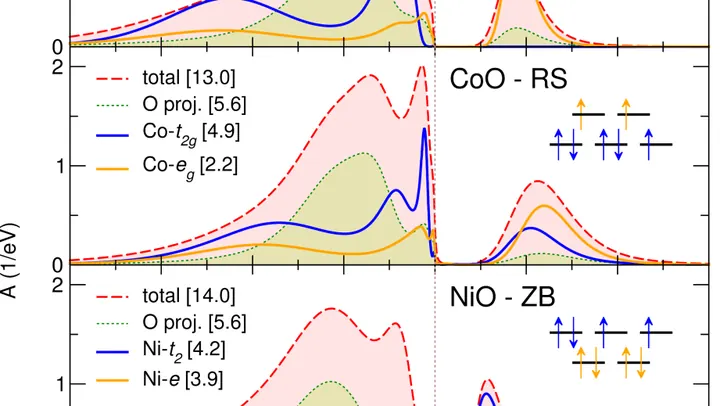
If you change not the composition but only the arrangement of atoms, you can make the same material conduct electricity or absorb light differently. That's exactly what the authors did with nickel and cobalt oxides. In one case, atoms are stacked like balls in a cubic box: each metal atom is surrounded by six oxygen atoms (rock salt structure).
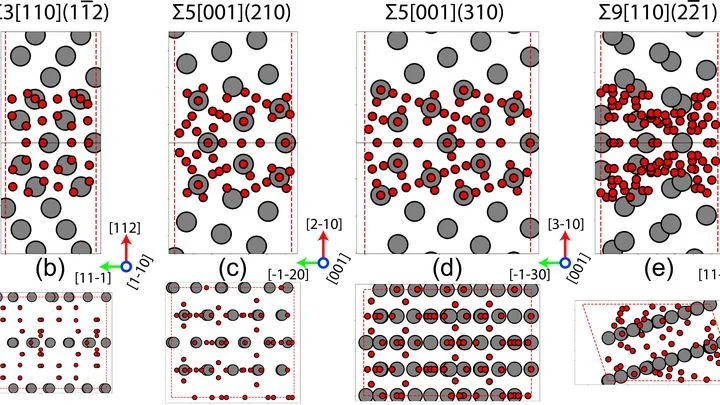
Steel is not a monolith but a mosaic of microscopic grains fused together. Their seams, the grain boundaries, are the most vulnerable spots: this is where cracks begin. Impurity atoms, even in negligible amounts, accumulate at these seams like sand between gears, and they can either lubricate the mechanism or jam it completely.
A metal part grown on a 3D printer looks indistinguishable from a forged one. But when load is applied, a very different story unfolds inside. A synchrotron X-ray beam is like a microscope that sees through steel and reveals what's happening right at the crack tip.
In ordinary forged steel, a crack blunts before it can propagate further.
Metal is like a rope made of many strands: pull too hard and it snaps. Engineers have long sought a way to make it both strong and flexible at the same time. Typically, additives that increase strength make the metal brittle. But a team of materials scientists found a loophole: they added a small amount of nitrogen to the CrMnFeCoNi alloy, just one atom in a hundred, and got an unexpected result.
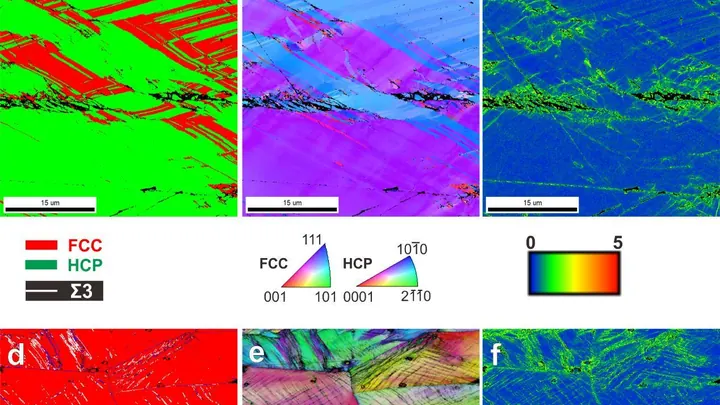
Steel is not just a piece of iron. Inside it, like in a layered pie, different structures, phases, coexist. In ultra-strong steel for cars, there are three such phases: soft ferrite, strong martensite, and ductile austenite. Medium-manganese steel owes its strength precisely to this trio.
A crystal one atom thick is like a sheet of paper you can write on with electricity. Such a material promises to become the foundation for tiny, fast microchips. But before putting it into production, you need to know exactly what it's made of. And that's where the usual formula falls apart.
A piece of chromium exposed to air gets covered in invisible armor, an oxide film, within a minute. That film protects the metal from rust, but for a battery it's a disaster: the film blocks chromium ions, so no current flows.
Scientists mixed five metals — chromium, bismuth, copper, tin, and nickel.
Bricks of different sizes laid in a single wall leave cracks in it. Atoms in superalloys behave much the same way: when two different metals form a common crystal lattice and their atoms differ slightly in size, stress appears inside the material. It accumulates and eventually destroys the alloy when heated.
The second interstellar guest, comet 3I/ATLAS, shines unusually due to rusting metal grains in its icy core. As it gets closer to the Sun, it behaves like an old tin can tossed into a fire: the heat melts the ice, water seeps into the metal, and vigorous corrosion begins.
In 1903, Fritz Heusler discovered an alloy, Cu₂MnAl, that behaved like a magnet even though none of its constituent metals were magnetic. Since then, the Heusler family has grown to three thousand compounds, and among them Co₂FeGe stands out for its high Curie temperature and spintronic promise.
In the stream of charged particles flying toward us from the depths of the Galaxy, iron turned out to be the odd one out. The ATIC-2 instrument, lifted on a balloon over Antarctica, compared how the fraction of nuclei from sulfur to chromium relative to iron changes with energy.