Thermodynamicstability refers to the condition of a system being in a state of minimum free energy, meaning it is in equilibrium with its surroundings and will not spontaneously change its macroscopic properties. In materials science, this concept is applied to alloys to determine whether a particular atomic arrangement is stable or whether it will transform into a different phase over time. A thermodynamically stable alloy is one that resists decomposition, phase separation, or unwanted chemical reactions, making it reliable for long-term use in engineering applications.
History
The concept of thermodynamicstability in alloys was developed in the late 19th and early 20th centuries, with foundational work by Josiah Willard Gibbs, who introduced the idea of free energy, and later by scientists like Gustav Tammann, who studied phase diagrams and transformations in metals.
How it works
The stability of an alloy is governed by the balance between enthalpy (the heat content) and entropy (the disorder) of the system. At a given temperature and pressure, the most stable phase is the one with the lowest Gibbs free energy. If an alloy is not in its minimum-energy state, it will tend to evolve toward that state, possibly through diffusion of atoms or nucleation of new phases. By calculating the free energy of different atomic configurations, scientists can predict which compositions and heat treatments will yield a stable alloy.
In practice
Thermodynamicstability is crucial in designing alloys for high-temperature applications, such as turbine blades in jet engines, where materials must resist creep and oxidation, and in developing corrosion-resistant steels and aluminum alloys for construction and transportation.
Fun fact
The concept of thermodynamicstability is so powerful that it can predict whether a new alloy will be usable for centuries, as long as the operating conditions remain within the stability range.
A thin film of neodymium nickelate, fifteen nanometers thick, sits on a neodymium gallate substrate. Below one hundred eighty kelvin it behaves as an insulator: electrons are locked inside their atomic cells and cannot move freely.
A translator who has memorized all the lines in advance responds instantly — no need to listen to the whole conversation again. That's how the new model works: instead of running atoms through a computer for hours, it immediately outputs the crystal's free energy at any temperature and pressure.
In the first moments after the Big Bang, the universe resembled a boiling cauldron. According to one hypothesis, dark matter, the invisible substance that holds galaxies together, could have been born there.
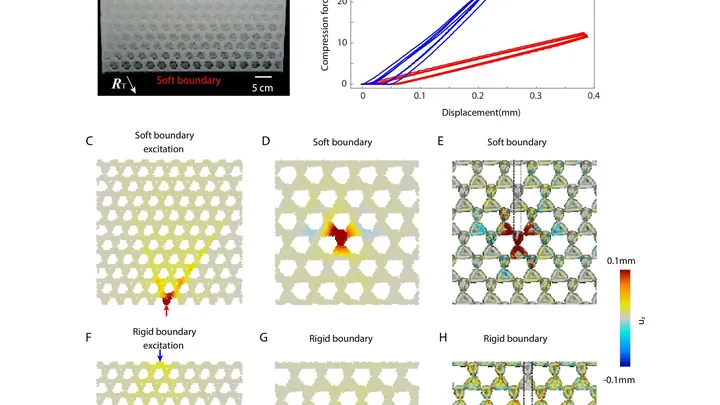
Bending a sheet of paper is easy. But compressing it by pushing from the edge is a different story: the paper will crumple but barely transmit the force further. That's how ordinary elasticity works — deformation depends on where and how you press. The new three-dimensional lattice pushes this contrast to the limit.
Imagine an audition for a symphony orchestra, where out of hundreds of hopefuls, only those whose instruments sound pure and withstand the furious crescendo remain. In the world of materials, computers have learned to generate 'atomic scores'—thousands of virtual crystals that promise to become the foundation for quantum chips or superconductors.
Heat is all around us: from a car's exhaust pipe to the casing of a running laptop. Thermoelectric materials could turn that waste heat into electricity.
A rubber band that gets thicker the harder you pull it. In electricity, this behavior is called negative capacitance: the more charge accumulates on the plates, the lower the voltage. A regular capacitor works the opposite way — voltage rises with charge.
In a pot of boiling soup, tiny droplets of fat occasionally flare up — a hundred times hotter than the broth. That's roughly how future fusion plasma works: the bulk of ions heats to hundreds of millions of degrees, while a small admixture of "fast" particles (born from nuclear fusion) is accelerated even further.
A chef pours hot sugar syrup onto a cold table, and it sets into crystals. That's roughly how engineers pictured metal solidification: the liquid instantly becomes a scatter of crystalline grains. But close-up imaging revealed an extra stage wedged between liquid and solid.
In a solid piece of tin-lead alloy, the layers of the two metals lie like pages in a book. When heated from one side, the layers don't melt uniformly but in whimsical tongues and fingers. Scientists studied this process using a transparent alloy that can be seen through under a microscope and compared it with a computer model.
A crystal that promised to conduct electricity without loss at room temperature turned out to be like a house of cards: touch it and it falls apart. Two compounds (one with silver, one with gold) were considered superconductor candidates, but tests showed that neither can withstand even ordinary conditions.
In the silver variant, the lattice simply collapses.
At the Large Hadron Collider, not only nuclei but also individual protons collide. Even in such small systems, collective behavior resembling the flow of a liquid is observed. But the proton is a quantum object; its state is described by a wave function, not by temperature and pressure.
Water can be ice, liquid, or steam. Physicists call these states phases. In theory, each phase has its own measure — a way to describe how likely it is. But not every measure you can imagine occurs in nature. Some phases are real, while others are just mathematical illusions.
Scientists have found a simple criterion that separates reality from mirage.
A quantum system can possess a property called magic. It's not about tricks: it's a measure of how hard it is to reproduce its behavior on a classical computer. Ordinary states, known as stabilizer states, are easy for a computer to handle. But states with magic leave it stumped.
Atomic clocks are pendulums that tick at the frequency of light. Inside a trap, an aluminum ion hangs, and a laser probes it like a tuning fork. If the laser's frequency matches the atom's natural frequency, the atom responds. The clock's rate is checked against this response.
Atoms settled along a chain of traps, like a line of coastal forts. Nearby, a quantum sea: a Bose-Einstein condensate (a substance with zero resistance, where particles move as a single wave).
A comet hurtling through space is a mountain of ice and dust that carries itself across the Solar System. If you mount small engines on such a mountain, it becomes a ship with its own fuel: gas from the interior can be vented through nozzles to change course.
A flexible thread, coiled into a loop, was locked in a tiny box with liquid. It can either absorb water and swell like a sponge, or expel the moisture and shrink into a tight ball. The choice between these states depends on whether the thread has a knot – and which one.
The reason lies in entropy, a measure of disorder.
A semiconductor film just one atom thick is like a communal apartment: it houses negatively charged electrons and positively charged 'holes.' When light hits such a film, an electron and a hole can pair up into an exciton — a bound state of an electron and a hole, akin to a hydrogen atom.
A solar panel on a roof produces little current in the morning, a lot at noon, and stays silent at night. Wind doesn't blow randomly either: it's often stronger in the morning and evening than during the day. Energy providers need to know in advance how much energy will be available in an hour or three, so they can switch on backup plants or store electricity in batteries in time.
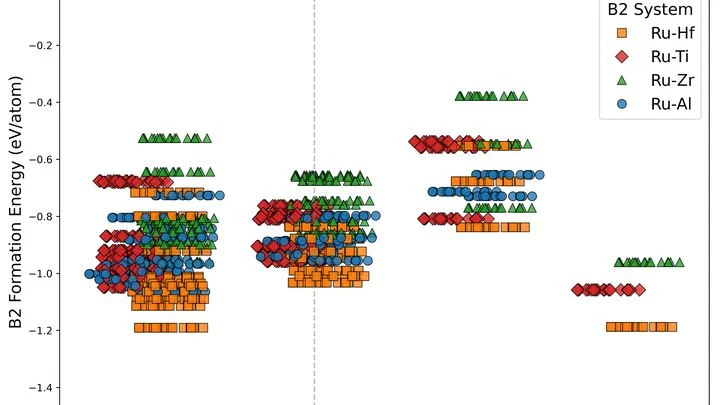
A metal alloy is like a cocktail: mix a few elements and you get a material with new properties. But while a bartender tastes the drink, engineers need to know in advance how an alloy will behave in service.
A hot coffee cools by radiating invisible light. To maintain temperature, it must receive exactly as much light back. This silent trade of photons is what we feel as steady warmth.
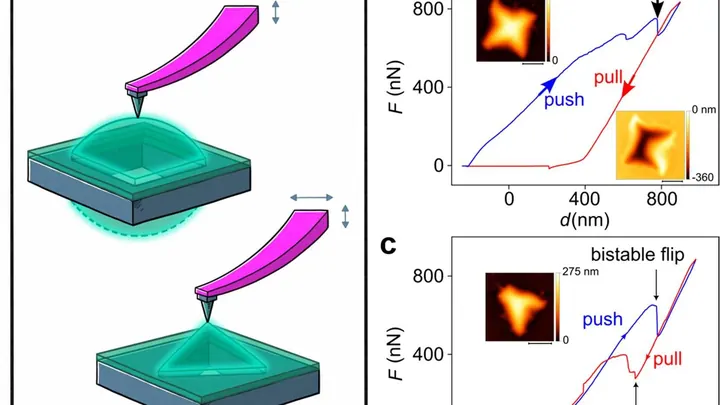
A thin film of metal oxide lies on a surface with a tiny pit. If you gently compress the film from the sides, it won't crumple — instead, it will bow downward into the pit or bulge upward like a hump. Both positions are stable, like a canning jar lid that is either concave or convex and doesn't flip back and forth on its own.
In a freezer, ordinary water turns to ice, but in living cells, such ice is a disaster: sharp crystals tear membranes apart like needles popping a balloon. Scientists who preserve cells for medicine have learned to avoid this calamity, but each method speaks its own language. A new study offers a common vocabulary — thermodynamics.
Water in a glass settles down once you stop stirring it. Oil in an engine dampens vibrations. It seems viscosity is always about damping. But in some flows, it's the opposite: add friction, and waves start to grow as if from nowhere.
Physicists have found a simple explanation.
Bricks of different sizes laid in a single wall leave cracks in it. Atoms in superalloys behave much the same way: when two different metals form a common crystal lattice and their atoms differ slightly in size, stress appears inside the material. It accumulates and eventually destroys the alloy when heated.
Quantum computers use GKP states, dreamed up by Alexei Kitaev, John Preskill, and Daniel Gottesman. Their hallmark is built-in stabilizer checks that catch errors. For a long time, it was believed that a successful check guaranteed a nearly perfect state. Alas, it's an illusion.
The Penrose tiling, assembled from two types of tiles, covers a plane without a repeating pattern — a mathematical marvel discovered by Roger Penrose that has found physical embodiment in the quantum world. Researchers modeled a chain of particles interacting according to a rule reminiscent of Fibonacci numbers and the golden ratio.
Quantum entanglement is a fragile resource. Heat a system, and thermal fluctuations will tear the delicate threads of correlations: at a sufficiently high but finite temperature, the Gibbs state of a local Hamiltonian becomes separable, that is, representable as a probabilistic mixture of products of local states.