The Crystal That Catches the Invisible express
An ordinary piece of germanium the size of your palm can spot a single dark matter particle flying through it. But for that, the crystal must be nearly perfect: free of electrical noise, with a uniform internal field, and contacts that don't spark at high voltage.
In the new work, they assembled the KL01 detector. On one side of the crystal, they applied lithium paint and melted it in with heat — creating a contact that holds voltage well. On the other side, they deposited a thin layer of aluminum over amorphous germanium. The side walls were coated with the same amorphous germanium to prevent current from leaking along the edges.
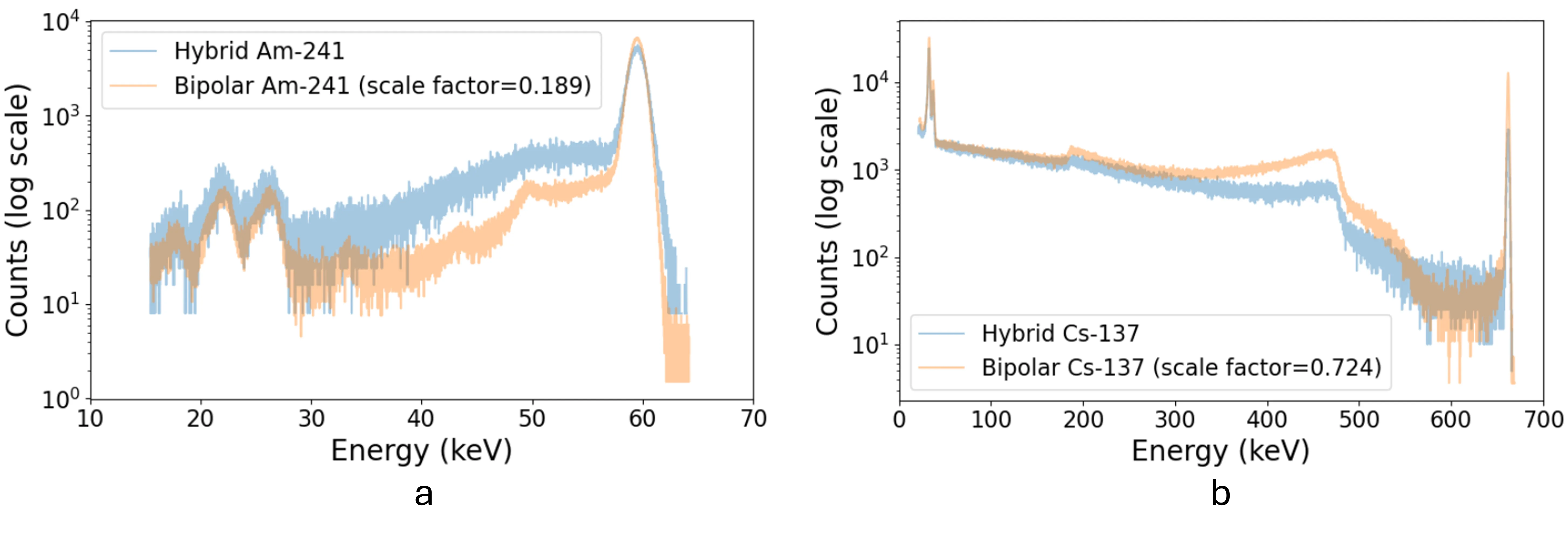
At liquid nitrogen temperature (77 K), the device passed a current of only a few picoamperes, like a single drop leaking from a full bucket over a year. The full depletion voltage was about 1300 volts. Energy resolution: 1.57 keV for 59.5 keV gamma rays and 2.57 keV for 662 keV. This means the detector can distinguish events with very close energies.
Why does this matter? For future detectors with annular grooves on the crystal. Such a shape allows making large crystals without losing signal quality. The hybrid lithium-aluminum contact is a viable way to fabricate such devices.
Original abstract
as written by the authors arXiv:2601.08934
Rare-event searches including dark matter, coherent elastic neutrino--nucleus scattering (CE$$ u$$NS), and neutrinoless double-beta decay (0$$ u\beta\beta$$) require high-purity germanium (HPGe) detectors with ultralow noise, stable backgrounds, and electrode geometries that can scale to larger single-crystal masses. Ring-contact (ring-and-groove) designs address scalability by shaping the electric field to preserve low-capacitance readout, but their nonplanar topology motivates a lithium-contact process that is compatible with conformal deposition and robust high-voltage operation. As a process demonstration toward future ring-contact prototypes, we fabricate and characterize a hybrid-contact planar HPGe device, KL01. Here, ``hybrid'' denotes an $$n^{+}$$ contact formed by an in-house lithium-suspension paint followed by controlled thermal diffusion, combined with an AJA-developed a-Ge/Al $$p^{+}$$ contact and a-Ge sidewall passivation. At 77~K the device exhibits pA-scale leakage current under kV bias, a depletion plateau near $$V_{\mathrm{dep}}\approx 1300$$~V, and energy resolutions of 1.57~keV FWHM at 59.5~keV and 2.57~keV FWHM at 662~keV. These results validate the compatibility of the paint-and-diffuse lithium process with thin-film a-Ge/Al contacts and establish a practical fabrication workflow to be extended to ring-and-groove electrodes for next-generation rare-event HPGe modules.
A leakage current of a few picoamperes is about one electron per billionth of a second, but in the detector it flows constantly and can be measured.
In the TV series 'Dark Matter,' characters search for particles that barely interact with matter — requiring detectors like the one described here.