Liquid nitrogentemperature, about 77 K (−196 °C), is a practical benchmark in physics and engineering. It is the boiling point of nitrogen, a cheap and abundant cryogenic fluid. In the context of quantum devices, it is often considered a relatively 'warm' operating condition, compared to the millikelvin temperatures required by many superconducting qubits. The fact that some quantum effects survive at this temperature is a major research frontier, as it would drastically reduce the cost and complexity of quantum technologies.
History
Liquid nitrogen was first produced in 1883 by Polish physicists Zygmunt Wróblewski and Karol Olszewski, who achieved the liquefaction of nitrogen and oxygen. Its use as a cryogenic coolant became widespread in the 20th century.
How it works
At 77 K, thermal energy is about 6.6 meV, which is still enough to disturb many delicate quantum states. However, certain materials and phenomena, such as nitrogen-vacancy centers in diamond or specific spin systems, have energy gaps large enough to remain coherent at this temperature. The key is to isolate the quantum system from thermal vibrations, either through material engineering or by using the inherent robustness of certain spin states.
In practice
Liquid nitrogen is used to cool infrared sensors, superconducting materials in MRI machines, and in research to test quantum devices that might operate at less extreme temperatures.
In a ballroom where couples were dancing, the music changed, and the pairs lined up in rows suddenly spun into whirlpools. That is how the magnetic crystal Fe3Ge rearranges its internal pattern once the temperature climbs above 375 kelvins, which is about a hundred degrees of heat.
A tiny diamond, invisible to the naked eye, sits on a chip and senses heat like no ordinary thermometer can. Hidden inside it are two defects: places where a carbon atom is replaced by a nitrogen atom, with a vacancy nearby.
The neutron is a particle that usually sits in the atomic nucleus and doesn't disappear. But some theories suggest that occasionally it might transform into its invisible twin — a particle that ordinary detectors can't catch.
Quantum computers make mistakes. Each qubit is like a ball balanced on the tip of a pencil: a slight tremor in the hand and it rolls off. To keep the balls from falling, you need someone to notice the wobble and correct it in time.
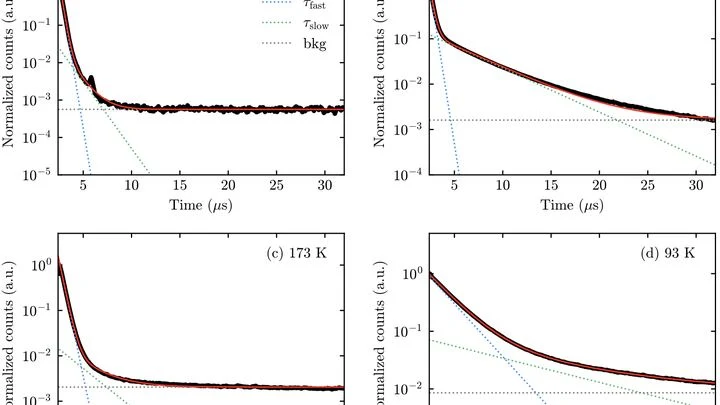
A sodium iodide crystal doped with thallium is like photographic film for invisible particles. When a gamma ray or a hypothetical dark matter particle hits it, it flashes with faint light. Two silicon photomultipliers pressed against the crystal's ends catch the flash from both sides.
In boiling water you can see a prototype of a quantum trick: if part of the liquid turns into long-lived vapor bubbles, the main mass cools down. This is exactly what happens when you sharply jolt a system of interacting electrons: doublons flare up — pairs of particles that absorb excess energy and don’t decay for an astonishingly long time.
The Sun is a giant nuclear reactor that continuously sends us light and heat. But it also has another, almost silent postal service: every second, tens of billions of neutrinos, ghostly particles born in the thermonuclear furnace, fly through a square centimeter of your palm. Most of them leave no trace.
In diamond quantum devices, there's a tiny defect — the nitrogen-vacancy center (a nitrogen atom plus a vacancy where a carbon atom should be). It acts as a switch that spontaneously flips back and forth: it can carry an extra electron or not, and this determines whether it emits light or not.
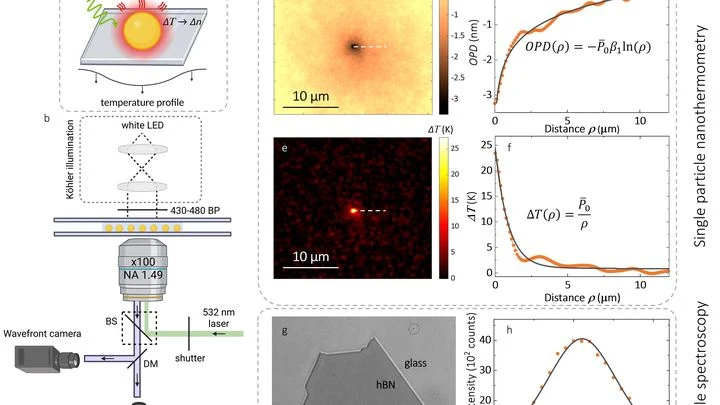
A gold speck the size of a hundred atoms catches a beam of light, and heats up. In everyday life, that's no big deal, but in the world of nanotechnology, this tiny heat can ruin a biosensor or fry a microchip. You can't just put a fan on it: at these scales, heat gets trapped like in a thick winter coat.
An ordinary kitchen knife made of niobium would suddenly start conducting electricity with zero loss at −258 °C. That's how superconductivity works, and you can "switch it on" right at the metal's surface by blasting it with a laser in a nitrogen atmosphere.
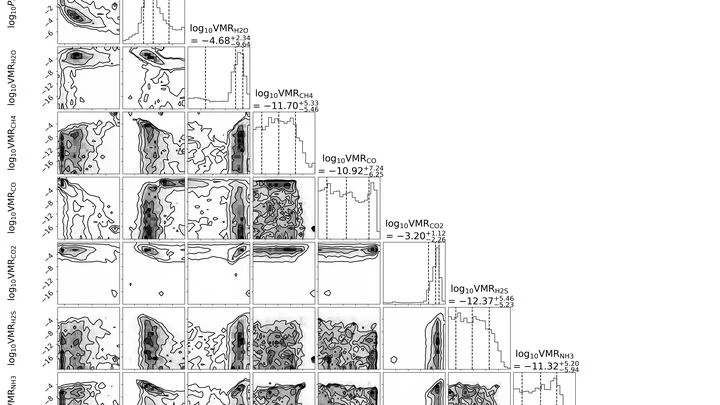
A world that for years refused to show its face. Planet GJ 1214 b is exactly such a case. It is larger than Earth but smaller than Neptune, and its dense envelope made the atmosphere invisible to telescopes: starlight passed through it without leaving clear traces. But astronomers' persistence and a new sensitive instrument provided the first clue.
An aluminum pot on the stove melts at 660 degrees Celsius — everyone knows that. But what happens if you heat aluminum a hundred times hotter? The liquid starts to boil, and here's the puzzle: at what exact temperature does that happen?
In superfluid helium, a vortex is like a tornado in a bottle, but instead of water, it's a quantum liquid that flows without friction. Such a vortex doesn't dissipate on its own, so the question of where its energy goes has long remained open.
Bismuth is a metal used to make low-melting alloys and additives to steel. But when you sputter it onto a substrate in a very thin layer, its behavior depends on how cold the substrate is. Physicists compared two methods: one at ordinary room temperature, the other at liquid nitrogen temperature, about −196 °C.
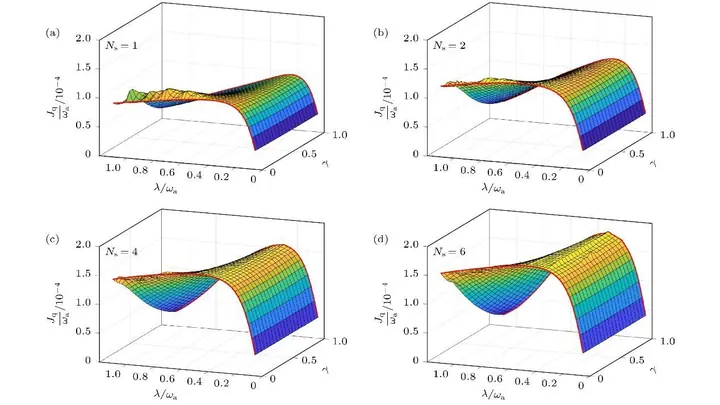
Light and atoms, like dancers, can move in sync or out of step. When their interaction is anisotropic (that is, direction-dependent) the dance gets trickier. In a new study, physicists considered a model where many atoms (qubits) collectively interact with an anisotropic light field, and each component is connected to a thermal reservoir.
The copper spins in Cs₂Cu₃SnF₁₂ sit on a triangular lattice that resembles the Japanese woven kagome pattern. When cooled below 20 K, these spins align into a pattern with negative vector chirality, as if all the whirlpools in a river spun in the same direction, but with a specific sign of twist.
Turning light gases like hydrogen and nitrogen into metal is a long-standing dream of physicists. In a new experiment, nitrogen was compressed to 130–140 gigapascals (pressure equivalent to 14 million kilograms pressing on a fingernail) and heated to 3000°C.
Every time deuterium and tritium fuse in a fusion reactor, a fast neutron flies out. It can turn one substance into another — for example, create valuable isotopes for medicine.
Today such neutrons cost a fortune, because there are few experimental facilities and they rarely operate.
A pot of water on the stove is just water, but inside each molecule, a continuous dance goes on. Hydrogen and oxygen atoms jitter, even at absolute zero, because that's how the quantum world works. These jitters change how much heat water stores and how it flows.
Physicists took 114 rubidium atoms, cooled them to near absolute zero (as in experiments with liquid helium), and neatly arranged them in a honeycomb pattern. They then smoothly adjusted the interaction strength, as if slowly turning up the heat under a pot.
A cage of sixty carbon atoms, shaped like a soccer ball, lets small molecules slip inside. Carbon buckyballs, fullerenes, pack into a crystal like oranges in a crate, leaving gaps between them. At 570 degrees Celsius and 30 atmospheres of pressure, hydrogen seeped into those gaps.
A tossed coin is the simplest source of randomness. But if the coin is shaved, it starts cheating. In the quantum world, light plays the role of the coin: its properties are fundamentally unpredictable. The catch is that the device that “flips” the quantum coin might be faulty or even swapped by an adversary.
In layers of molybdenum telluride twisted at a specific angle, electrons behave unusually: they can split into parts. This is akin to a whole pie suddenly being cut into perfectly equal slices, even though there's only one knife. In ordinary materials, the electron's charge is indivisible, but in these layers, under strong cooling, states emerge where the charge splits into three parts.
A quantum computer is like an orchestra that has to tune its instruments before every piece. Tuning takes time and requires quiet — in our case, deep cold. For silicon chips with boron atoms, this tuning is usually done with microwaves, slowly and only at temperatures below 2 kelvin (minus 271 degrees Celsius).
A thermometer that doesn't lie for years. Ordinary resistance thermometers, even very accurate ones, start to err over time: the material ages, contacts oxidize, and readings drift. The new quantum thermometer works differently: it uses the rubidium atoms themselves as a reference.
Quantum devices usually live inside cryostats — giant thermoses where temperatures are colder than deep space. An erbium ion trapped in a tiny well on a silicon chip breaks that mold.
Inside a refrigerator that cools matter to near absolute zero beats a mechanical heart — the pulse tube. It pumps gas and extracts heat, but along with the cold it brings tremors. Each beat of this heart shakes the instruments sitting next to the sample and ruins delicate measurements.
In the tungsten bronze family, one material was considered the quiet one. When cooled, its siblings rearrange their electrons into wave-like patterns, but it did not, or so it was thought until recently.
Now it turns out that this material also undergoes rearrangement.
A qubit, the heart of a quantum computer, is like a soap bubble: the slightest puff and it bursts. On Earth, gravity pulls bubbles down, creating vibrations, and the thermal hustle of atoms adds jitter. Entropy, the measure of this chaos, destroys quantum information.
In diamond, you can embed a “spy.” Simply replace a carbon atom with nitrogen: you get a defect that responds to magnetic fields and sends a light signal.
A tiny seesaw weighing 1.5 nanograms oscillates not from the wind, but from the heat of its surroundings. Physicists nearly stopped it by cooling it to 0.006 degrees above absolute zero.
In a laboratory at Purdue University, a laser beam strikes a crystal of hexagonal boron nitride, and in response, a single point of light flashes. This is not just luminescence; it is a signal from a spin defect, a pair of electron spins, one of which is coupled to a carbon-13 nuclear spin.