Scientist

Bohdan Paczyński

1940–2007 · Astrophysics, stellar evolution
Polish astrophysicist who pioneered gravitational microlensing as a method to study dark matter and search for exoplanets. His theoretical models of accretion disks and gamma-ray bursts became paradigms in high-energy astrophysics. A brilliant educator who trained a whole school of researchers.

Biography

Graduated from the University of Warsaw, worked at the Institute of Astronomy of the Polish Academy of Sciences. Since 1982, professor at Princeton University. Led major observational projects such as OGLE.

Key discoveries

💡 Paczynski was one of the first to realize the potential of microlensing for detecting dark matter and planets, and his work inspired projects such as OGLE.
"He considered astronomy a teacher of humility and awe before the infinite."
Concepts
microlensing

Related articles

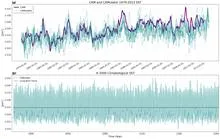
Climate as a Conversation: How to Hear Who Is in Charge
A translator who hears only the meaning, not the noise in the hall, can convey a conversation accurately. Climatologists have long sought such a translator for the ocean–atmosphere pair: their interaction resembles a dialogue where voices drown in the roar of extraneous sounds.
Enso: The Blockchain That Learns to Store Logic as Data
Today's blockchain is like a music box: the melody (the rules of the game) is embedded in the mechanism, and to change it you have to take the whole thing apart. Every time developers want to change an application's logic, they have to perform a fork, splitting the network into two branches that then compete with each other.
A neural network trained on 127,137 years of model climate predicts winter
A translator who learned a language from thousands of books can interpret a conversation without being distracted by noise in the hall. Similarly, a neural network trained on 127,137 years of model climate produces a winter forecast in a fraction of a second, faster and more accurately than bulky dynamical systems.
A Translator That Never Loses the Meaning
A long conversation between two people can be condensed into a few key phrases that preserve the essence. That is exactly how a macrovariable works: temperature stands in for billions of moving molecules, and sea level for thousands of waves.
The Ocean Conducts the Rivers: How a Neural Network Heard the Whole Orchestra, Not Just the First Violin
The orchestra plays a symphony, and you listen only to the first violin. That is roughly how river discharge forecasts have worked for decades: the entire El Niño signal is reduced to a single number calculated from a small rectangle in the Pacific Ocean. Yet the ocean is a vast ensemble, where heat flows from one region to another, and its full score contains far more information than a single note.
A Sieve for Nature: How IMPIT Indices Sift Important Episodes from Noisy Signals
A fisherman in Queensland notices that in some years snapper are harder to catch, even though the nets and boat are the same. The reason hides not in the catch itself but in the water temperature several months earlier, when the fry were just hatching. A warm current arrived not for the whole year but only for a few weeks, and that short episode decided the fate of an entire fish generation.
A Translator That Follows the Meaning: How a Neural Network Reads the Ocean Two Years Ahead
A translator who gets distracted by every rustle in the room turns a one-hour meeting into two. That is how old statistical El Niño models worked: they picked out individual numbers from ocean maps but missed how a warm patch off Peru connects to a cool tongue near Australia. The new neural network behaves differently: it follows not every word but the meaning of the paragraph.
SFANet: a translator that hears both words and intonation
A translator at negotiations picks up not only the words but also the tone in which they are spoken. If they focus only on vocabulary, they might miss sarcasm or fatigue in the voice. If only on intonation, they could mistranslate the details of the contract.
Neural Network Hears the Ocean's Whisper Three Months Before a Storm
Imagine an interpreter in a huge hall who hears not only the person next to them but also a whisper in the far corner, and from those fragments reconstructs the entire conversation. That's how the CAS-Canglong neural network works: it picks up connections between pressure, wind, and heat across the whole planet and uses them to predict what the ocean will look like three months from now.
A Digital Twin of the Atmosphere: How a Neural Network Speeds Up Climate Modeling by 350 Times
A translator at a high-stakes negotiation doesn't just render words quickly; they make sure the meaning doesn't get lost. CAMulator does the same: it takes the complex climate model CAM6 and translates it into the language of a neural network that runs hundreds of times faster, without losing the physical essence.
IAFormer: Sparse Attention for Collision Analysis
At the Large Hadron Collider, millions of jets are born every second: streams of particles flying out from a single quark or gluon. Telling a jet from a top quark apart from a jet from an ordinary quark is a task on which the hunt for new physics depends.
Exoplanets2025-11-051 minarXiv:2511.03392express
Warm Moons of Rogue Planets
The planet's gravity rhythmically squeezes and kneads the moon like dough: from this constant 'kneading', the interior heats up, and oceans of water can persist under the icy crust for ages. In the Galaxy, there are plenty of rogue planets, thrown out by supernova explosions.
Exoplanets2025-12-031 minarXiv:2512.03940express
Deadly Resonance: How Stars Toss Out Planets
Two stars, drawing together in a cosmic dance, experience an extra wobble — a consequence of spacetime curvature (an effect predicted by Einstein). A planet orbiting them also wobbles. Sometimes the rhythms align: the gravitational tugs from the stars fall in step with the planet’s orbit, like hands pushing a swing.
Exoplanets2026-01-011 minarXiv:2601.00325express
Rogue Planet Gave Itself Away with Warped Light
The lone planet KMT-2024-BLG-0816, one of many free-floating planets, was discovered when its gravity acted like a magnifying glass for a few hours. Passing in front of a distant star, the invisible body warped space like a glass marble, and boosted the background light.
Stellar2026-01-011 minarXiv:2601.00470express
Giant Star Betelgeuse Gains a Companion
Betelgeuse is a giant star ready to explode as a supernova. But it may not be alone: a small companion star, Sivarkha, circles in a tight orbit. Every 2000 days, it plunges through Betelgeuse’s outer layers, like a boat cutting through water, leaving waves of superheated gas.
Stellar2026-01-022 minarXiv:2601.00945express
Invisible Donors in Binary Stars
In three binary systems, a white dwarf, the dead core of a star, steals gas from its companion. The companion is so dim that it cannot be seen with an ordinary telescope. The James Webb Space Telescope looked at these pairs in infrared light, like a night-vision camera.
Quantum Physics2026-01-041 minarXiv:2601.01437express
Neural Networks Learn in Five Steps
An ordinary neural network for quantum chemistry is like a student who learns from mistakes but keeps tripping over the same spot. It crawls toward the right answer, is sensitive to settings, and often loses stability. For the fluorine molecule, the new method sped up calculations by 17,900 times compared to the popular Adam method.
Stellar2026-01-051 minarXiv:2601.02012express
Betelgeuse Is Not Alone: A Stellar Companion Found
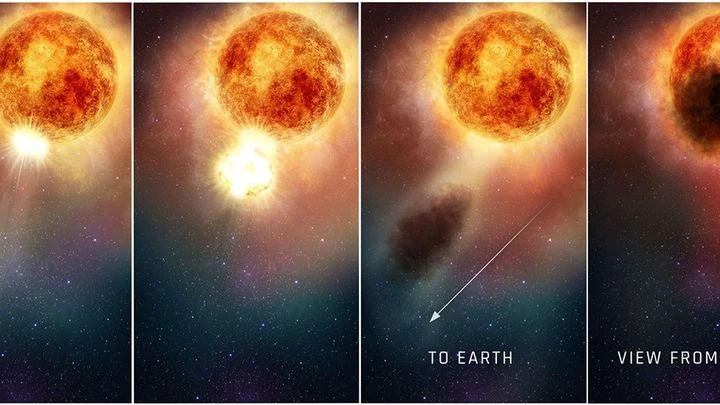
In 2019, Betelgeuse suddenly dimmed, sparking rumors of an imminent explosion. But clouds of cosmic dust turned out to be the culprit. Now, the Gemini North telescope has discerned a minuscule companion star in its dazzling glare, just as calculations had predicted.
Stellar2026-01-071 minarXiv:2601.03539express
Dance of the Invisible Giants: Gaia Finds a 'Desert' of Brown Dwarfs
Sun-like stars rarely spin alone. Many of them dance with invisible partners — brown dwarfs: objects bigger than planets but too lightweight for steady stellar burning. In their cores, hydrogen fusion flickers, only to fade fast, never matching the stability of the Sun.
Stellar2026-01-071 minarXiv:2601.04323express
The Star That Blinks on Schedule
The binary star KL Dra works like a neon clock: every two months it lights up for a few days, and between these outbursts it blinks with short but bright pulses. For eleven straight years, telescopes have kept their eyes on it, and now the whole mechanism is visible.
Stellar2026-01-091 minarXiv:2601.05980express
How Young Stars' Rotation Destroys Their Magnetic Field
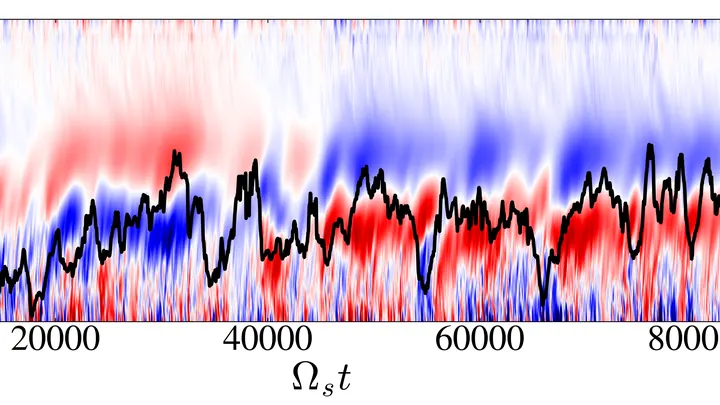
A young star is like a layered spinning top: its outer layers rotate slower, its inner ones faster. The magnetic field here acts like sturdy threads binding these layers together. When the speeds differ, the threads begin to twist and stretch more and more.
General Relativity2026-01-101 minarXiv:2601.06491express
A Star's Dance Puts Gravity's Symmetry to the Test
Star S2 completes an orbit around the black hole at the Milky Way's center every 16 years, reaching speeds of 7650 kilometers per second. Its orbit is a stretched ellipse, and at its closest approach, the star comes within a distance 120 times the Earth-Sun separation.
Stellar2026-01-122 minarXiv:2601.07925express
The Crystal That Catches the Invisible
An ordinary piece of germanium the size of your palm can spot a single dark matter particle flying through it. But for that, the crystal must be nearly perfect: free of electrical noise, with a uniform internal field, and contacts that don't spark at high voltage. In the new work, they assembled the KL01 detector.
High Energy2026-01-142 minarXiv:2601.09226express
The Double Heartbeat of a Stellar Wind
For thirteen straight years, the Swift space observatory recorded the X-ray "breathing" of the pulsar GX 301-2. Every few minutes, the BAT instrument measured how much hard radiation came from this pair — a neutron star and its massive companion.
Exoplanets2026-01-141 minarXiv:2601.09835express
Cosmic Billiards: How Planets Become Wanderers
Space works like a billiard table. Massive outer planets, like heavy balls, transfer their energy to light inner worlds. Such a gravitational kick can fling a small planet out of the stellar system. It turns into a free-floating wanderer — a rogue exoplanet without a star. Detecting these invisible bodies is hard: they neither emit nor reflect light.
High Energy2026-01-161 minarXiv:2601.11784express
X-ray Clock in a Binary Star
In a dark corner of the Milky Way, a natural metronome is at work. Every 8196 seconds, about 2 hours and 16 minutes, X-ray light flares on the surface of a neutron star. The star EP J171159.4-333253 pulls gas from a neighboring star, and this gas, falling inward, accumulates on its surface.
Fluid Dynamics2026-01-172 minarXiv:2601.11946express
The Secret of Transparency: How a Neural Network Learns from Water
Water in a stream bends around rocks, but the math of that motion hides in a black box: that's how ordinary neural networks work. They give an answer but don't say why. Engineers can't trust a prediction if they can't see its reasoning. Fluid dynamics now has a transparent model.
Stellar2026-01-192 minarXiv:2601.12999express
A Star with an Invisible Companion
For 39 years, astronomers have been recording how the star BE Lyn brightens and dims. Its light pulsates with a rhythm of several hours, like a lighthouse that never stops blinking. But there is a glitch in this rhythm: sometimes the flashes came a little early, sometimes a little late. The star was moving closer to Earth and then farther away, as if something were dragging it in a circle.
Materials2026-01-241 minarXiv:2601.17253express
Neural Network Distinguishes Real Crystals from Fantasies
Porous zeolite minerals work like tiny sponges with holes of a strictly defined size. Through such holes, molecules of one kind pass while others get stuck: this is the basis for water purification, gas separation, and catalysis in petrochemistry.
Neural Network Reconstructs Particles from Debris
At the Large Hadron Collider, protons smash into each other like two trucks full of confetti. The debris, dozens of new particles, scatters in all directions. The detector records their tracks, and then the real work begins: piecing together a complete picture of the collision from those tracks. Previously, this was done by a set of rules devised by physicists.
A Map in the Mind: How the Brain Transfers Experience
When moving to a new apartment, a person doesn't relearn how to open doors or turn on lights. Experience from the old home transfers automatically: a kitchen is a place with a stove and a sink, a bedroom is a place with a bed. The brain doesn't store an exact map but a flexible schema that it overlays onto unfamiliar space. Scientists have built a computer model of this transfer. It has two levels.
Stellar2026-01-281 minarXiv:2601.20652express
Two Stars, Different Fates
Two stars circle each other like a pair of figure skaters on ice. Both resemble the Sun, but one shines brighter and has puffed up, while the other remains compact. Astronomers peered into their light using spectrographs, instruments that split light into colors, and found something odd: one star is clearly poorer in heavy elements than the other.
Stellar2026-01-291 minarXiv:2601.21727express
Invisible Stars: How Galaxies Hide Their Secrets
Sometimes you find a movie ticket from three years ago in the pocket of an old jacket. You can't reconstruct the time from it, but you can figure out where the owner went. The same goes for hot subdwarfs — tiny stars in the late stages of life that shine mostly in ultraviolet. Their light is like that ticket: it tells you about the past, but reading it is tricky.
Machine Learning2026-01-312 minarXiv:2602.00670express
Emotions Under the Hood: How a Forest of Random Trees Reads the Brain
Every thought leaves a trace — a faint electrical blip on the scalp. A device with dozens of wires, resembling a swim cap, catches these traces and turns them into wavy lines. From those lines, you can guess what a person feels even if they stay silent. In a new study, three computer programs competed to see which could read such lines most accurately and determine whether the mood was bad, neutral, or good.
cs.SD2026-01-311 minarXiv:2602.00681express
Forest Sounds Turn into Pictures
An ornithologist in the jungle hears a trill, but the bird is hidden in the foliage. It would be great to get its portrait right away — at least from a photo database. Usually, that requires thousands of pairs of “song recording + photo of the same bird,” and collecting them is expensive and time-consuming. The authors took a detour: they used two ready-made models.
Stellar2026-02-031 minarXiv:2602.03650express
The Invisible Partner in the Tarantula Nebula
In the Tarantula Nebula, where thousands of stars are born, one bright blue star is behaving strangely. It moves toward us and then away, as if something is tugging it on an invisible string. That 'something' completes an orbit every 17 days, but telescopes can't see it. Astronomers observed the star 30 times with a spectrograph, which splits light into colors like a prism.
Neural Networks Learn to Read a Fish's Brain
The zebrafish larva is almost transparent, and its brain can be examined under a microscope. But even in such a tiny creature, neural connections are so tangled that sorting them out by hand is nearly impossible. Scientists made a clever move: they built an exact computer replica of the larva, where every connection is known.
Stellar2026-02-041 minarXiv:2602.04661express
Binary Stars That Don't Stick Together
Wide binary stars are like two dancers holding hands but standing at opposite ends of the hall. Their bond is weak, and any passerby can break them apart. Astronomers found 26 such pairs and tested how tightly they hold on. It turned out that 12 pairs dance by Newton's rules: their orbits can be calculated like those of planets around the Sun. But three pairs move too fast.
High Energy2026-02-051 minarXiv:2602.06192express
Invisible Beacons of Galaxies
The night sky is full of beacons, but some shine in a way that makes them nearly invisible. Astronomers have discovered a new class of objects: ultrasoft X-ray sources. They are so "cool" by X-ray standards that their emission falls at the boundary between ultraviolet and soft X-rays, where ordinary telescopes are almost blind.