Gamma rays are the most energetic form of electromagnetic radiation, with wavelengths shorter than about 10 picometers — smaller than an atomic nucleus. They are produced by the hottest and most violent processes in the universe: supernova explosions, neutron star collisions, pulsars, and matter falling into black holes. On Earth, they also arise from radioactive decay and nuclear reactions.
History
Gamma rays were discovered by Paul Villard in 1900 while studying radiation from radium. Ernest Rutherford named them 'gamma rays' in 1903, following the earlier naming of alpha and beta rays.
How it works
Gamma rays are photons with energies above roughly 100 keV. Because of their extreme energy, they interact with matter primarily through pair production and Compton scattering, making them highly penetrating and difficult to focus with conventional lenses or mirrors. They are detected indirectly, often via the flashes of light produced when they strike a scintillator crystal or via the particle showers they trigger in detectors.
In practice
Gamma rays are used in medical imaging (PET scans), cancer radiotherapy, sterilization of medical equipment, and industrial radiography for inspecting welds and metal structures.
Fun fact
Gamma-ray bursts are the most luminous electromagnetic events known, releasing more energy in a few seconds than the Sun will emit in its entire 10-billion-year lifetime.
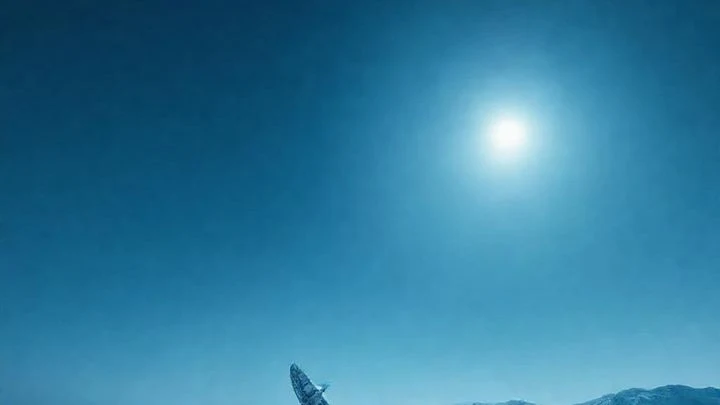
The blue glow in water around a nuclear reactor is light born when a charged particle outruns light in that medium. The effect was discovered by Pavel Cherenkov in 1934, with the theory provided by Igor Tamm and Ilya Frank.
Cosmic rays are particles that race across our Galaxy at enormous speeds. Their energies can be millions of times higher than those of particles in the most powerful accelerator on Earth. But the higher the energy, the fewer such particles there are: the plot of their numbers shows a noticeable kink, which is called the knee.
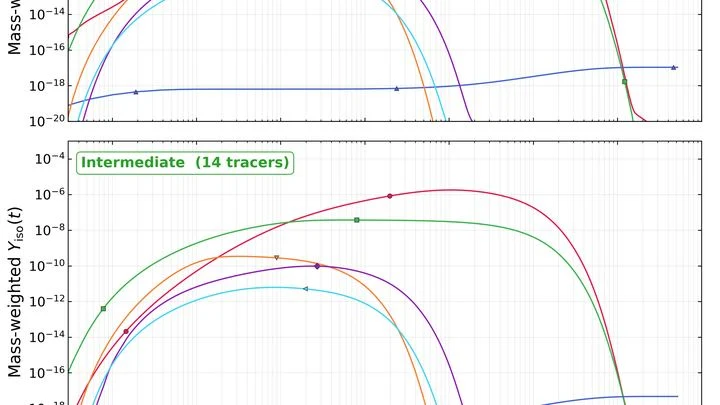
A collision of two neutron stars is a cosmic forge where the heaviest elements of the periodic table are hammered out in seconds. In 2017, detectors picked up gravitational waves from such a merger, and telescopes saw a flash — a kilonova.
Two heavy spheres of dark emptiness hurtle toward each other and collide dead-on. This is not billiards: it's the collision of two equal black holes. The impact sends a tremor through space itself — gravitational waves.
Most of this tremor is a low hum that physicists call bremsstrahlung.
A black hole is a cosmic pocket into which everything, even light, falls. But the pioneering work of John Wheeler, Stephen Hawking, and Roger Penrose showed: sometimes, due to the colossal spacetime curvature, the pocket turns inside out.
The ASKAP radio telescope in Australia has spotted a very faint glowing ring in the southern sky, like a soap bubble the size of several full moons. Inside the ring, exactly at the center, shines a tiny point. Usually, such a picture means one thing: a star exploded here, leaving behind an expanding shell and a collapsed core at its heart.
But this pair has a quirk.
A massive star, 40 times heavier than the Sun, dies in a fraction of a second. Its core compresses like a spring squeezed too hard, then snaps back: that's a supernova explosion. But what if the star is also spinning, like a figure skater pulling in their arms, and threaded with a magnetic field, like invisible strings?
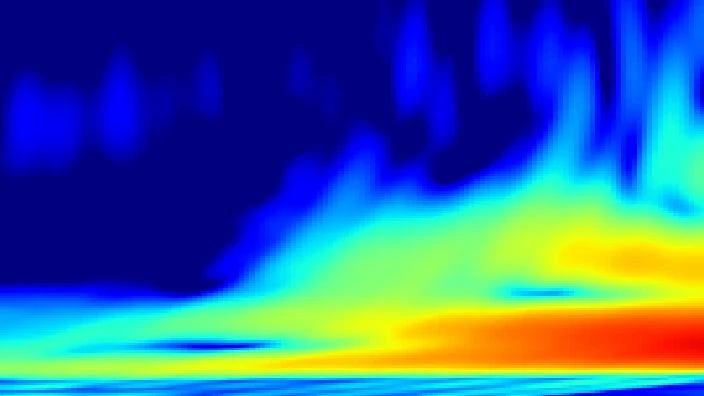
In the stream of charged particles that constantly blows from the Sun, radio bursts sometimes occur — short, powerful signals at frequencies you can pick up on an ordinary radio. Until now, it was unclear how exactly these signals are born in that stream.
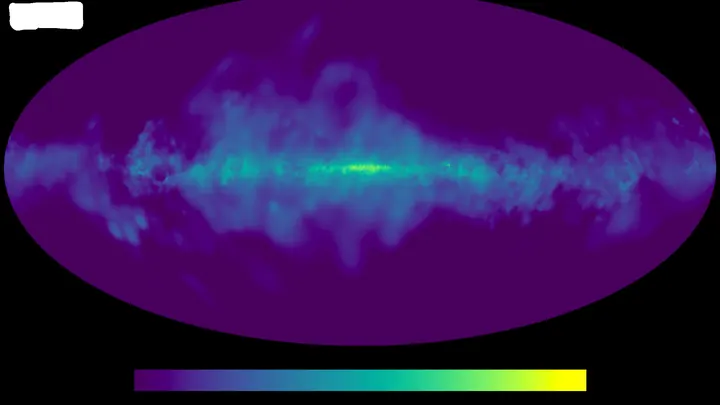
At the center of the Milky Way, a giant stellar cauldron boils. Massive stars are born and die there: each death is a supernova explosion, hurling clouds of charged particles into space.
In 2017, the LIGO and Virgo gravitational detectors caught ripples in spacetime from the merger of two black holes 540 megaparsecs away. The event was named GW170814. But what remained after this cosmic collision? Besides distorted space, tiny black holes, or 'crumbs', might have been born.
In 1181, Chinese and Japanese astronomers recorded the appearance of a 'guest star', a bright object that shone for six months in the constellation Cassiopeia and then vanished. Today, that spot hosts Pa 30: a nebula with a hot central source ejecting material at 16,000 km/s.
At a distance of 8.58 megaparsecs, the spiral galaxy M51 spins its arms, while the VLA radio telescope in its most extended configuration observes it with a resolution of 0.16×0.14 arcseconds. That is like spotting a coin on the surface of the Moon from Earth.