Germanium is a metalloid element with semiconductor properties, historically crucial in electronics before silicon took over. In the provided titles, germanium appears in contexts like stretching atoms for quantum bits and studying quantum spins on impurities, highlighting its role in advanced quantum technologies. Its crystals are also used in detectors for rare events due to their purity and energy resolution.
History
Germanium was predicted by Dmitri Mendeleev in 1871 and isolated by Clemens Winkler in 1886. It became central to early transistors in the 1940s–1950s, later replaced by silicon for most applications.
How it works
Germanium has four valence electrons, forming a diamond cubic crystal structure. As a semiconductor, its conductivity can be tuned by doping or applying electric fields. In quantum applications, its nuclear and electronic spins can be manipulated, and its low atomic number reduces background noise in particle detection.
In practice
Used in high-purity germanium detectors for gamma-ray spectroscopy, in infrared optics, and in experimental quantum computing devices.
Fun fact
Germanium's name derives from the Latin 'Germania' for Germany, where it was first discovered.
Imagine a ladder whose rungs are tiny magnets. If neighboring magnets point in opposite directions, the ladder is "calm." But if you make them all point the same way, the whole structure becomes magnetized and "stubborn."
Scientists built such a ladder from germanium atoms — a semiconductor used to make transistors.
A bridge where pedestrians and cyclists flow together without getting in each other's way. That's roughly how hybrid systems of superconductors and semiconductors work: the former carry current without loss, the latter control that current.
Some crystals behave like a switch: nudge the temperature or pressure, and they turn from a conductor into an insulator. This is called a metal–insulator transition (a change in the ability to conduct electricity).
A quantum computer is like an orchestra where every musician must play their part without missing a beat. The musicians are qubits — carriers of quantum information. For the orchestra to sound harmonious, you need qubits that are reliable, controllable, and not too sensitive to noise.
A quantum computer is like an orchestra where each musician is an electron spin: its tiny magnetic moment. For the orchestra to play in harmony, the conductor must hear each musician individually.
To catch a whisper in a noisy room, you need a highly sensitive microphone that barely makes noise itself. In the physics of rare events, that role is played by detectors made of ultra-pure germanium — a semiconductor crystal that turns a passing particle into a tiny electrical pulse.
When treating epilepsy, doctors adjust the drug dose almost blindly. Too little, and seizures continue; too much, and side effects appear. Usually, a patient's blood is sent to a lab, and the result comes back a day or two later. Now, the same test can be done on a tiny silicon chip.
The sensor works like a highly sensitive nose.
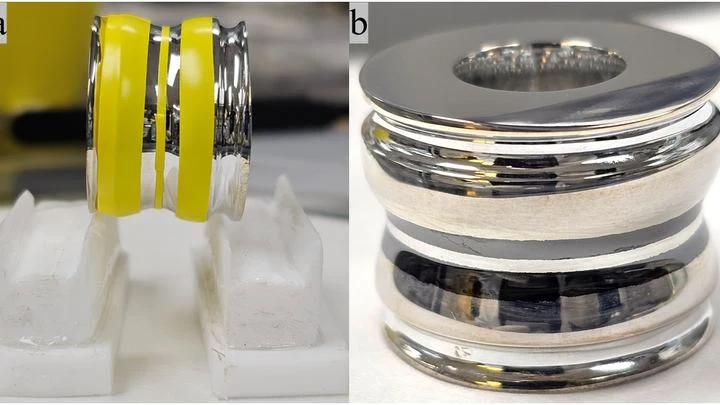
Growing an ultra-pure germanium crystal is a bit like baking a finicky soufflé: a slight overheating or an extra speck of impurity, and the whole ingot is only good for remelting. Such crystals are the heart of detectors that catch the rarest events, from dark matter to double beta decay.