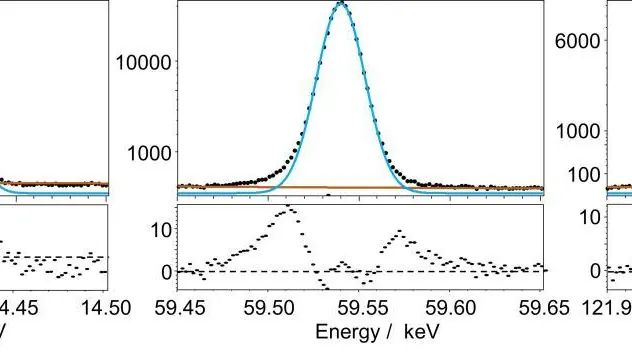
Energyresolution is a measure of a detector's ability to distinguish between particles or photons that have slightly different energies. It is typically expressed as the full width at half maximum (FWHM) of the energy peak divided by the peak energy, often given as a percentage — for example, a resolution of 1% means the detector can separate two peaks that differ by about 1% of their energy. High energy resolution is crucial in nuclear and particle physics, astrophysics, and medical imaging, where identifying the exact energy of a particle can reveal its identity or the process that produced it.
When a particle deposits energy in a detector, it creates a signal (such as a number of electron-hole pairs or photons) that is proportional to the energy. Statistical fluctuations in this signal — due to the random nature of energy deposition and charge collection — set a fundamental limit on resolution. Better detectors minimize these fluctuations by using materials with low Fano factors (like silicon or germanium) and by reducing electronic noise. Advanced techniques, such as cryogenic operation or pulse-shape analysis, can push resolution to parts per million, as seen in some gamma-ray spectrometers.
In practice
It is essential in gamma-ray spectroscopy for identifying radioactive isotopes, in particle physics for distinguishing particle types, and in medical imaging (e.g., PET scans) to improve image quality.
Fun fact
The best energyresolution ever achieved for gamma rays is about 0.0001% (1 part per million), using cryogenic microcalorimeters that measure the tiny temperature rise caused by a single photon.
The quantum many-body world is a jazz ensemble, where each electron improvises, continuously listening to all the others, and the overall wave function is born from this tense dialogue.
A stone falls into water, and ripples spread in all directions. Throw a handful of stones at once, and the ripples overlap: you can no longer tell which ripple came from which stone. A neutron beam hitting a detector looks much the same: a bright spot blurred by many causes.
A chamber the size of a small truck is filled with liquid argon at minus 186 degrees Celsius. When a particle flies in, it knocks electrons off argon atoms, and those electrons drift toward the walls, tracing a three-dimensional picture of the event.
An alpha particle is a helium nucleus that flies out when heavy atoms decay. When it hits a gallium nitride crystal, it deposits its energy and creates an electrical pulse. The pulse height tells you how much energy the particle had.
At the very heart of the Milky Way, something is continuously glowing in gamma rays. This light is special: its energy is exactly 511 thousand electronvolts. Such energy is produced when an electron meets its antimatter counterpart, a positron, and they annihilate, leaving behind a flash of light.
When two particles fly at almost the same speed in the same direction, their signals in the detector merge, like two voices in unison. Telling a duet from a soloist is an art in itself.
Cosmic rays are charged particles that constantly bombard Earth from deep space. When one of these particles enters the atmosphere, it collides with air nuclei and spawns a whole cascade of secondary particles: electrons, muons, photons.
Gamma rays are the most energetic flashes of light born deep within atoms. Their energies are like fingerprints: each radioactive element has its own pattern. But measuring that pattern with high precision is like weighing a grain of sand on a scale sitting on a vibrating truck.
The new setup works like an ultra-sensitive thermometer.
An X-ray photon hits the detector like a pebble dropping into still water. The water is a thin film of aluminum and manganese, cooled to near absolute zero. The impact sends a heat wave rippling across the film, and by measuring its height, you can tell how much energy the photon carried.
The helium atom is like a tiny solar system: electrons orbit the nucleus, but their orbits are governed by strict rules. Scientists have learned to observe these motions with incredible precision.
In a tank of pure water, particles traveling faster than light in that medium leave bluish flashes, like a plane breaking the sound barrier creates a sonic boom. From these flashes, you can tell what kind of visitor passed through: a gamma quantum or a neutron. This is no idle task: at borders and warehouses, you need to quickly distinguish a harmless radioactive cargo from weapon-usable material.
Light hits a silicon wafer, and a single electron is born inside it. An ordinary instrument wouldn't notice — the signal is too faint. The new detector not only hears it but also determines its energy with an accuracy of 589 millielectronvolts. That's like distinguishing the footsteps of an ant at arm's length.
Inside the detector, a particle knocks an electron out of a silicon atom. This takes 0.
Magnetic resonance is like a tuning fork that rings only at its own note. Each molecule has its own frequency, and from that you can tell what the molecule is and what state it's in. But previously, this tuning fork was listened to through a thick wall: the signal was blurred, and you couldn't make out the exact note.
Every second, dozens of particles from space fly through each of us. Most are light protons, but there are also heavier atomic nuclei: carbon, oxygen, iron. They are born in stellar explosions and travel to Earth for millions of years. Their energy can be staggering: a single particle can carry as much as a tennis ball on a serve.