Why Giant Planets Often Have Slightly Stretched Orbits express
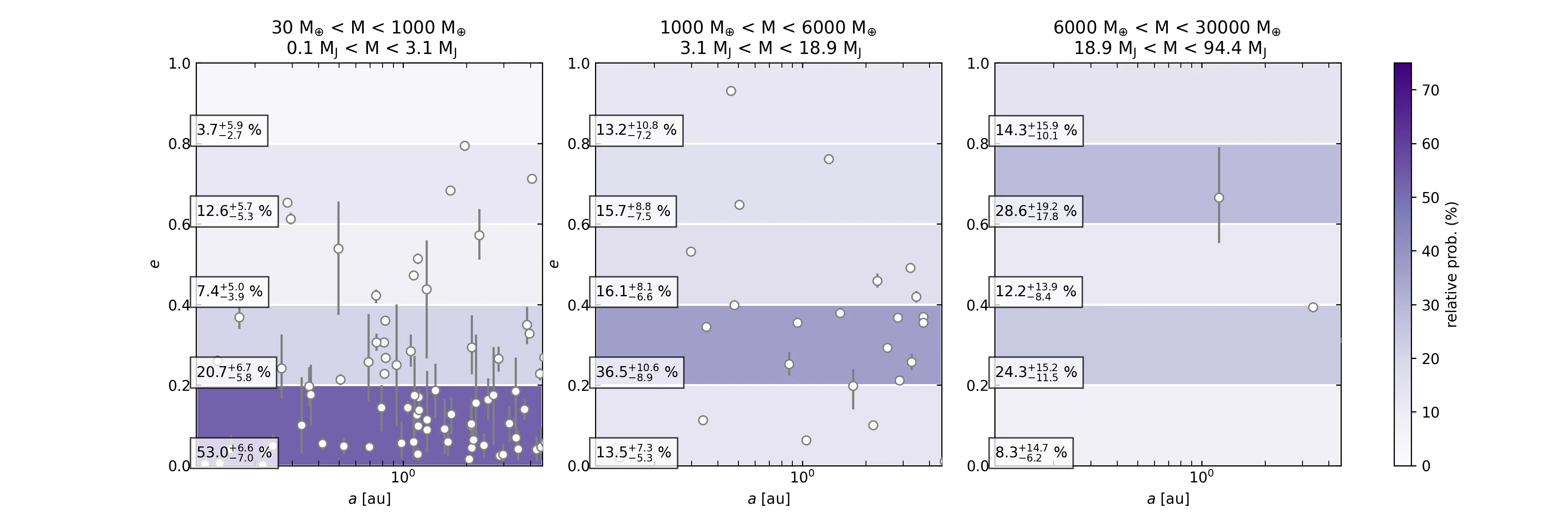
A planet's orbit is its path around its star. If the path is perfectly circular, the planet always stays at the same distance from the star. But many planets have slightly stretched paths, like a running track in a stadium. Astronomers studied hundreds of giant planets around other stars and found a curious pattern.
The most massive planets, those several times heavier than Jupiter, most often move in slightly elongated orbits. Elongation is measured on a scale from 0 to 1: zero means a circle, one means a highly stretched oval. For such heavyweight planets, the elongation is most often around 0.3. It's as if a runner on a track were running not in a circle but in a slightly flattened oval.
Where does this elongation come from? It seems that in their youth, these planets experienced violent events. Possibly, they collided with other large bodies, like when our Moon formed, when a Mars-sized object slammed into the young Earth. Such impacts could have slightly "stretched" the orbits of giant planets.
This discovery helps us understand how planetary systems are born and evolve. If a star has a massive planet on a slightly elongated orbit, it could be a trace of an ancient cosmic accident. So by studying orbits, we read the history of distant worlds.
Earth's orbital elongation is only 0.017—almost a perfect circle. Pluto's is 0.25, which is why Pluto sometimes comes closer to the Sun than Neptune.