Jupiter is the largest planet in our Solar System, a gas giant with a mass more than twice that of all other planets combined. Its sheer size and gravitational influence make it a natural reference point for astronomers studying exoplanets: when a distant world is described as a 'hot Jupiter' or a 'super-Jupiter,' it is being compared to this familiar giant. Jupiter's powerful gravity also shapes the architecture of the Solar System, deflecting comets and asteroids and influencing the orbits of neighboring planets.
History
Known since antiquity, Jupiter was first studied in detail by Galileo Galilei in 1610, when he discovered its four largest moons, providing early evidence for the Copernican model. The Great Red Spot was observed as early as the 17th century, though its continuous observation began in the 19th century.
How it works
Jupiter is composed primarily of hydrogen and helium, with no solid surface. Beneath its visible cloud tops, pressure and temperature rise until hydrogen transitions into a metallic state, where it conducts electricity and generates the planet's immense magnetic field. This field, the strongest of any planet, traps charged particles and produces intense radio emissions. The planet's rapid rotation—a day lasts under ten hours—drives its banded atmosphere and the Great Red Spot, a storm larger than Earth that has persisted for centuries.
In practice
Jupiter serves as a gravitational slingshot for spacecraft heading to the outer Solar System, and its moons are prime targets in the search for habitable environments beyond Earth.
Fun fact
Jupiter's magnetic field is so large that it extends past Saturn's orbit, making it the largest structure in the Solar System after the heliosphere.
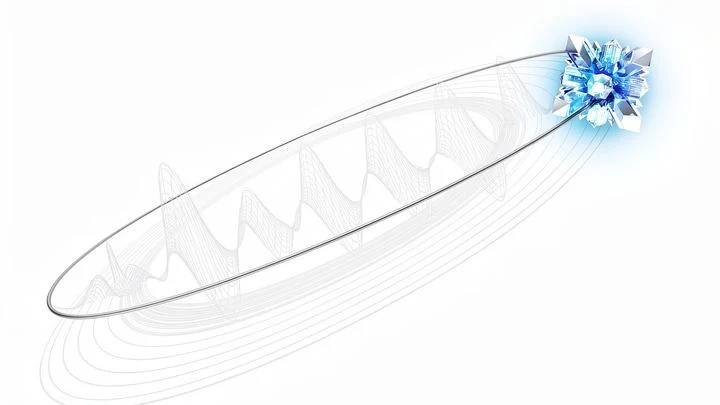
Pulsar PSR J0614-3329 spins 318 times per second. A point on its equator moves at about 10% of the speed of light. From a distance, the star looks like a lighthouse spinning so fast that its beam blurs into a continuous ring.
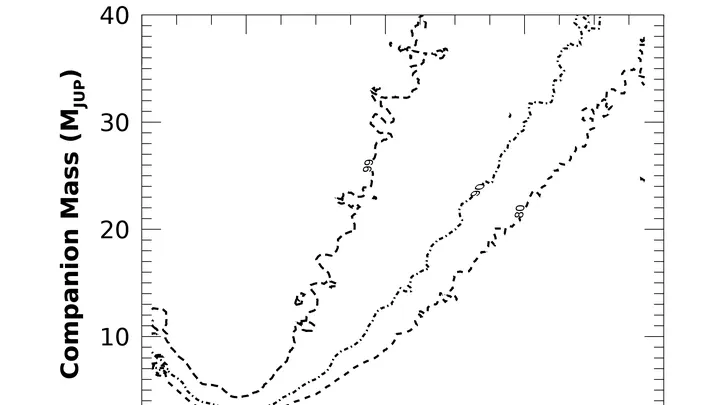
Astronomers catch distant planets by the trembling of their stars: an invisible companion tugs the star toward us and away, and its light subtly shifts in color. But that trembling tells only half the truth. If the planet's orbit is tilted to our line of sight, only part of its weight rocks the star, so telescopes reveal not the true mass but its shadow.
On a sunny street, there's a house with a big family: a giant father who always sits by the window and a small child running around the yard. That's the TOI-4468 system: a gas giant hot Jupiter hugs the star, while a bit farther out circles a sub-Neptune — a planet smaller than Neptune but larger than Earth.
In the first moments after the Big Bang, matter and antimatter should have been created in equal amounts. But today, everything around us is ordinary matter, and antimatter is almost nowhere to be found. Where did it all go? The standard answer: a tiny imbalance in favor of matter wiped out almost all antimatter.
The most massive stars are like overinflated balloons: their envelope stops stretching and instead begins to furiously vent material. At a certain stage, the mass loss becomes so intense that the star stops growing in size. Astronomers see this moment as a kink in the diagram where stars are sorted by luminosity and temperature.
Tabby's Star, a beacon in the cosmic sea, has baffled astronomers since 2015. Its light flickered not in the rhythm of planets, but as if scattered by a storm — deep dips, sharp spikes. But amid this chaos, a smooth, nearly perfect dip was found. The eye of the storm.
Water comes in different varieties. Not just fresh or salty, but also "heavy"—when one of its hydrogen atoms is replaced by deuterium, its heavier cousin. Such water is called HDO, and it's a true cosmic passport: the amount of deuterium in water reveals where and when that water was born.
In August 2019, the LIGO and Virgo detectors picked up gravitational waves from the merger of two compact objects in a binary star. One weighed 23 solar masses — a standard black hole. The other came in at 2.5–2.67 M⊙.
Every 165 days, the giant planet dives toward its star, nearly grazing its fiery corona, then flies off into the icy void. This is TIC 241249530 b — an exoplanet with a record eccentricity of 0,94.
Among the scorching exoplanets that circle perilously close to their stars lies the secret of their birth. Nearly three decades ago, Michel Mayor and Didier Queloz discovered the first such world, and since then astronomers have been tormented by the question: how does a gas giant end up pressed against…
When the JWST telescope breaks the light of a distant exoplanet into a spectrum, it reads a chemical chronicle. But this chronicle is not a monolithic truth; it's an atmosphere constantly rewritten by the star's radiation.
At the center of the Milky Way, shrouded in dust and glare, lurks a supermassive black hole — Sagittarius A*. Around it, like moths around a flame, swarm dozens of guide stars. Two of them, S2 and S38, with eccentric orbits and periods of just a few years, have become the protagonists in testing the fundamental laws of the cosmos.
When a distant planet passes in front of its star, it briefly blocks part of the light. Astronomers call this a transit and judge the planet's size by the depth of the dip. But light has a property: a massive body acts like a lens. Even a giant planet can slightly bend the star's rays, and the dip becomes a bit shallower than you might expect.
Forget the familiar images of planetary cores — a sharp boundary between rock and gas is a thing of the past. The Juno probe, diving into Jupiter’s gravitational field, and Cassini, into the embrace of Saturn, discovered that heavy elements are not gathered at the center but smeared over a vast region, as if someone carelessly shook a cocktail.
The gravitational dances of celestial bodies long remained silent to astronomers. We learned to catch the shadows of planets against stars with the transit method — a breakthrough that delivered thousands of worlds thanks to William Borucki and his Kepler telescope.
When a star dies, it turns into a white dwarf — a dense ball of carbon and oxygen the size of Earth. Predicted by Subrahmanyan Chandrasekhar, these objects were long thought to be lifeless graveyards.
Using James Webb, astronomers 'fished out' a third giant planet from the murky dust disk of the star β Pictoris. Two others were already known, but this one was hiding in the bright light, like a fish in muddy water.
A world where a year lasts just one and a half Earth days, and the star in its sky is hundreds of times larger than our Sun. This is KELT-9 b — a gas giant heated to temperatures at which iron vaporizes. Its atmosphere is not just hot; it is literally boiling away into space, like steam rising from a giant cauldron.
WASP-121 b is not just a hot ball. It's a world where iron vaporizes and the sky glows with its own heat. A fresh look at it has revealed what 'ingredients' went into making it.
The James Webb Space Telescope has for the first time clearly detected vaporized silicon monoxide in its atmosphere — a refractory substance usually locked inside dust grains.
A pot of boiling soup is shaken hard — the liquid sloshes, waves crash against the walls. Something similar happens inside a gas planet when it swings past its star on an elongated orbit. The star's gravity excites powerful internal waves in the planet, known as tidal fundamental modes. These waves can completely change the planet's fate.
Previously, Uranus and Neptune were considered ice giants because of assumed thick layers of frozen water, methane, and ammonia. New calculations paint a different picture: deep inside them hides an ocean of hot magma, which under immense pressure has absorbed a colossal amount of hydrogen.
In the catalogs of exoplanets, there are many worlds with sizes between Earth and Neptune. They are divided into two groups: rocky super-Earths and gaseous mini-Neptunes. The Solar System has none of these, and scientists debate where they come from.
The authors of the study looked into each planet's 'passport'—its orbit.
On the periphery of the Solar System lurk thousands of objects comparable in size to an exoplanet — a body of planetary mass not bound to our star. Their orbits are chaotic, and from time to time the trajectory of such a wanderer crosses Earth's path.
Among the hundreds of moons in the Solar System, Nereid dances the most desperate dance: diving toward Neptune as close as 1.4 million kilometers, then soaring away to 9.7 million — all within less than an Earth year. An eccentricity of 0.75 — the brand of a captured wanderer.
A kindergarten where some kids are busy making sandcastles while others are already assembling building blocks. That's roughly what the V1298 Tau system looks like: it's only 20 million years old — by cosmic standards, it just left the nursery. Several planets orbit it, and two of them, b and e, turned out to be surprisingly different.
At the edge of the solar system, where the Sun is barely brighter than other stars, icy boulders, trans-Neptunian objects, circle around. Their orbits resemble hoops scattered by someone. But look closer: twelve of these hoops are not just floating in the void.
When a planet slips behind the edge of its star, the star backlights the planet's atmosphere, just as a setting sun illuminates clouds on the horizon. This brief moment, lasting only minutes, carries the imprint of the gases through which the starlight has passed.
The first exoplanet was discovered around an unusual cosmic lighthouse — a neutron star known as a pulsar. These ultra-dense remnants of dead stars spin at tremendous speeds and emit precise radio pulses.
Planet WASP-121 b always shows the same face to its star, like a rock in a campfire. The dayside is so hot that ordinary hydrogen, the very stuff most of the universe is made of, can't take it: its molecules tear apart into individual atoms, and the temperature flips upside down: the higher you go, the hotter it gets.
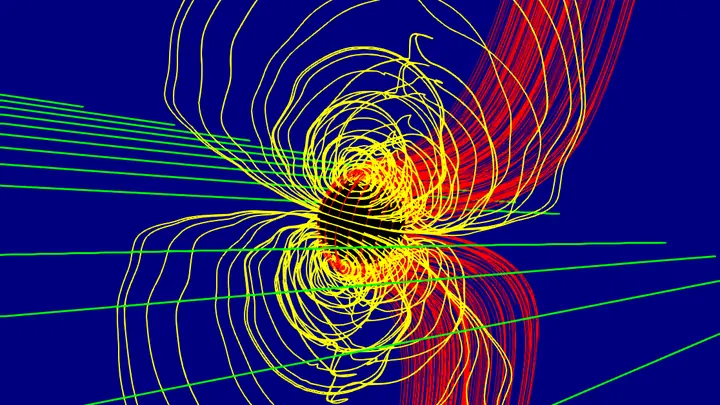
A planet's magnetic field is like an invisible shield: it catches charged particles from the solar wind and stretches out behind the planet into a long tail, like a fluttering scarf.
The carousel spins all the horses in one direction, but one stubbornly gallops against the flow. That's exactly how the planet TOI-1710 b behaves around its star. Using the HARPS-N and GIANO-B instruments, astronomers measured its tilt at 149 degrees. That's nearly a 180-degree flip, meaning the planet orbits "backward" relative to the star's rotation.
At the edge of the solar system, far beyond Neptune's orbit, something is knocking icy chunks off their paths. Their orbits are stretched and tilted in the same way, as if an invisible hand arranged them in a pattern.
A baker adds more sugar to the dough, and the pie turns out different. So it is with a star: the composition of its "dough"—the cloud of gas and dust from which planets are born — determines what worlds will form around it.
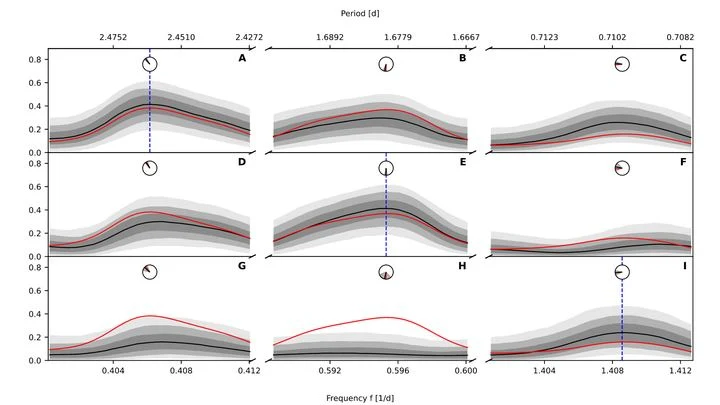
The star GJ 436 is a dim red dwarf, and orbiting it is a Neptune-sized planet on a nearly vertical, tilted orbit. Astronomers spent 18 years taking spectra of this star to track its spots and flares. Suddenly, a rhythm emerged in the data that matched neither the star's rotation nor its 8-year activity cycle. This rhythm exactly followed the planet's orbit.
Every 1151 years, seven planets of the Solar System, from Mercury to Neptune, find themselves at almost the same points in their orbits. Their positions scatter by less than a degree, as if the celestial mechanism is wound to the same tune. This rhythm was discovered by comparing planetary positions over 2600 years using precise tables of celestial motion.
The Kepler telescope spent years watching thousands of stars, spotting planets by the tiny dips in starlight when a planet passes in front of its star. Such a passage, or transit, lets us measure the planet's size but not the shape of its path.
A cosmic neon sign lit up in an incredibly distant galaxy: almost all its light comes from hot gas, and the stars are lost in this glow. The James Webb telescope recorded that the gas, a mix of hydrogen and helium, is so heated that it glows on its own.
Above Jupiter's poles, auroras blaze as electrons are accelerated by electric fields and slam into the upper atmosphere, making the gas glow. But not all electrons head downward. Some, it turns out, get a kick in the opposite direction — away from the planet, into deep space.
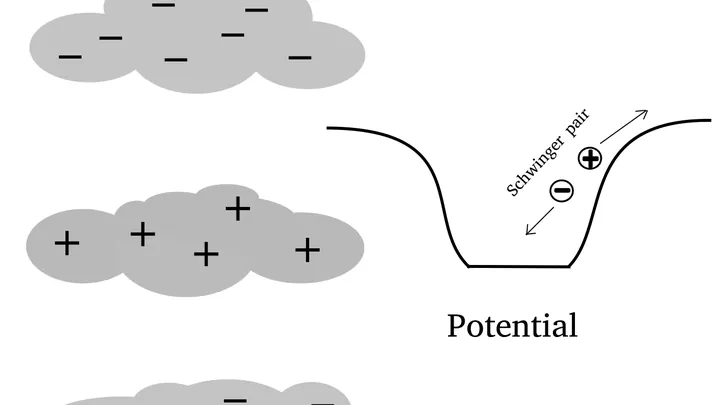
A thundercloud stores electricity like a battery before a flash. It can discharge in two ways: by lightning or by producing particles with a tiny charge: these are called millicharged particles. Such particles are nearly invisible to detectors, but their trace can be caught by how often lightning strikes.
The authors compared thunderstorms on different planets in the Solar System.
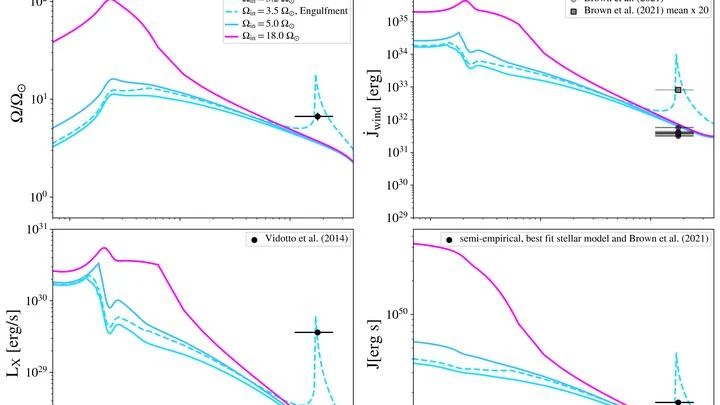
GJ 504, a star almost the same age as our Sun, is spinning with remarkable vigor: it completes a full rotation in just 3.4 Earth days, while actively emitting X-rays. For comparison, typical stars of the Sun's age rotate much more slowly, as if they've lost their youthful energy. GJ 504, however, behaves like a figure skater who has received a powerful push and launched into a rapid spin.