Eccentricity is the fundamental measure of how much an orbit deviates from a perfect circle. In astronomy, it is a dimensionless number between 0 and 1 (or greater for hyperbolic trajectories) that describes the shape of an elliptical orbit. An eccentricity of 0 means a perfectly circular orbit, while values closer to 1 indicate increasingly elongated ellipses. This single parameter encodes a wealth of information about a celestial body's history, its interactions with other objects, and the environment in which it formed.
History
The concept was formalized by Johannes Kepler in the early 17th century, who discovered that planetaryorbits are ellipses with the Sun at one focus. The term 'eccentricity' itself derives from the ancient Greek 'ekkentros', meaning 'out of center', referring to the offset of the ellipse's center from the focus.
How it works
The eccentricity of an orbit is determined by the orbital energy and angular momentum of the object. In a two-body system governed by gravity, the shape of the orbit is fixed by these conserved quantities. A circular orbit has the minimum possible energy for a given angular momentum; any extra energy stretches the orbit into an ellipse. When multiple bodies interact, gravitational perturbations can exchange energy and angular momentum, changing eccentricity over time. For example, a passing star or a massiveplanet can 'kick' a smaller body, increasing its eccentricity, while tidal interactions or dynamical friction can circularize orbits.
In practice
Eccentricity is used to detect exoplanets (a slight orbitalwobble reveals a companion), to predict the timing of transits, and to analyze gravitational wave signals from merging black holes, where the orbital eccentricity leaves a distinct imprint on the waveform.
Fun fact
Mercury has the highest orbital eccentricity of any planet in the Solar System (about 0.206), which was crucial in Einstein's confirmation of general relativity, as it explained the anomalous precession of its perihelion.
Imagine a quiet room where you need to pick out a single melody among many barely audible rustles. That's roughly what it's like to search for signals from extreme systems of two black holes — one huge, the other millions of times smaller.
In May 2020, the LIGO and Virgo detectors picked up a gravitational-wave burst known as GW200105. Among the many similar gravitational waves recorded, this one stood out for an oddity: the orbit of the colliding neutron star and black hole was not a perfect circle, but a stretched ellipse.
At the center of a galaxy, a huge black hole is shrouded in an invisible cloud — a swarm of ultralight particles that it itself spawned. Into this cloud dives another black hole, about the size of a star, and begins a long spiral dance. The approach takes millions of years, but the most dramatic events unfold right at the horizon.
An orchestra of millions of instruments plays a single note, but each enters at its own moment and with its own volume. That's how the stochastic gravitational wave background sounds — a hum from black hole mergers that are individually indistinguishable.
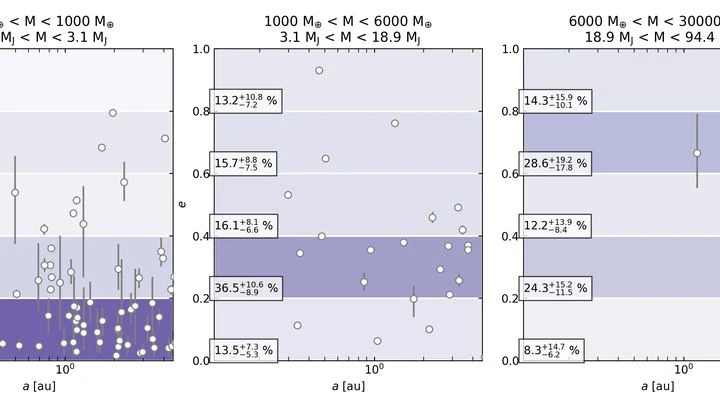
A planet's orbit is its path around its star. If the path is perfectly circular, the planet always stays at the same distance from the star. But many planets have slightly stretched paths, like a running track in a stadium. Astronomers studied hundreds of giant planets around other stars and found a curious pattern.
The trace of a short-lived particle is like a signature left in the detector. The particle is born and decays in an instant, but from its trace you can reconstruct its character — whether it's compact like a stone or fluffy like a snowball. That's exactly what this work is about: the authors propose a new way to read such signatures.
They noticed that each particle has an angle that links its mass and lifetime.