Jupiter mass (often abbreviated as M_Jup or M_J) is a unit of mass equal to the mass of the planet Jupiter, approximately 1.898 × 10^27 kilograms, or about 318 times Earth's mass. It is the standard unit for expressing the masses of giant planets, both in our solar system and around other stars. When astronomers report that an exoplanet is 'half a Jupiter mass' or 'two Jupiter masses,' they are using this unit to convey its scale relative to the largest planet in our solar system.
History
The first reliable measurement of Jupiter's mass was made in the 17th century after Galileo discovered its moons; Isaac Newton later used these observations to refine the value. The unit became standard in exoplanet science after the first detection of a Jupiter-like planet around another star in 1995.
How it works
Jupiter's mass is determined from the orbits of its many moons, particularly the four Galilean satellites, using Kepler's third law. The same method is applied to exoplanets: by measuring the gravitational influence of a planet on its host star (via radial velocity or transit timing variations), astronomers can calculate the planet's minimum mass, often expressed in Jupiter masses. For directly imaged planets, the mass can be estimated from their brightness and age using evolutionary models.
In practice
Jupiter mass is used to classify exoplanets, distinguishing gas giants from rocky super-Earths, and to study planetary formation and migration. It is also a reference for understanding the dynamics of planetary systems.
Fun fact
Jupiter is so massive that its gravitational pull affects the orbits of other planets in the solar system, and it is often described as a 'failed star' because its mass is about 80 times too small to ignite hydrogen fusion.
Systems:SI1 Jupiter mass = 1.898 × 10^27 kg (accepted as non-SI unit)
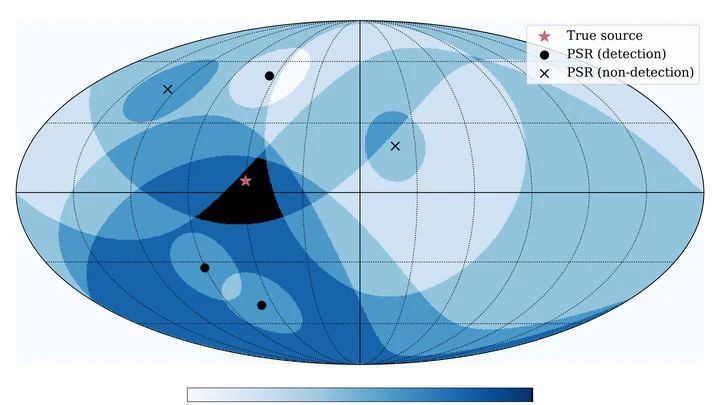
Pulsar PSR J0614-3329 spins 318 times per second. A point on its equator moves at about 10% of the speed of light. From a distance, the star looks like a lighthouse spinning so fast that its beam blurs into a continuous ring.
Astronomers catch distant planets by the trembling of their stars: an invisible companion tugs the star toward us and away, and its light subtly shifts in color. But that trembling tells only half the truth. If the planet's orbit is tilted to our line of sight, only part of its weight rocks the star, so telescopes reveal not the true mass but its shadow.
Two stars circle each other, gradually drawing closer. Their dance loses energy, and that energy escapes into space — in the form of gravitational waves, and sometimes other fields.
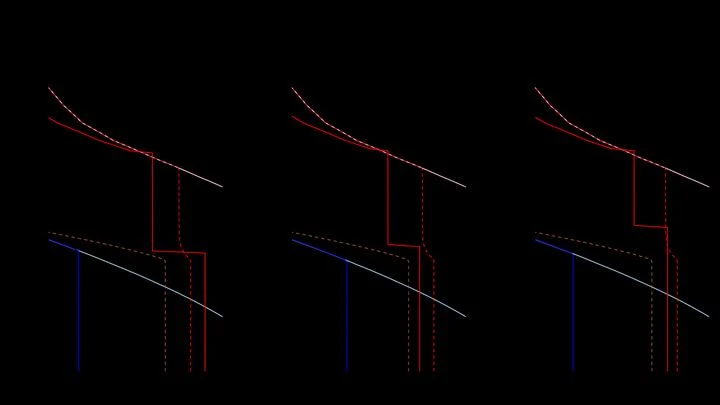
Jupiter's atmosphere resembles a layered cake, where each layer plays its role. Scientists took data from four instruments at once (VLT/MUSE, Cassini/VIMS, IRTF/SpeX, and Juno/JIRAM) and built a model of clouds and ammonia in the planet's equatorial zone, from 0.1 to 10 bar (pressure equivalent to hundreds of kilometers below Earth's…
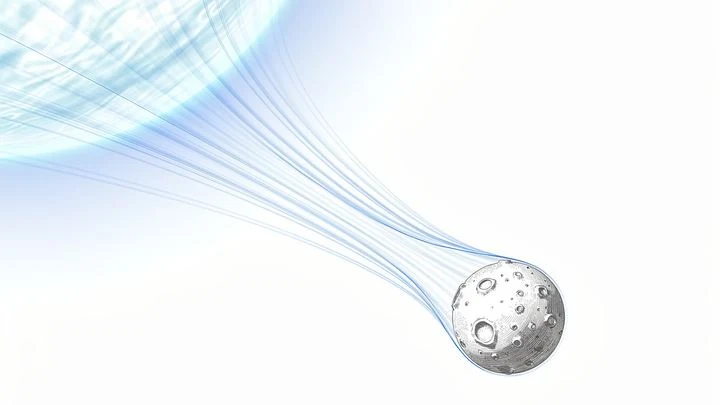
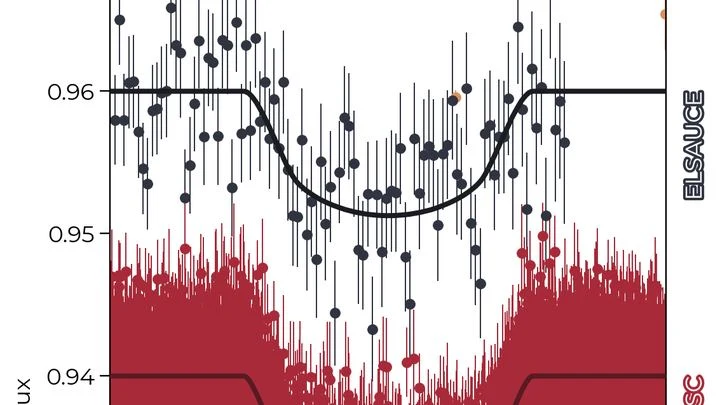
When a distant planet passes in front of its star, it briefly blocks part of the light. Astronomers call this a transit and judge the planet's size by the depth of the dip. But light has a property: a massive body acts like a lens. Even a giant planet can slightly bend the star's rays, and the dip becomes a bit shallower than you might expect.
A quarter-century ago, Michel Mayor and Didier Queloz discovered the first hot Jupiter, and shattered all the rules of planet formation. A gas giant on a days-long orbit couldn't have formed next to the star: it's far too hot and lacks building material. So, it must have been born far away and then migrated.
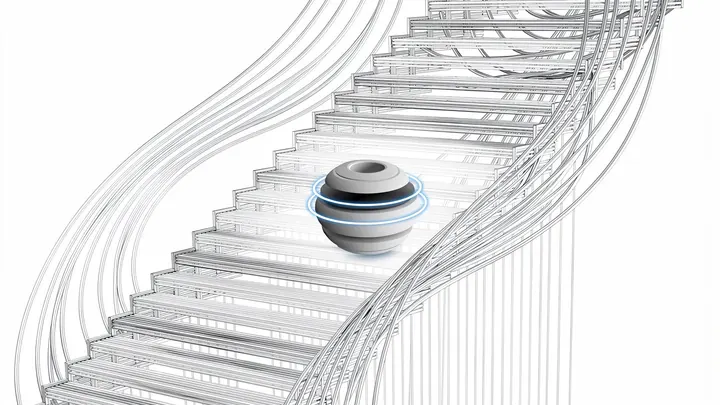
Forget the familiar images of planetary cores — a sharp boundary between rock and gas is a thing of the past. The Juno probe, diving into Jupiter’s gravitational field, and Cassini, into the embrace of Saturn, discovered that heavy elements are not gathered at the center but smeared over a vast region, as if someone carelessly shook a cocktail.
The gravitational dances of celestial bodies long remained silent to astronomers. We learned to catch the shadows of planets against stars with the transit method — a breakthrough that delivered thousands of worlds thanks to William Borucki and his Kepler telescope.
A ball, almost weightless for its size, circles its star every four days. Planet TOI-2195 A b is a real riddle: by mass it's slightly heavier than Neptune, yet bloated to Jovian volumes. If there were an ocean big enough, this exoplanet would float on its surface like a giant inflatable ball.
Using James Webb, astronomers 'fished out' a third giant planet from the murky dust disk of the star β Pictoris. Two others were already known, but this one was hiding in the bright light, like a fish in muddy water.
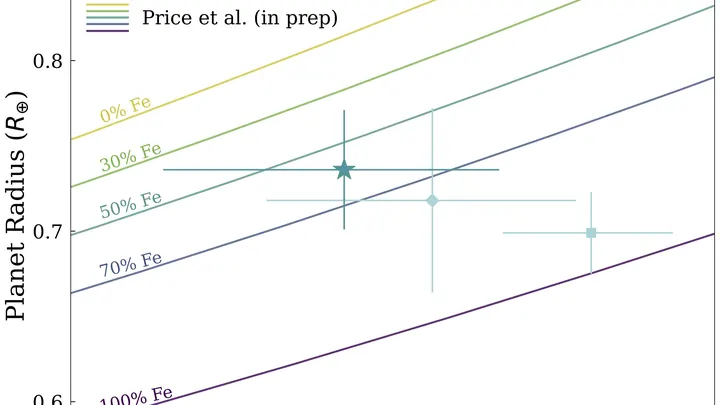
A cosmic sprinter on a short track: that's how you might describe planet GJ 367 b. It whips around its star in just 7.7 hours. This world is slightly smaller than Earth but has a personality: it was once thought to be nearly a solid ball of iron.
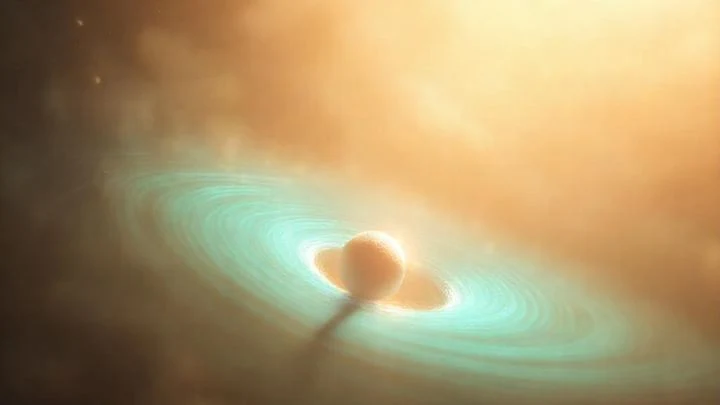
A giant baby planet is still pulling in leftover building material from its surrounding cloud. That's the scene the Hubble Space Telescope captured when it aimed its cameras at an object catalogued as SR 12 c. This companion planet orbits a young star at a wide distance — farther out than Neptune is from the Sun.
Red dwarfs are tireless blacksmiths of planetary fate. Their radiation, like a hammer, beats off gas envelopes, leaving only naked rocky cores.
In the depths of the constellation Hercules, around the dim M-dwarf GJ 3929, orbits a world one-and-a-half times Earth's size, like a billet on an anvil.
Eight hundred million years ago, in the main asteroid belt, a giant inkwell shattered. The parent body, over a hundred kilometers in diameter, made of primitive carbonaceous chondrites, suddenly broke apart near the J3:1 resonance with Jupiter.
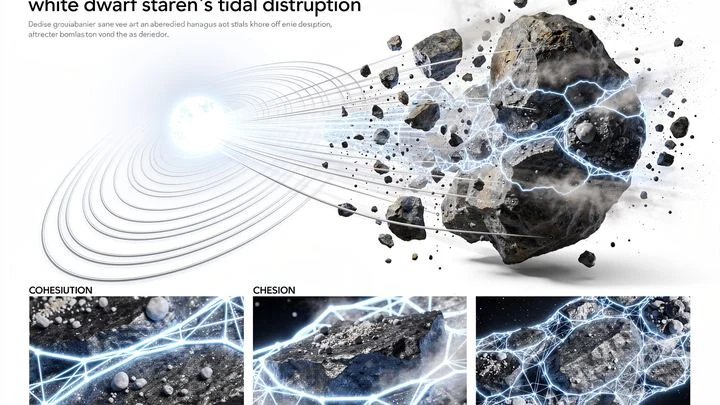
When a telescope catches the light of a distant white dwarf, the spectrograph sometimes fishes out heavy elements — calcium, iron, magnesium. These metals could not have stayed in the thin atmosphere of the stellar remnant; they are the traces of recently fallen planetary debris.
At the edge of the solar system, where the Sun is barely brighter than other stars, icy boulders, trans-Neptunian objects, circle around. Their orbits resemble hoops scattered by someone. But look closer: twelve of these hoops are not just floating in the void.
The cosmic accounting has hit a snag. The bookkeeper is balancing the books: in one column, all the planets astronomers have counted in the galaxy; in the other, the stockpile of building material in the dusty cocoons of newborn stars. The numbers don't line up. Even if you gathered every last grain of dust and molded it into planets, there wouldn't be enough material.
Light from a distant star seeps through a planet's gaseous envelope, and astronomers try to guess what that envelope is made of. That's how we study the atmospheres of worlds we can never touch. When a planet passes in front of its sun's disk, its gaseous veil briefly intercepts some of the rays.
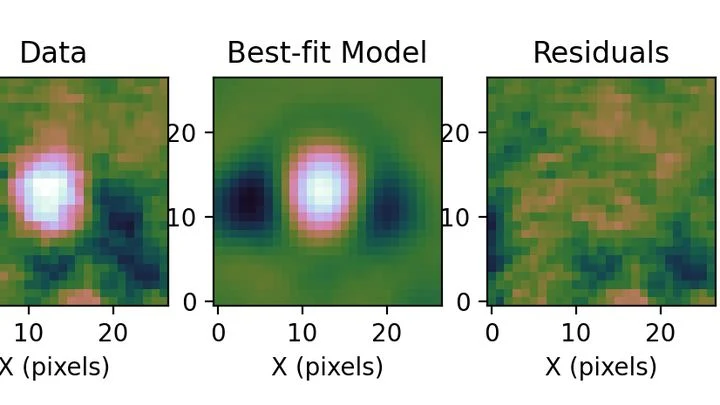
Astronomers pointed JWST at a planet near the star Epsilon Indi — a giant gas ball resembling Jupiter, just 12 light-years away. In thermal images, the planet shone like a lantern. But nearby they noticed a faint dot — like a firefly. Calculations showed that two objects describe the picture better than one. However, it's most likely a lens flare — like a ghost of a lamp.
When two supermassive black holes circle each other before merging, they shake spacetime itself, like a speedboat racing across a lake leaves waves in its wake. These waves are called gravitational waves. They travel through the Universe and pass through everything, even the Earth.
Every 1151 years, seven planets of the Solar System, from Mercury to Neptune, find themselves at almost the same points in their orbits. Their positions scatter by less than a degree, as if the celestial mechanism is wound to the same tune. This rhythm was discovered by comparing planetary positions over 2600 years using precise tables of celestial motion.
Above Jupiter's poles, auroras blaze as electrons are accelerated by electric fields and slam into the upper atmosphere, making the gas glow. But not all electrons head downward. Some, it turns out, get a kick in the opposite direction — away from the planet, into deep space.
Around the star Epsilon Indi, visible to the naked eye from the Southern Hemisphere, orbits a planet the size of Jupiter. The temperature there is like a good freezer: minus 200 degrees Celsius. The James Webb Space Telescope has for the first time directly imaged it and measured the light the planet emits in the thermal range.
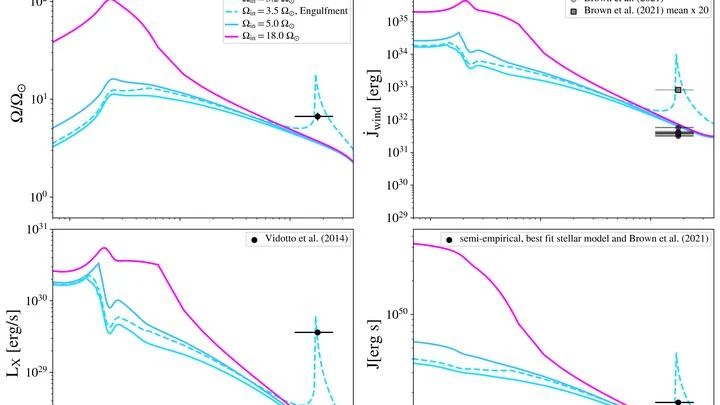
GJ 504, a star almost the same age as our Sun, is spinning with remarkable vigor: it completes a full rotation in just 3.4 Earth days, while actively emitting X-rays. For comparison, typical stars of the Sun's age rotate much more slowly, as if they've lost their youthful energy. GJ 504, however, behaves like a figure skater who has received a powerful push and launched into a rapid spin.
NASA's TESS space telescope monitors thousands of stars, catching the moment when a planet crosses its star's disk — the star's light dims slightly. That's how astronomers spotted two planets orbiting stars similar to our Sun. One, TOI-883 b, completes an orbit in ten days; the other, TOI-899 b, takes nearly thirteen.
Planet HIP 67522 b is quite young: it's only 17 million years old, compared to Earth's 4.5 billion. It's a hot Jupiter — a gas giant that orbits very close to its star, so its atmosphere is heated and puffed up.
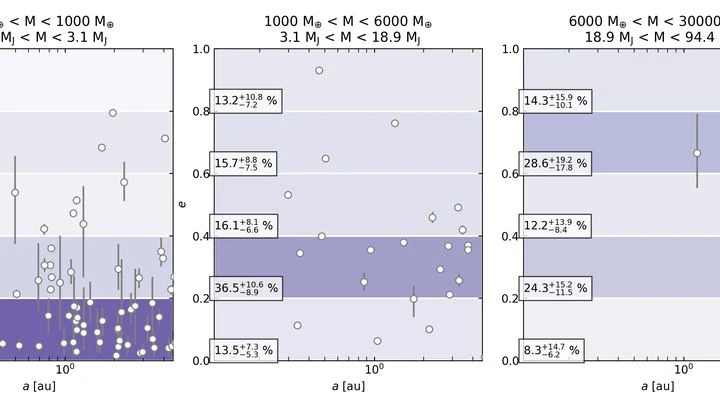
A planet's orbit is its path around its star. If the path is perfectly circular, the planet always stays at the same distance from the star. But many planets have slightly stretched paths, like a running track in a stadium. Astronomers studied hundreds of giant planets around other stars and found a curious pattern.
Jupiter is a colossal ball of gas that sits five times farther from the Sun than Earth. Now imagine a similar ball, but around another star, at a distance tens of times greater. These are called cold Jupiters, and they remain a puzzle: how did they get there?
Astronomers studied four such planets around distant stars.
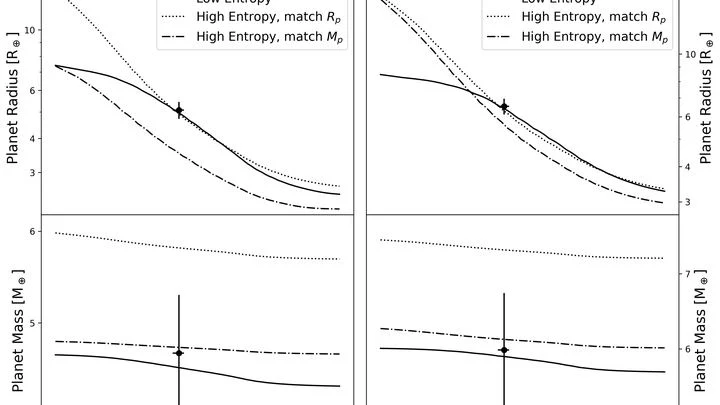
350 light-years away, four planets orbit the star V1298 Tau. They are 5–10 times larger than Earth but lighter than they appear. For nine years, astronomers tracked their motion to understand what they are made of and how they lived in the past.
The planets are lined up in a chain: their orbital periods are nearly in 3:2, 2:1, and 3:1 ratios.
Astronomers have discovered a close pair of stars whose orbital dance is speeding up year after year. These are white dwarfs — superdense, cooled remnants of stars, roughly the size of Earth, where matter is compressed to a degenerate state.
Using the Keck telescope and spectroscopy (light analysis that reveals rotation speed), astronomers measured 32 objects: from giant planets to brown dwarfs — bodies heavier than planets but lighter than stars that never ignited.
A star 300 light-years away dances with an invisible partner. One side of the star heats up more than the other, as if the unseen dancer is breathing a hot wind onto it. This partner is a neutron star — a city-sized cinder so dense a teaspoon of its matter outweighs Mount Everest.
In the darkness of interstellar space drift millions of rogue planets — worlds not bound to any star. They are almost impossible to see, but when such a wanderer passes in front of a distant star, its gravity bends the light and momentarily creates a cosmic magnifying glass.
In a dance with an ordinary star, astronomers have found a true heavyweight — a neutron star with 2.35 times the mass of the Sun. That's more than any other whose mass has been precisely measured. These objects are born when a star explodes as a supernova and its core collapses into a city-sized sphere.
The Moon can have its own tiny moon — like a nesting doll, but in space. The outer doll is a planet, the middle one is a moon, the inner one is a small moon-satellite, or submoon. Ньютон showed that all bodies attract each other, and gravity holds them together.
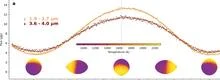
A wind blowing against the planet's rotation stokes a carbon forge. That is what the atmosphere of PSR J2322-2650b looks like: a Jupiter-like companion to a millisecond pulsar.
The three planets in the Kepler-51 system have long intrigued astronomers: they are Saturn-sized but less dense than water. These 'super-puff' worlds, with masses no more than ten Earths, are like cosmic dandelions — massive yet almost weightless. Their orbits are arranged like musicians in an orchestra, each playing its part, beating the rhythm with transits.