An orbit is the curved path an object takes around a star, planet, or other massive body, governed by the pull of gravity. In essence, it is a perpetual falling: the object is constantly drawn toward the central body, but its sideways motion keeps it from ever hitting it. Orbits are not just circles — they can be ellipses, and in complex gravitational environments, they can wobble, tilt, or even reverse direction relative to the host star's spin.
History
Johannes Kepler first described planetaryorbits as ellipses in the early 1600s, based on Tycho Brahe's precise observations. Isaac Newton later explained why they take that shape, showing that gravity alone could produce such paths.
How it works
The shape and orientation of an orbit are set by the balance between the object's velocity and the gravitational pull of the central mass. If the object moves fast enough, it escapes; if too slow, it spirals inward. In multi-body systems, like planetary systems with several planets, gravitational interactions can slowly alter orbits over time, causing shifts in tilt, eccentricity, or even flipping them entirely.
Some planetsorbit their stars in the opposite direction of the star's rotation, a phenomenon called a retrograde orbit, which likely results from a violent gravitational encounter early in the system's history.
A thrown stone arcs through the air, but a planet around the Sun follows a closed curve. Why an ellipse, and not a circle or a spiral? Kepler's first law provides the answer, but its usual proof requires heavy computation. This work offers a shorter path — through a single simple ratio of velocities.
A thrown stone arcs through the air and falls. A planet orbiting a star is the same stone, but it falls forever, looping around the star in a closed curve. In Newton's world, that curve is a perfect ellipse, and the planet returns to the same point each orbit. In reality, the orbit slowly rotates: its closest point to the star, the perihelion, shifts.
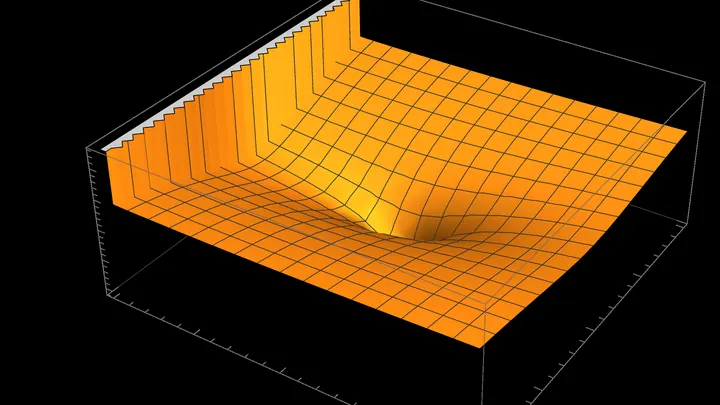
The spiral of water draining into a sink spins faster and faster toward the center. In an ordinary black hole, that funnel ends in an infinitely sharp point — a singularity where the laws of physics break down. But this new work considers a different picture: the funnel doesn't taper to a needle but ends in a smooth, swelling bubble.
For decades astrophysicists painted a neat picture: a galaxy, like a giant carousel, spins in a unified rhythm, and the supermassive black hole at its center inherits that dance.
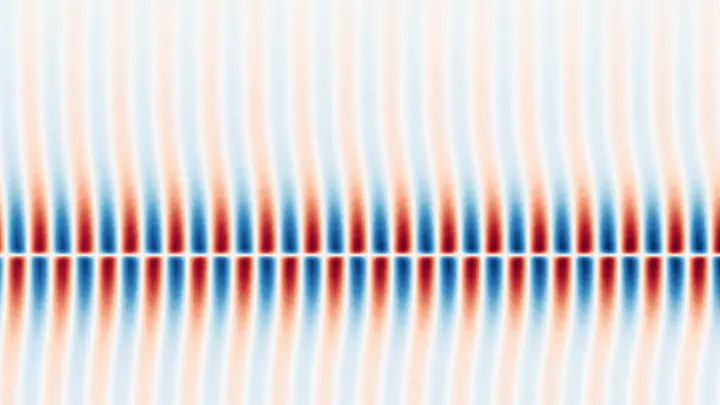
A lone fold runs across a taut sheet — a sharp drop in height that doesn't spread out but moves as a whole. Physicists call such a fold a 'kink'. If you give the sheet a sharp tug in one spot, ripples will travel across it. But in some media, these ripples don't disperse; instead, they gather into a clump and tremble in place for dozens or hundreds of cycles. Such a clump is an oscillon.
Gravitational waves from a tiny body falling into a black hole work like an X-ray image. Only instead of a bone, they illuminate the curved spacetime itself.
A quantum particle traveling around a closed ring leaves two distinct 'records' along its path. The first is like a fingerprint on a doorknob: it remains unchanged no matter how many times you turn the knob, and it only tells you about the shape and material.
Deep inside Earth lies a solid iron core about the size of the Moon. It floats in liquid metal and sways slightly, like a pit in a peach when you shake the fruit. Such oscillations are called Slichter modes: the core shifts both along the planet's axis and perpendicular to it.
Three forces act together to damp this motion.
A plastic heart rests on the water and doesn't tip over, no matter how you turn it. It freezes in any position, as if the water were holding it by invisible strings. This trick is possible thanks to the Zindler curve — a shape in which all lines that divide the area in half have the same length. The Zindler curve is a closed curve where any chord that bisects the area has the same length.
Vortons are invisible cosmic hoops, closed loops of curved spacetime. Thinner than an atom but heavier than stars, these Big Bang relics spin like giant carousels, churning everything around them. Einstein's equations describe how particles dance near such a hoop: paths twist into spirals or dart chaotically.
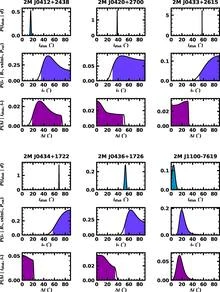
A spinning top tilted over a table, with a dusty pancake swirling around it. That is what a young stellar system looks like when the star's spin axis and the plane of its protoplanetary disk do not align. Until recently, astronomers did not know how common such a configuration is in nature.
A century ago, quantum mechanics gave the world a neat picture: a particle rotating around a point can only have certain discrete amounts of angular momentum, integer multiples of Planck's constant. This rule seemed as solid as the law of gravity, and it followed from simple algebraic arguments.