How a Neural Network Speeded Up Molecular Collision Calculations express
Atoms in a gas behave like billiard balls: they fly, collide, and scatter in different directions. But instead of solid balls, they have a soft "coat" of attractive and repulsive forces. At close range, atoms repel sharply; at longer range, they attract slightly. Scientists need to calculate these collisions precisely to model gas flows around airplanes or inside microchips.
Previously, each collision required solving a complex equation, and the computer spent a lot of time on it. Now, researchers trained a neural network on millions of precomputed collisions. The network learned to instantly predict the angle at which atoms will scatter — with an error of less than one-tenth of a degree. Thanks to this, the entire gas calculation sped up by a third.
This approach is especially important for modeling cold and rarefied gases, where attractive forces between atoms noticeably alter the flow pattern. For example, in new calculations, the wake behind a cylinder in a supersonic flow turned out to be wider than in older simplified models. This means that previous simulations may have underestimated the effects of rarefaction and low temperatures.
Now engineers can more quickly test how a gas will behave under unusual conditions — from high-altitude flights to cooled microchannels. And the neural network, trained on collision physics, continues to get faster with each new processor.
Original abstract
as written by the authors arXiv:2602.13601
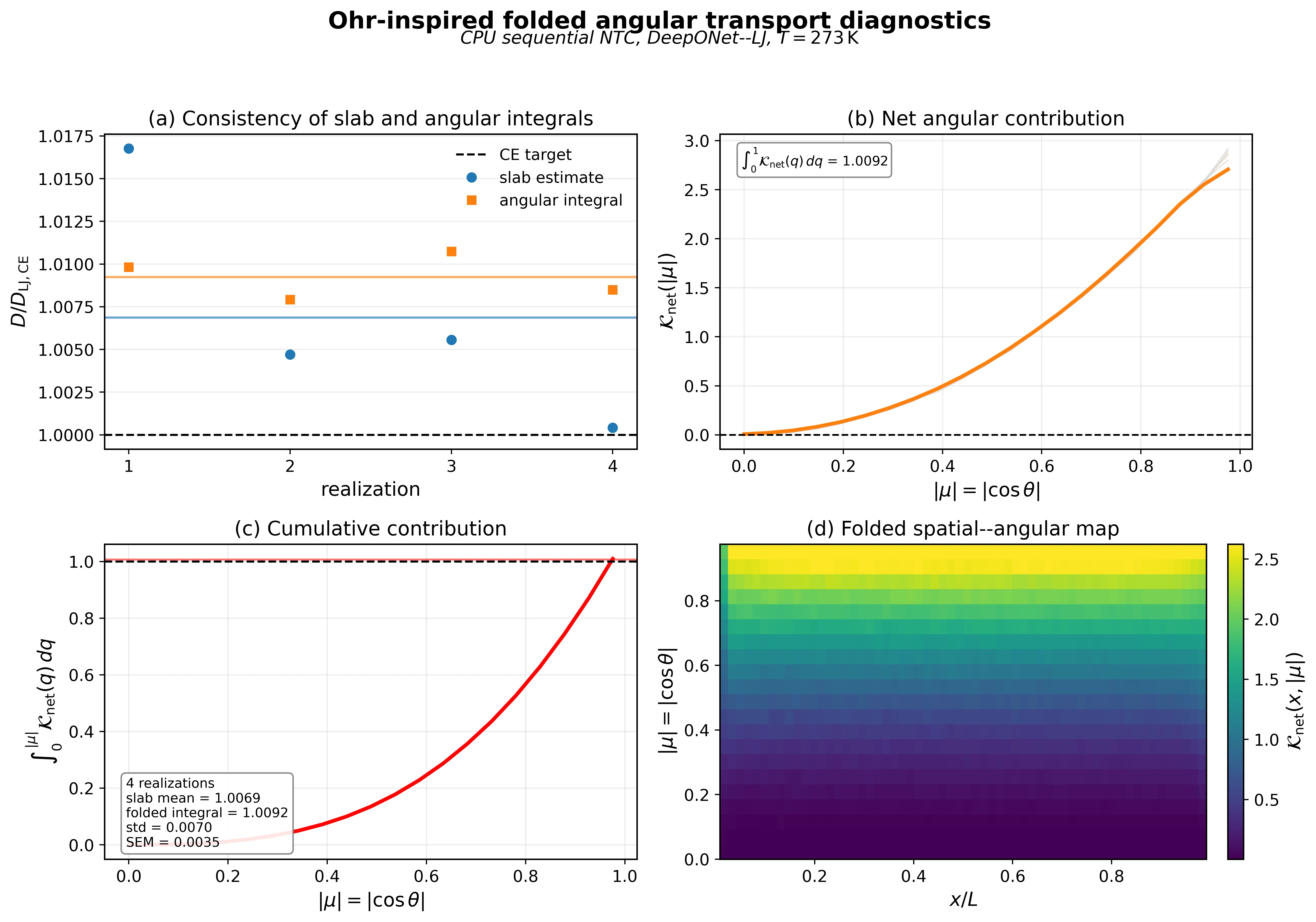
Integrating the physically realistic Lennard--Jones (LJ) potential into Direct Simulation Monte Carlo (DSMC) remains challenging because the long-range potential complicates collision-rate definition and makes repeated scattering-angle evaluation expensive. This study develops an LJ--DSMC framework built around two methodological advances and a transport-level validation of the resulting collision kernel. First, a generalized collision-selection treatment is formulated for Bird's DSMC algorithms (DSMC1, DSMC1S, and DS2V) through a Variable Effective Diameter (VED) model obtained from local Chapman--Enskog viscosity matching. This viscosity-consistent pair-selection model provides a finite DSMC collision-rate closure for the LJ potential and is validated in helium and argon normal shocks, cryogenic supersonic Couette flow, and hypersonic cylinder flows. The results show agreement with VHS in high-temperature repulsive regimes, but reveal clear LJ effects, including reduced shear stress and larger cryogenic wakes, when attractive forces become important. Second, the computational bottleneck of the accepted LJ binary-scattering step is removed by training a Deep Operator Network (DeepONet) to predict the LJ deflection angle from high-fidelity scattering data, replacing the numerical Matsumoto--Koura integral while preserving the standard elastic post-collision update. The surrogate gives a bulk mean wrapped-angle error of \(1.6\times10^{-3}\,\mathrm{rad}\) and a 99th-percentile error of \(9.9\times10^{-3}\,\mathrm{rad}\), accelerates the collision subroutine by 40\%, and reduces total wall time by 36\%. Finally, the same DeepONet--LJ scattering kernel is tested beyond viscosity-controlled flows through diffusion benchmarks.
The neural network predicts the atomic deflection angle with an error of just 0.0016 radians — about one-tenth of a degree, as if a billiard ball deviated by the thickness of a hair at arm's length.