A rarefied gas is a gas with such low density that the average distance between molecules is large compared to the typical scale of the system, making molecular collisions rare. In this regime, the continuum assumption of fluid dynamics—which treats the gas as a smooth, continuous medium—breaks down. Instead, the gas behaves as a collection of individual particles, and phenomena like slip flow, thermal transpiration, and non-equilibrium velocity distributions become important.
How it works
The key parameter is the Knudsen number, the ratio of the molecular mean free path to a characteristic length scale. When this number is high, molecules travel ballistically between surfaces, and their interactions are dominated by collisions with boundaries rather than with each other. This requires kinetic theory or direct simulation Monte Carlo methods to model accurately, rather than the Navier-Stokes equations.
In practice
Rarefied gas dynamics is essential for designing vacuum systems, micro-electromechanical devices (MEMS), high-altitude aircraft and spacecraft re-entry, and for understanding planetary atmospheres at high altitudes.
Fun fact
In a rarefied gas, temperature can be different in different directions, a concept known as 'thermal non-equilibrium,' which is impossible in a dense gas.
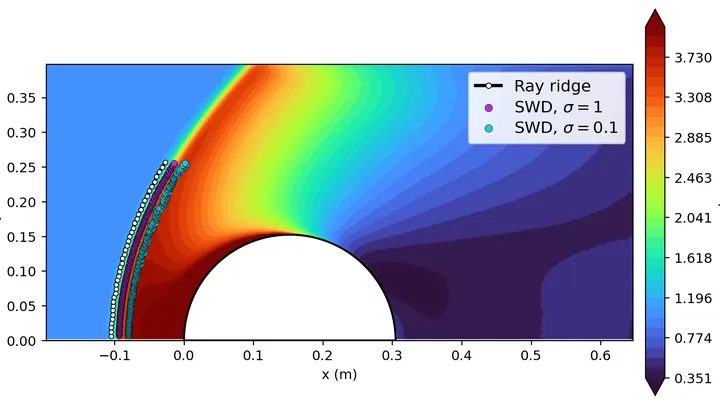
A cylinder slams into the air at enormous speed, and a shock wave is born around it — a sharp boundary where the air is instantly compressed and heated. Ernst Mach was the first to photograph these jumps, and since then we've thought of them as thin, almost invisible walls.
A pot of water has just been stirred: the whirlpools and eddies gradually calm down, and the liquid becomes smooth. A similar process, but in the quantum world, occurs in superfluid helium or in a cloud of ultracold atoms.
A distant city seen through a fogged-up window: bright lights blur, details are lost. That's roughly how astronomers see gas with magnesium ions (magnesium) in our galaxy — the strongest spectral lines "peg the needle," preventing us from knowing how much material is really there.
A ship gliding through water constantly rubs against it, like a palm against a rough surface. This friction eats fuel and slows progress. One way to reduce it is to blow air under the hull: water stops sticking to the hull, and drag drops. But air is finicky: sometimes it helps, sometimes it hurts.
Toss a handful of peas into a pot of semolina porridge — the peas quickly sink, pushing the grains aside. But if you make the porridge very thick and sticky, the peas get stuck. That's roughly how light lithium atoms behaved in a cloud of heavy potassium atoms at temperatures just a few millionths of a degree above absolute zero.