Computational fluid dynamics solves the conservation equations of mass, momentum, and energy on a discrete grid that describes the flow domain. These differential equations — Navier–Stokes — are notoriously nonlinear and turbulent. CFD methods (finite volume, finite element, spectral) approximate derivatives and advance the solution through iterations. Turbulence models (RANS, LES, DNS) handle the chaotic small scales. The result is a detailed map of velocities, pressures, and temperatures, allowing engineers to test designs virtually and scientists to study galaxy formation and blood flow.
History
Ideas date back to the early 20th century and Lewis Fry Richardson's dream of a 'weather prediction factory' with human computers. True CFD emerged in the 1960s with the work of Francis Harlow at Los Alamos (particle-in-cell method) and panel methods in aerodynamics. In the 1980s, commercial codes FLUENT and CFX appeared, and in the 1990s, unstructured meshes and massive parallelization. Today, CFD is a pillar of engineering design and environmental sciences.
How it works
The Navier–Stokes equations for incompressible fluid: ∇·v = 0 and ρ(∂v/∂t + v·∇v) = -∇p + μ∇²v + f. They are discretized on a grid. In the finite volume method, fluxes through cell faces are computed for each cell using Gauss's theorem. Convective terms are treated with limiters to prevent spurious oscillations. The pressure–velocity coupling is resolved by algorithms like SIMPLE. The resulting large sparse linear systems are solved iteratively (multigrid, Krylov subspace methods). Boundary conditions specify inlets, walls, and far field. Postprocessing extracts forces, moments, and particle trajectories.
In practice
It optimizes aircraft wings, forecasts weather and ocean currents, helps design quiet fans and heart valves — all without expensive prototypes.
Fun fact
The first CFD calculation of an entire aircraft (F-16) was performed in 1983 on a Cray supercomputer with 8 million grid nodes. Today, toy CFD apps run on a smartphone.
In a rubber band stretched in the lab, three different elasticity mechanisms operate simultaneously. At small strains, Hooke's law prevails; at intermediate strains, entropic chain elasticity; at large strains, strain-induced crystallization.
Water that stagnates at the edges of a drainage pipe eventually stops flowing altogether. The same happens in a catheter that drains excess fluid from a child's brain: if the flow near the hole walls is too weak, cells start to grow into them, and the tube gets clogged.
Water in a river, flowing around a stone, changes its course: some streams press against the surface, others detach and swirl downstream. A classical computer calculates such flows by dividing the fluid into millions of tiny parcels and tracking each one.
Water confined between two cylinders flows in smooth layers when the inner one rotates. But once the speed crosses a certain threshold, the layers crumple into toroidal rolls, like a stack of bagels. Physicists call these Taylor vortices: the flow loses stability and a regular pattern emerges.
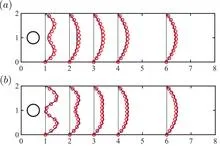
If you push water in a narrow channel too fast, a steep wave forms and breaks into foam. In the world of ultracold atoms, cooled to near absolute zero, quantum laws prevent such a wave from breaking. Physicists took a cloud of rubidium atoms stretched into a thin thread and sharply compressed it from one end with a movable wall of light.
When a fluid flows around an obstacle, it spawns vortices and shock waves. Describing their behavior means solving a nonlinear equation in which the flow velocity depends on itself. Classical supercomputers spend days on this, while quantum computers have barely been used: their native language is linear operations, but fluids are inherently nonlinear.
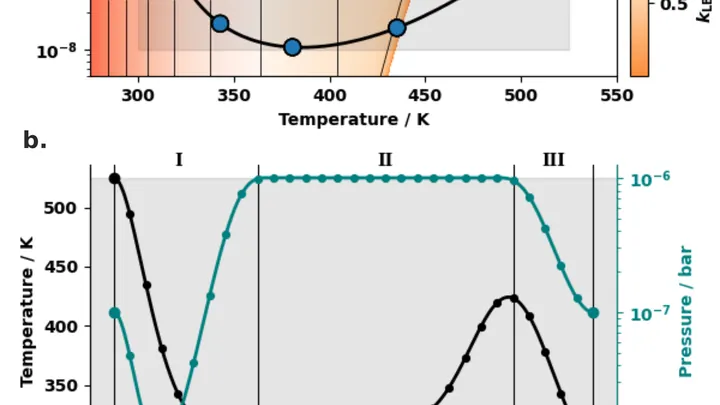
Microwave plasma in a vortex is like a kitchen mixer that simultaneously heats and stirs the gas. In the reactor, the gas is swirled, and microwaves heat it to thousands of degrees, tearing carbon dioxide molecules apart. Scientists created a computer model of such a reactor to understand how pressure affects the process.
When a fluid flows around an obstacle, it spawns vortices and shock waves. Describing their behavior means solving a nonlinear equation in which the flow velocity depends on itself. Classical supercomputers spend days on this, while quantum computers have barely been used: their native language is linear operations, but fluids are inherently nonlinear.
A conventional computer computes by shuttling electric charges along wires. But can you compute with heat? A network of pipes carrying hot and cold water can perform simple logic operations if the pipes are connected in the right order.
A superfluid gas is like a crowd of people marching in step: each atom knows where to go and doesn't fall out of the common rhythm. But this crowd has three 'valleys'—three different directions it can take. In a new experiment, physicists made one valley slightly more 'favorable' than the others and watched how the crowd darted between them.
The early universe was less like a calm pond and more like a boiling cauldron. Matter flowed, collided, and swirled against the backdrop of rapid spatial expansion. To understand how stars and galaxies emerged from this hot soup, physicists build digital simulations.
This new work is the third part in a series on lattice-based cosmological modeling. The first two focused on fields; this one deals with fluids.
At night, when we sink into deep, dreamless sleep, a tide begins in the depths of the brain. Each heartbeat and each breath sends gentle pulses through the fluid-filled cavities (the ventricles). During the day, these pulses are timid and monotonous — the fluid sloshes back and forth almost in place.
But with the onset of slow-wave sleep, the rhythm changes.
A car with a single suspension setting for all wheels — smooth on asphalt, but bumpy on dirt roads. That's roughly how modern computer models of fluids and gases work: all disturbances, from large whirlpools to fine ripples, are calmed with one common "brake." Stochastic modeling of flows has long been seeking a more refined tool.
A basin of wet sand. You press in one corner, and water starts moving. But how exactly? Instead of an even circle, it might spread in tongues, linger in some spots, and rush through others. Underground, the same thing happens: oil, water, or gas migrate through rocks not by the textbook, but following the chaos of fractures and heterogeneities.
A shock wave is like a steep wall of water rolling down a calm river. In physics, such waves arise when matter is compressed faster than the signal about that compression can spread sideways. In ordinary water or air, things are more or less clear.
In calm water, the route is clear. But in turbulent flows, a robot needs a different strategy. Typical approaches demand an accurate map of currents, but in reality, you can't get one. Nature does it differently: fish feel pressure and vortices right against their bodies.
A person in a boat turns by shifting their body weight. An unmanned vessel uses the same trick: a sliding weight inside the hull does the steering. Its movement is controlled by a neural network, anticipating the chaos of waves and gusts of wind. The propeller pushes the boat forward, while the weight shifts balance — like moving from one foot to the other.
Complex machinery, from drones to surgical robots, sometimes behaves like a wild mustang: full of disorder and whims, where the slightest touch triggers a storm. Instead of rote memorization of formulas, the new method observes the system like a horse breaker.
When a glass of water is full, pouring more is pointless waste. Cloud gaming often does the same with video data: encoders push the stream to maximum, even though the eye stops noticing improvements long before the limit. This overconsumption means extra traffic and entropy in the network — useless noise clogging the channel.
DFTB is a high-speed train in the world of quantum chemistry: hundreds of times faster than classical DFT, yet still on electronic rails. But its engine — iterative self-consistency of charges — sometimes resembles an orchestra where each instrument starts from an arbitrary note.
Imagine water as a ballroom, where each molecule is a dancer, constantly forming fleeting partnerships. These hydrogen bonds give rise to local patterns: some resemble a stiff waltz — an ordered network with cavities (low-density structure), others a wild jitterbug, where partners crowd into chaotic dense clusters.
Gravitational microlensing is a fascinating cosmic effect predicted by Einstein and developed by Zwicky. A massive body passing between us and a distant star bends its light like a lens, creating characteristic magnifications and distortions.
In the conventional Heisenberg picture, spins at low temperatures are supposed to line up in a strict pattern. But there are crystals — like pyrochlore — where geometry has its own way. Each ion sits at a vertex of a tetrahedron, and the main interaction enforces a rule: two spins point inward, two outward.
A gardener wants to grow a rare flower. Watering and fertilizing can't be done haphazardly; it must follow a strict schedule: a bit more warmth in the morning, a bit less moisture in the evening. Otherwise, the bed will be overrun by common weeds. Molecules on a metal surface behave in much the same way.
When organic molecules settle on a metal, they assemble into patterns, like pieces of a mosaic.
The number −0.000459 is no random guest in the Blasius equation. It's the coefficient of η⁵, defining the boundary layer on a flat plate — a thin whisper of air friction against metal. Standard numerical methods like Runge–Kutta yield only an approximate curve. Physics-informed neural networks (PINNs) try to guess the entire solution. Often — unsuccessfully.
Air flowing over a wing or turbine blade behaves like a string: it starts smooth and layered: that's the laminar regime. But as speed increases or external ripples appear, the string breaks into chaotic vibration — turbulence. Predicting the exact moment of breakdown is crucial: it affects drag, heating, and noise.
In the 1990s, philosopher John Searle devised a thought experiment: a person sits in a room and, without knowing Chinese, follows instructions to produce correct answers in Chinese. From the outside, it seems they understand the language, but inside, it's just mechanical rule-following.
A stone falls into a pond, and ripples spread evenly in all directions. But some media behave as if the wave knows which way to turn, like water that only swirls clockwise. This asymmetry comes from odd viscosity and odd elasticity — properties of media with broken mirror symmetry.
In the Pacific Ocean, there is a warm current that flows eastward against all the others. It is called the North Equatorial Countercurrent, or NECC. In normal years, this band of warm water, a few hundred kilometers wide, quietly carries heat from Indonesia toward the Americas.
In the watery environment, vortices batter the mechanical fish. The AI agent, like an experimental chef, ran simulations, tried out 'recipes' of movements, and improved the program. Each experiment was like spectroscopy: the agent broke down behavior into elements, uncovering patterns. At first, the fish only paddled in one direction.
On a sound mixing console, there are hundreds of volume knobs, and each one affects its neighbors. Turn one, and the whole picture changes, but you can only check the result by listening to the entire chord, which takes hours. Designing a laser pulse for inertial confinement fusion is much the same.
An orchestra plays without a conductor, and you hear the tempo speeding up and slowing down. All you have is a recording of the sound, not the score. Can you tell from that recording which string to pluck to make the whole orchestra play more steadily?
Mountain river water doesn't flow smoothly: it churns, swirls into eddies, and suddenly accelerates. This chaotic motion is called turbulence. But even within it, there are hidden rhythms — rare and intense bursts that briefly alter the entire flow pattern.
A drop of honey spreads slowly across a table, while water spreads quickly. The resistance to flow, viscosity, differs from one fluid to another. But what if the viscosity changes on the fly, as the substance compresses or expands?
Inside every cell, life is bustling: tiny protein machines tirelessly haul cargo, read genes, and fix errors. But their work is far from perfect: they often 'spin their wheels,' take backward steps, or get stuck in futile cycles. It's like a city traffic jam where cars dart around aimlessly, burning fuel.
A drop of thick shampoo falls into water and freezes into a strange rope. A liquid that both flows and springs back is called viscoelastic. In it, tiny particles under ultrasound behave quite differently than in water. Viscoelasticity is a material's ability to both spread like honey and return to shape like rubber.
Sugar dissolves in tea, and then with a single motion gathers back into the spoon. In an ordinary kitchen, you won't see that — viscosity and disorder get in the way. But in the world of ultra-slow motions, where inertia vanishes, such tricks become reality.
Imagine a river that doesn't flow in an open channel but through the inside of a sponge, with its currents shifting from place to place. That's a good way to think about the brain's glymphatic system: a network of ultra-fine channels around blood vessels, through which cerebrospinal fluid seeps into the tissue and washes away the waste that has piled up during the day.
River water often swirls into funnels. But in semiconductors, the foundation of microchips, electrons at low temperatures and high purity also turn into a fluid. If you create a circular cavity, vortices appear, just like in a river backwater.
A boiling pot, a gust of wind, a wisp of smoke from a campfire — all obey equations that mathematicians call 'nonlinear and dissipative.' In plain terms, energy is lost to friction, and parts of the flow influence each other so strongly that predicting the motion ahead of time is a task on the edge of feasibility.