Atoms in a Ring: How to Make a Bagel of Light and Magnetism express
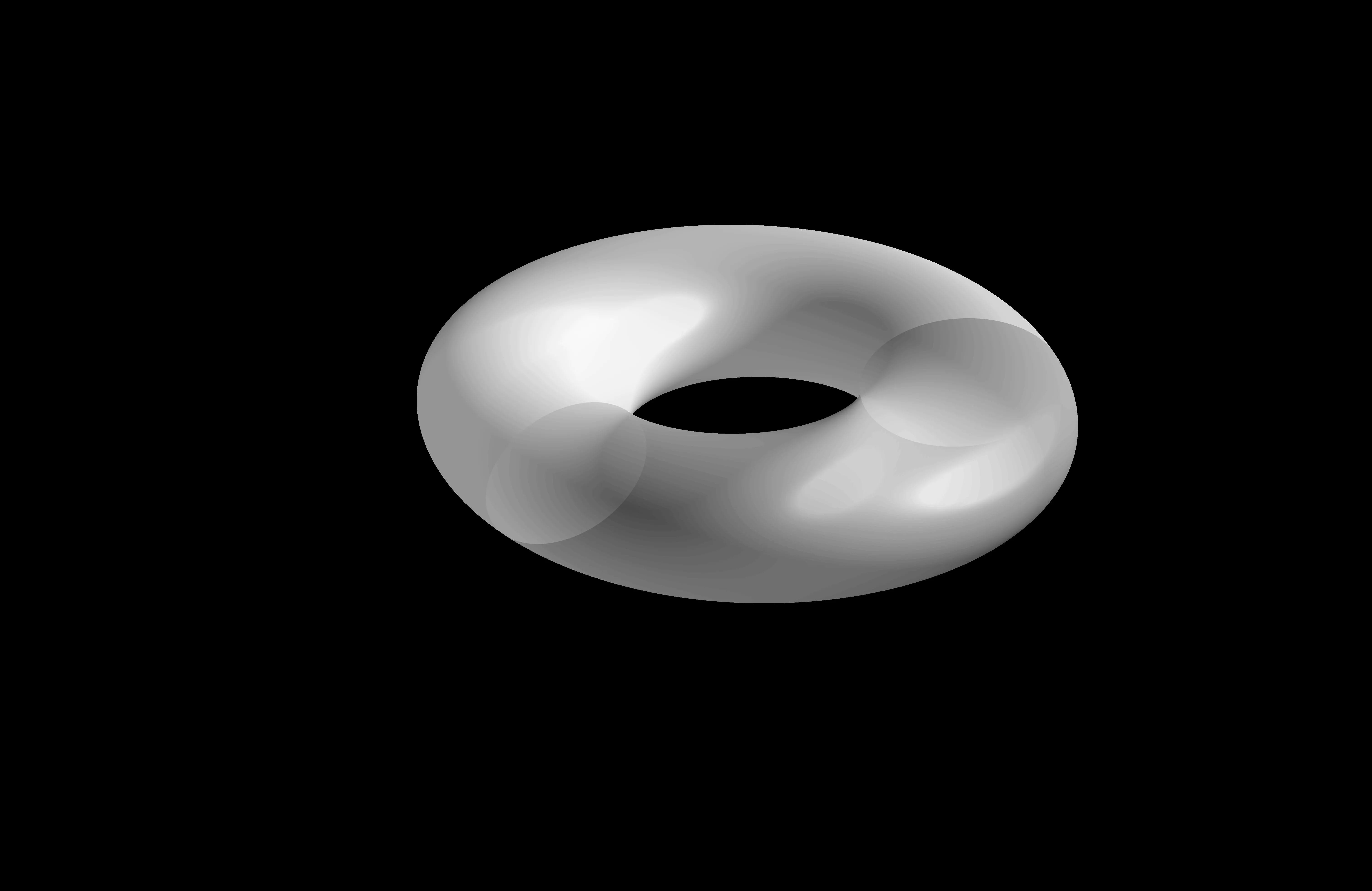
A tiny cloud of atoms, cooled to millionths of a degree above absolute zero, floats in a ring-shaped trap. It looks like a glowing necklace, but physicists have made it live on the surface of an invisible bagel.
Using laser beams and microwave pulses, three internal states of the atoms were linked into a cycle. It's as if three roads were closed into a loop, and an atom could move from one to the next until it returned to the start. This hidden loop, together with the real ring, forms a torus — the surface of a bagel. Magnetic flux flows through this torus and leaves its mark: the density of atoms in the ring becomes wavy, with peaks and troughs.
The number of waves is strictly set by quantum rules — a hallmark of the torus's geometry. By changing the coupling phase between states, the researchers shifted the waves, as if rolling a pattern around the bagel. This reveals an effect similar to charge pumping in microelectronics, but here, instead of electrons, it's the atoms themselves.
The experiment started with a cylinder: atoms moved around the ring, but the hidden loop was not yet closed. When the cycle was closed, the cylinder became a torus, and density waves emerged on their own. This is the first time the quantum Hall effect has been reproduced on an artificially curved space.
Such atomic 'bagels' could become a laboratory for testing ideas about how matter behaves in curved worlds. Perhaps this is how we can simulate conditions near black holes or in the early universe.
The quantum magnetic flux through a torus changes only in jumps, as if water were poured into a bottle in sips, not a continuous stream.
In Greg Egan's novel 'Schild's Ladder', physicists create a universe with unusual topology to test the laws of quantum mechanics: this experiment takes a first step in the same direction.