Microelectronics is the technology of fabricating tiny electronic circuits and components on semiconductor substrates, typically silicon. It underpins modern computing, communication, and sensing devices. The field has driven the miniaturization of transistors, enabling billions of components to fit on a single chip, which has revolutionized technology and society.
History
The field began with the invention of the transistor in 1947 by John Bardeen, Walter Brattain, and William Shockley. The integrated circuit was later developed by Jack Kilby and Robert Noyce in the late 1950s, leading to the rapid growth of microelectronics.
How it works
Microelectronics relies on processes like photolithography, doping, and etching to pattern and build circuits at micrometer or nanometer scales. Transistors, the basic building blocks, act as switches or amplifiers by controlling the flow of electrical current. Advanced techniques like extreme ultraviolet lithography allow for ever-smaller feature sizes, improving performance and energy efficiency.
In practice
Microelectronics is used in virtually all electronic devices, including smartphones, computers, medical implants, and automotive control systems.
Fun fact
The number of transistors on a chip has roughly doubled every two years, a trend known as Moore's Law, named after Intel co-founder Gordon Moore.
In a quiet room with no magnets anywhere, two electrons in a silicon trap still feel a faint trembling. It comes from the nuclei of silicon and germanium atoms, which spin randomly like the needles of broken compasses. This trembling was once considered noise, but now it has become a measuring instrument itself.
You're looking for fireflies in a dark forest. Instead of photographing the whole forest every second and then poring over the images, you carry a small device that spots the flashes on its own and cuts out only a circle around each one. The rest, the blackness, isn't saved. That's exactly how the new sensor for scientific cameras works.
The orchestra plays, but the conductor hears only a general hum. Each instrument plays its own part, but you can't tell where the flute is and where the double bass is. You need a spectrum analyzer — a device that breaks down sound by frequency.
A drop of water on glass trembles and shimmers: it seems to have a life of its own. Similar behavior can now be observed in the world of colloids: tiny particles suspended in a liquid. Researchers simulated particles that emit chemical signals. These signals, like scents in the air, spread around and cause neighbors to either draw closer or move apart.
Blood vessel cells were seeded onto a transparent film just 700 nanometers thick — a hundred times thinner than a human hair. Flat electrodes are hidden beneath the film. They send a weak alternating current and listen as the resistance changes.
Organic light-emitting materials are like a busy intersection without traffic lights. Molecules receive energy but, instead of honestly giving it back as light, they often turn into dead ends: they form dark pairs (exciplexes — short-lived complexes that do not emit) or collide with each other, losing charge.
An electron microscope is a giant pipe organ: instead of pipes (electromagnetic lenses, instead of air) a stream of accelerated electrons. It once merely painted mute frescoes of the atomic world, condemning scientists to grueling decipherment.
A quantum computer is like an orchestra where each ion is a musician and laser pulses are the conductor's baton. But if someone in the audience rustles, the delicate melody of quantum states goes off key.
A comb rubbed through your hair picks up scraps of paper. Physicists decided to apply this simple trick at the microscopic level — to control magnetic vortices called skyrmions. A skyrmion is like a tiny tornado in a sea of magnetization: at its center, compass arrows point up, while at the edges they twist downward.
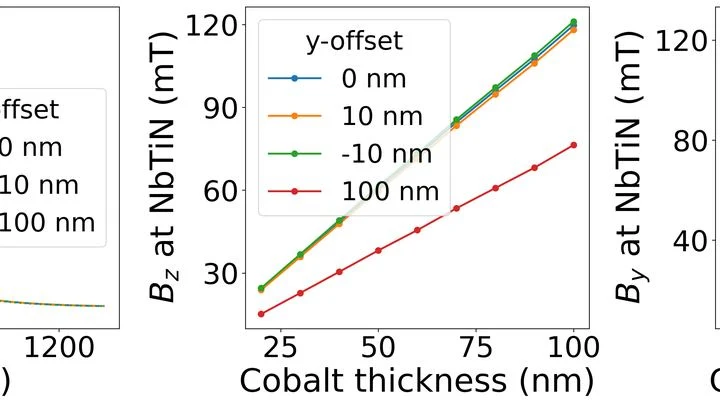
A bridge of aluminum just a few atoms thick is the heart of many quantum devices. Current flows through such a bridge without resistance, and it can be controlled with a magnetic field. These bridges are called Josephson junctions, after the British physicist who described their behavior.
Inside every cell, there's a network of thin tubes — microtubules. They act as both scaffolding and rails: they hold the cell's shape and transport cargo. These tubes are built from the protein tubulin and naturally glow faintly under ultraviolet light. Scientists wondered: can we make this glow stronger or weaker on demand?
The key to control is the amino acid tryptophan.
A regular laser is a light amplifier in which atoms, after receiving energy, collectively emit waves of a single frequency. A maser does the same thing, but for microwaves — the invisible radiation that heats food in a microwave oven and carries signals in phones.
Think of a stack of paper: when the sheets lie perfectly aligned, light passes through them uniformly. But turn one sheet by a few degrees, and the picture changes. Something similar happens with layers in certain materials: rotate them relative to each other, and their properties change — sometimes dramatically.
Spectroscopy isn't the key here, or rather, it's not the method used.
A cell is like a house with many doors. Some doors open only for certain guests, others let anyone through. To understand how these doors work, scientists build models of them. The new model is a glass slide with 52 miniature wells. Each well is covered with an ultrathin lipid film, like a jar with a lid. A protein that forms a channel through the film was inserted into it.
An ordinary sheet of paper looks white because it scatters all light rays chaotically. But a butterfly's wing shimmers blue and green without a drop of paint: its surface is covered with microscopic grooves that dampen some light waves and amplify others. Engineers have long dreamed of replicating this trick: creating a material that colors itself simply by trapping light in the right places.
In a thin layer of liquid crystal (a substance that flows like a liquid but has molecules arranged in order, as in a solid) vortices smaller than the thickness of a human hair are born. These vortices resemble tiny spinning tops: they can move without breaking apart and behave almost like real particles.
Light that has traveled to us for nearly 14 billion years is like an old photograph whose details emerge with careful processing. The cosmic microwave background (the afterglow of the Big Bang) holds the imprint of the universe's first moments, but its signal is faint and distorted.
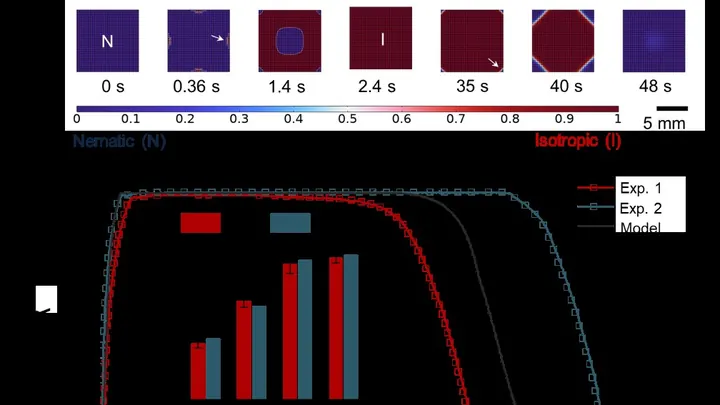
Radio waves surround us, but our eyes can't see them. This new sensor, the size of a fingernail, turns them into a colored patch on a tiny screen.
Inside the chip is a layer of liquid crystals — the same kind used in phone displays. Among them are embedded thin ferromagnetic nanowires. When a radio wave arrives, the nanowires heat up quickly.
Ordinary soldering doesn't work for quantum circuits: when cooled to liquid helium temperatures, metal cracks, and the contacts themselves introduce noise. Engineers from the research group tried something different — a drop of gallium alloy that stays liquid at room temperature, like mercury in an old thermometer.
A semiconductor film one atom thick is like a tightly stretched membrane. Light makes it flash: luminous points (excitons) are born, which quickly fade. Where the membrane is torn or crumpled, the glow flickers and stutters, like a string with a knot sounding off-key.
Light passing through a thin crystal can change color and the direction of its oscillations. In a molybdenum disulfide flake just hundreds of atoms thick, an infrared beam turns green, and its polarization, the way the light wave oscillates, obeys the crystal's geometry.
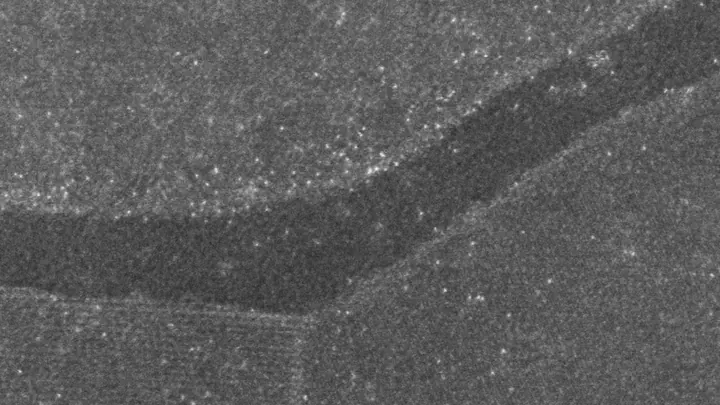
Silicon is like a universal building block: it goes into the chips in your phone, solar panels, and lasers. But if you squeeze it with immense force, the atoms rearrange into new patterns: these forms are called allotropes. One of them, Si-XIII, was first spotted more than twenty years ago, but its exact pattern remained a mystery.
A quantum computer is like an orchestra where every musician must play their own note precisely. But the hall is filled with invisible noise — defects in superconducting contacts that throw qubits off rhythm. These defects are called two-level systems. They are like cracks in glass: tiny, yet capable of ruining the whole picture.
An X-ray photon hits the detector like a pebble dropping into still water. The water is a thin film of aluminum and manganese, cooled to near absolute zero. The impact sends a heat wave rippling across the film, and by measuring its height, you can tell how much energy the photon carried.
A microwave signal that doesn't jitter from interference is needed in both radar and telecommunications. Until now, a clean signal was obtained on bulky setups where lasers and resonators sat on an optical table. Now engineers have packed everything into a box the size of a cup—166 milliliters.
A light beam passing through a piece of glass usually just bends slightly. But if you engrave ultra-fine patterns inside the glass with a laser, you can make the light split into separate beams, much like white light fans out into a rainbow after rain.
Terahertz radiation sits between microwaves and infrared light. It passes through clothing, paper, and plastic, but not through metal or water. That's why it's used in security scanners and medical imaging. To see the polarization of such radiation, you need a detector.
A quantum computer is a machine where qubits replace ordinary bits. A qubit can be not just a 0 or a 1, but both at the same time. One way to make a qubit is to take an electron and make it hover above the surface of liquid helium. The helium is cooled to below two degrees above absolute zero.
A silicon wafer is like cookie dough. Heat it in an oven, and tiny raisins appear inside — defects in the crystal lattice that can emit single photons. These "raisins" are called color centers, and they are needed for quantum computers and secure communication.
A printer that prints not with ink but with metal and ceramic is now a reality. Scientists took an ordinary drop of water containing dissolved metal salts and made it deposit copper, zinc oxide, or nickel hydroxide onto a surface — all with precision down to millionths of a meter.
The secret lies in electricity.
A laser pointer shines a neat spot: all its light waves march in step, like soldiers on parade. Such light is called coherent. But nature and technology also feature another kind of light—'messy' light, where waves are out of sync, like a crowd at a market. It's called partially coherent.
Ordinary computer memory constantly consumes energy to avoid forgetting what's stored. A superconductor could store data without loss, but it's hard to make it switch.
In the new work, a superconductor is sandwiched between two magnetic insulators.
A drop of ink falls into a glass of water, and instead of a flat stain, a ring is born that immediately starts to spin. That's roughly what the birth of a skyrmion looks like: light emitted by a tiny source twists into a stable vortex. Until now, such vortices could only be produced by large lasers.
The tip of a tunneling microscope hovers above a surface at a distance smaller than the diameter of an atom. Usually, it feels out the topography like a finger reading a page of Braille. Now, that same tip has learned to listen to how a membrane the size of a fingernail trembles.