concept

curved space

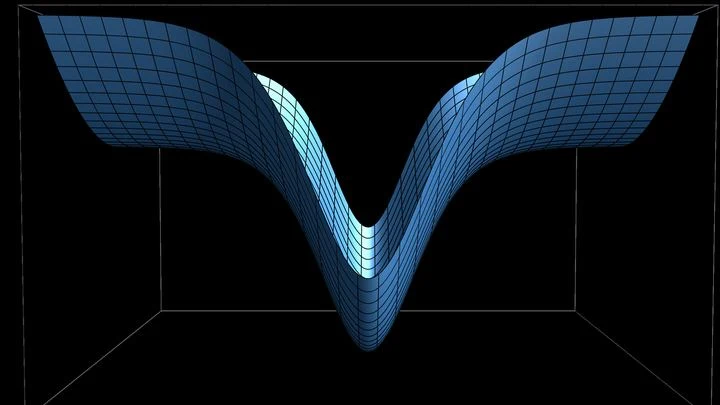
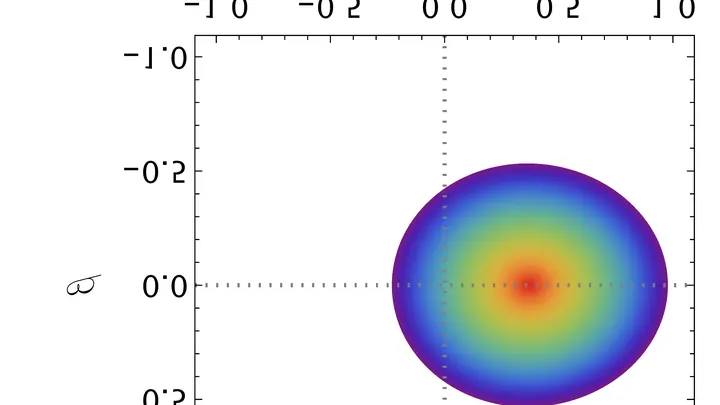
A space with non-Euclidean geometry, simulated here to test quantum phenomena in curved worlds.
31 related articles

Description

Curved space refers to a space whose geometry is non-Euclidean, meaning the familiar rules of flat geometry (like parallel lines never meeting) do not hold. In physics, this is the arena of general relativity, where mass and energy warp spacetime, and particles follow geodesics—the straightest possible paths—in this curved background. The concept is also used in condensed matter and quantum simulations, where artificial curved spaces are created to test quantum phenomena in geometries that are otherwise inaccessible.

History

The idea of curved space was formalized by Bernhard Riemann in the 19th century, but its physical significance emerged with Albert Einstein's general relativity in 1915, which identified gravity with spacetime curvature.

How it works

In general relativity, the metric tensor encodes the curvature, and the Einstein field equations relate this curvature to the stress-energy tensor. In simulations, curved spaces are often mimicked by engineering effective metrics—for example, using arrays of spins or optical lattices where the interactions mimic a curved geometry. Particles moving in such backgrounds experience forces that resemble gravitational effects, even though the underlying physics is different.

In practice

Curved space concepts are used in gravitational lensing calculations, in the design of metamaterials that bend light, and in quantum simulations of curved spacetime using ultracold atoms or photonic lattices.

Fun fact

In a curved space, the sum of angles in a triangle can be greater than or less than 180 degrees, depending on whether the curvature is positive or negative.


Concept graph →

Related articles · 31

Mountain Trails of Quantum Phases
In a mountain range, there are trails that can be contracted to a point if you walk through a flat valley. But there are also loop routes that cannot be shrunk without crossing a ridge.
Quantum Physics2026-08-132 minarXiv:2608.13041express
Quantum Computer Simulates Turbulence for the First Time
When a fluid flows around an obstacle, it spawns vortices and shock waves. Describing their behavior means solving a nonlinear equation in which the flow velocity depends on itself. Classical supercomputers spend days on this, while quantum computers have barely been used: their native language is linear operations, but fluids are inherently nonlinear.
General Relativity2026-07-312 minarXiv:2607.29350express
How Orbits Reveal the Universe's Curvature
A thrown stone arcs through the air and falls. A planet orbiting a star is the same stone, but it falls forever, looping around the star in a closed curve. In Newton's world, that curve is a perfect ellipse, and the planet returns to the same point each orbit. In reality, the orbit slowly rotates: its closest point to the star, the perihelion, shifts.
General Relativity2026-07-262 minarXiv:2607.23776express
A Black Hole with a Curved Momentum Space
In a two-dimensional universe, a black hole looks like a funnel in spacetime. But the authors of the new work went further: they proposed that the space where particle momenta 'live' is also curved, like a saddle.
Celestial Mechanics of Cells: How Curvature Dictates Size
Forget the flat sheet: embryonic tissue is a dynamic landscape of hills and folds. On convexities, cells stretch; in concavities, they compress, as if performing a dance governed by laws eerily similar to spacetime curvature.
HEP Theory2026-07-082 minarXiv:2607.07785express
Gluing Two Shadows of Spacetime Together
Two light rays meet at a point and then diverge. Their paths form two intersecting surfaces in spacetime — null hypersurfaces (boundaries along which light propagates). It is on such a pair of surfaces that physicists can set initial data for Einstein's equations. This is called the characteristic Cauchy problem.
Quantum Physics2026-07-072 minarXiv:2607.05715express
How Curved Space Changes the Rules of the Quantum Game
Two synchronized swimmers dive into the sea. One hits calm water, the other a whirlpool. Their movements, perfectly coordinated at the start, diverge. Something similar happens to two quantum particles when one moves in flat space and the other in curved space.
Quantum Waltz: Nonlocal Transfer of Magnetic Flux
In the quantum world, there is its own dance. Two superconducting toroids, each comfortably holding its quantized magnetic flux, whirl in a synchronous waltz. Between them is a vacuum, not a single field line, yet they mirror each other’s moves without fail.
Quantum Physics2026-07-042 minarXiv:2607.04040express
The Universe in a Matrix: How Quantum Simulations Do Without a Lattice
A translator who translates not words but the very structure of a conversation runs into trouble when the chat moves beyond a quiet room. In a familiar simulation on a spatial lattice, everything follows a strict script. But the moment the interlocutors find themselves in a noisy square, where sound is distorted by echoes and the crowd keeps changing direction, the script falls apart.
General Relativity2026-07-011 minarXiv:2607.00788express
Time Loop from an Empty Universe
In the ocean, a whirlpool pulls everything into a closed loop, just as a gravitational wave in empty space twists time into a loop. Gravitational wave — a ripple in the fabric of spacetime, and its special shape can turn the usual flow of events into a closed cycle. In such a zone, an object can return to its own past without violating the laws of physics.
math.GN2026-07-013 minarXiv:2607.01068
The Sieve of Infinity: How Q-spaces Intertwine with Measurable Cardinals
In mathematics there is a sieve that sifts not dust, but infinity itself. It’s called a Q-space: here any subset turns out to be a Gδ set — a countable intersection of open sets, as if sifted through an unimaginably fine mesh.
General Relativity2026-06-201 minarXiv:2606.22196express
A Universe Without a Magic Wand
A builder checks the strength of an arch not by running through all possible shapes in their head, but by mentally nudging it and seeing how much force is expended. That's essentially how the principle of virtual work works in mechanics. The authors of a new study have applied this approach to the very geometry of spacetime. They constructed a covariant framework of virtual work for the metric.
Strongly Correlated2026-06-192 minarXiv:2606.21648express
Quantum Geometry Lurks in the Current Jump
Toss a handful of phosphorus into silicon, and at a certain impurity concentration the material suddenly starts conducting electricity. This is a metal-insulator phase transition, and it happens abruptly. But what exactly changes in the electron wave functions when an insulator becomes a metal?
General Relativity2026-06-082 minarXiv:2606.09945express
How a Pocket Watch Fits into an Expanding Universe
Time is a fickle thing. Inside a massive star, it flows calmly, like sand in an old clock on a mantelpiece. Outside, on the scale of the entire universe, it stretches along with space, as if the same clock were in an elevator that speeds up and slows down. For a long time, physicists puzzled over whether these two worlds could be glued together without visible seams.
General Relativity2026-06-062 minarXiv:2606.08022express
Wormholes Without Exotic Matter
Usually, a wormhole is imagined as a tunnel in space, whose walls are held open by something unusual — matter with negative energy. Like the supports in a mine that keep the ceiling from collapsing. But in this work, the physicists did without supports.
Quantum Physics2026-05-292 minarXiv:2605.31442express
Quantum Roulette with a Winning Ticket
Imagine a library where instead of books, you have every conceivable combination of a few dozen quantum particles. The number of combinations grows like a snowball: add one particle, and the volume doubles. For fifty particles, there are more shelves than atoms in the visible universe.
General Relativity2026-05-211 minarXiv:2605.26134express
Ghosts of the Universe: Neutrinos as Dark Matter
For nearly a century, astronomers have watched galaxies spin as if held together by invisible mass. Fritz Zwicky first noticed it, and Vera Rubin precisely measured the speeds of stars at the edges.
General Relativity2026-05-141 minarXiv:2605.14798express
Black Holes: Quanta Won't Break Cosmic Censorship
In the mid-20th century, Roger Penrose described a black hole using the concept of a “trapped surface” – a region where even a light ray directed outward inevitably falls inward. A situation familiar to everyone: water in a sink’s vortex is irretrievably sucked down the drain.
Mesoscale2026-05-092 minarXiv:2605.08643express
When Two Currents Merge into One
Sunlight hits a silicon wafer, and a current flows in the circuit. That's the familiar work of a solar cell: light knocks out electrons, and a p–n junction (the boundary between two layers with different conductivities) forces them to move in one direction. But in some crystals, current arises differently — without any junctions, purely from the material's internal structure.
HEP Theory2026-05-072 minarXiv:2605.06780express
When Quantum Connectivity Beats Area
Holography is the idea that everything happening inside a volume can be encoded on its boundary, like an image on a hologram. In physics, this helps connect gravity to the quantum world. But sometimes, the holographic rules fail to assemble familiar spacetime, and scientists are looking for where exactly the mechanism breaks down.
Superconductivity2026-05-041 minarXiv:2605.03133express
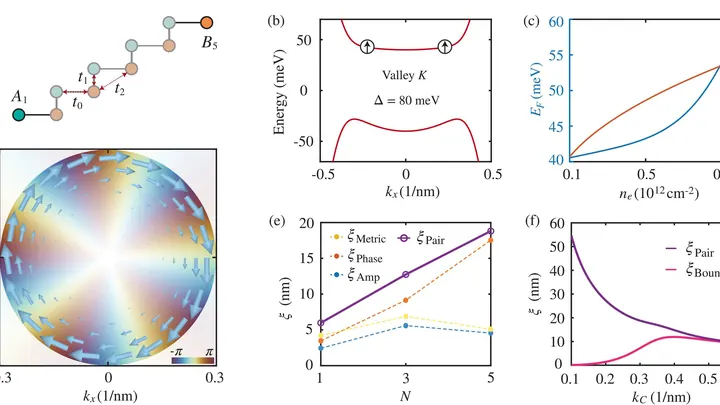
How a Flat Band Makes a Pair of Electrons Tiny
In a superconductor, electrons pair up like dancers holding hands. Usually, the distance between them, the pair size, depends on how fast they move and how strongly they are bound. But sometimes the dance floor almost disappears, and there's nowhere to move. This happens in materials with flat electronic bands: electrons nearly freeze, and the usual rules stop working.
Optics2026-04-251 minarXiv:2604.23209express
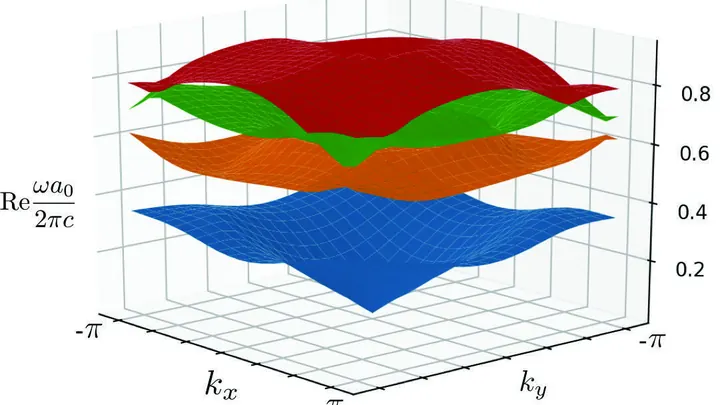
Light in a Trap: A New Effect in Special Crystals
Light, discovered by Maxwell, behaves differently in different media. In a new study, researchers simulated a two-dimensional crystal that absorbs light and has magnetic properties. In it, light waves behave like passengers on a one-way escalator: they relentlessly move toward edges and corners, where they accumulate.
General Relativity2026-04-211 minarXiv:2604.19418express
The Quantum Fabric of Spacetime
According to Einstein, spacetime is a flexible fabric, curved by matter. But in the quantum world, everything is different: particles are smeared over a probability cloud, governed by a rigid rule discovered by Max Born.
Quantum Physics2026-03-052 minarXiv:2603.04744express
Quantum pendulum learns to hop over a barrier
A laser beam holds a single ion in a vacuum, and that ion behaves like a ball trapped between two cups. The cups aren't pits in the ground but regions where the ion energetically prefers to be. In the classical world, a ball would roll into one cup and stay there.
Ideas Nobody Was Looking For
Science is like a city where residents pave the streets themselves. Where paths are already worn, new houses go up, while untouched vacant lots go unnoticed — not because building there is impossible, but because no one ever looks.
Quantum Physics2026-02-161 minarXiv:2602.15080express
The Quantum Dance of Rings on a Doughnut
Each qubit has its own little ring, freely sliding on the doughnut. All quantum logic boils down to smooth movements: shift, flip, connect. Entanglement, for example, is when two doughnuts stick together, and the rings on them begin to spin synchronously, like figure skaters in pairs skating. The key insight: the geometry of the surface dictates the rules of the game.
Quantum Physics2025-12-032 minarXiv:2512.03681express
Quantum Walks and Oscillator Networks: A Mathematical Duality
Two seemingly incompatible mathematical languages describe a single quantum reality. The first is the language of quantum walks: here, a particle (such as an electron or even a quasiparticle in a condensed medium) takes a stroll on a graph, simultaneously exploring all possible paths — much like a pedestrian in an unfamiliar city instantly finding…
General Relativity2025-11-231 minarXiv:2511.18502express
Black Holes — Portals to a Mirror Universe
An ordinary black hole is a trap from which nothing escapes. But a rotating black hole is structured differently: at its center is not a point, but a ring of infinitely compressed matter. Space here is curved to the limit, and light rays trace unimaginable loops.
Quantum Physics2025-11-101 minarXiv:2511.06844express
How Light Reveals the Hidden Laws of Open Systems
Open systems exchange energy with their surroundings, like a guitar string fading into the air. Scientists built such a system out of light, twisting the beams into corkscrews and forming an artificial lattice — a maze where losses can be controlled at every step. Light in this maze always moves at the maximum possible speed, but its energy can fade or grow.
Heartbeat vs. Noise: How to Spot Chaos at a Black Hole
In 2019, the Event Horizon Telescope gave humanity the first image of a black hole's shadow. Since then, astrophysicists have dreamed of more: seeing how matter moves in the very funnel of spacetime. One of the mysteries is chaos.
Mesoscale2025-06-043 minarXiv:2506.04335
Electronic Gravitational Lensing in Quantum Materials
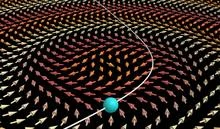
An electron gliding over invisible hills and valleys created by a spin texture: that is the picture behind a new chapter in condensed matter physics. In quantum materials where the direction of localized spins varies smoothly (a spin texture), an electron is no longer just a particle flying through the lattice.