Magneticflux is a measure of the total magnetic field passing through a given surface area. It is a fundamental concept in electromagnetism, quantifying how much magnetic field lines penetrate a surface. In quantum physics, magnetic flux plays a critical role in phenomena like superconductivity and the operation of superconducting qubits, where the quantization of flux leads to discrete energy levels.
History
The concept of magneticflux was developed in the 19th century, with Michael Faraday's law of induction relating changes in flux to induced electromotive force. The quantization of flux in superconductors was predicted by Fritz London in 1950 and experimentally confirmed in 1961.
How it works
Mathematically, magneticflux is the product of the magnetic field strength and the area it passes through, adjusted for the angle between the field and the surface normal. In superconductors, magnetic flux is quantized in units of the flux quantum, meaning it can only take discrete values. This quantization arises from the requirement that the superconducting wavefunction be single-valued, leading to the formation of vortices that carry integer multiples of the flux quantum.
In practice
Magneticflux is central to the design of superconducting qubits, where the qubit state is controlled by applying precise magnetic flux values, as well as in magnetic sensors and transformers.
Fun fact
In superconducting circuits, magneticflux can be 'trapped' in loops, and the title 'Металл запирает магнитный поток' highlights how certain metals can lock in flux, a key effect for quantum memory.
A pale green crystal was placed in a magnetic field and cooled below one kelvin — almost to absolute zero. Inside it hide chains of copper atoms that behave like tiny magnetic needles. Usually their orientation is chaotic, but the strong field and cold make the needles align in a unified impulse, like soldiers on a parade ground.
In the quantum world, there is its own dance. Two superconducting toroids, each comfortably holding its quantized magnetic flux, whirl in a synchronous waltz. Between them is a vacuum, not a single field line, yet they mirror each other’s moves without fail.
An invisible film, a quantum field, is stretched over a rubber bagel. While the bagel is small, the film stays taut and doesn't sag anywhere: the vacuum remains empty. But once you stretch the bagel to a certain size, a dent spontaneously appears in the film — the field starts to be felt at every point.
This dent is not random.
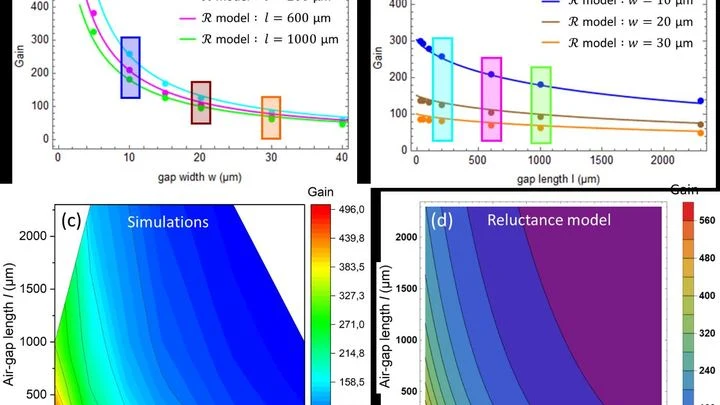
Magnetic sensors smaller than a match head can already detect weak fields — from a beating heart or a distant planet. But making them even more sensitive involves a trade-off: improve one part, and you lose performance in another.
Imagine a line of dominoes: when the first one falls, it pushes its neighbor, and a wave rushes down the chain. The boundary between fallen and standing dominoes is a perfect image of a magnetic wall. In microscopic magnetic films, these walls separate zones with different magnetizations.
A thin sheet of graphene, just a few micrometers thick, was placed in a weak magnetic field, and it began to push the field out of itself, like a sponge squeezing out water. This effect, known as the Meissner effect, is the hallmark of a superconductor: a material that conducts electricity without loss.
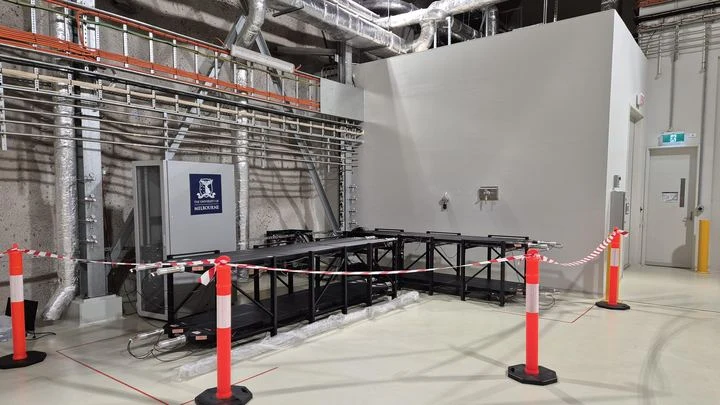
Deep underground, in a former gold mine in Australia, stands a laboratory where silence is broken only by rare flashes of light. These flashes are the traces of cosmic particles that punch through hundreds of meters of rock. Eight plastic panels, resembling large glowing sheets, catch these particles.
The quantum Hall effect has long been suspected of superfluidity — the ability to flow without friction. Imagine a cook following a recipe: for each unit of magnetic flux, he must add exactly a certain number of electrons.
A tiny tungsten tip with a radius of less than a hundred nanometers is the perfect stage for watching a quantum performance. Apply an electric field of a few volts per nanometer, and electrons start flying out of the metal: that’s field emission.