Laser (LightAmplification by Stimulated Emission of Radiation) creates coherent monochromatic radiation. The main components: an active medium (gas, liquid, crystal, or semiconductor), a pumping system to supply energy, and an optical resonator—two mirrors between which light is repeatedly reflected. The operating principle is based on stimulated emission: a passing photon 'nudges' an excited atom to emit an exactly identical photon, doubling the radiation. An avalanche of identical photons arises, which after amplification forms a laser beam.
History
In 1917, Einstein theoretically predicted stimulated emission. In 1954, Charles Townes, James Gordon, and Herbert Zeiger created the first maser, operating on ammonia. Six years later, Theodore Maiman demonstrated the first optical laser using ruby. Soon Ali Javan designed a helium-neon laser (1961), and Robert Hall the first semiconductor laser (1962). These discoveries transformed science, telecommunications, medicine, and manufacturing.
How it works
The active medium (for example, neodymium in a YAG crystal or a helium-neon mixture) is excited by external pumping, transferring atoms to a metastable energy level. When the upper-level population exceeds the lower-level population (population inversion), a spontaneously emitted photon stimulates emission from neighboring excited atoms, generating a cascade of coherent photons. Inside the optical resonator (e.g., a Fabry–Pérot etalon), light is repeatedly reflected by mirrors and amplified on each pass. Part of the radiation exits through a semi-transparent mirror. Photons, being bosons, accumulate in a single quantum state, ensuring identical parameters of the laser beam. In semiconductor lasers, feedback is achieved through Bragg diffraction on periodic structures (distributed feedback) with the condition mλ = 2nΛ.
In practice
Lasers are used everywhere: they cut and weld metal, read barcodes, transmit terabytes of information over fiber optic cables, and allow measuring the distance from Earth to the Moon with millimeter precision.
Fun fact
A femtosecond laser produces flashes lasting only a few quadrillionths of a second (femtoseconds). Such ultrashort pulses allow 'filming' the motion of electrons in atoms and molecules.
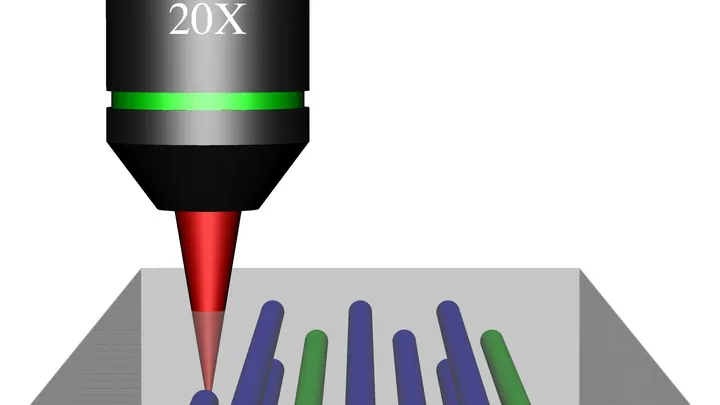
In a dark room, you can hold a glowing sphere without touching it: walls of light push it away but do not burn it. That is roughly how the trap built in Rio de Janeiro for yeast cells works. A conventional optical tweezer, that is, a focused laser beam, acts like tweezers made of light, but the light itself pierces the cell from side to side.
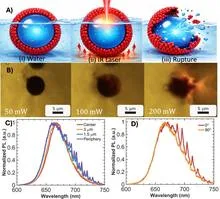
A tiny capsule, like a soap bubble but with a shell of glowing crystals, behaves like a laser. While its wall is intact, light circulates, amplifies, and escapes as a narrow, bright beam. Once the wall bursts, the beam turns into a dim spot. Such a capsule is a colloidosome, and it can change its glow on command.
The blue glow in water around a nuclear reactor is light born when a charged particle outruns light in that medium. The effect was discovered by Pavel Cherenkov in 1934, with the theory provided by Igor Tamm and Ilya Frank.
In a dark room, a spark jumps between two wires, and for an instant, there is light. Physicists have done something similar, but a million times smaller: at the boundary of two transparent crystals, they drew a conducting path and left a break just a few atoms wide. When a direct voltage was applied across this tiny gap, it began to glow.
The mirror races along at nearly forty thousand kilometers per second. Light that strikes it bounces back, but changed, like a ball volleyed by a racket in mid-swing. That's exactly the kind of mirror scientists have built inside an ultra-thin glass thread filled with hydrogen.
First, a powerful laser pulse is sent down the fiber.
An ordinary lamp shines steadily, while a lighthouse flashes. Scientists in London have made a tiny diamond work like a lighthouse, but not for light — for radio waves. To do this, they added a bit of nitrogen to the crystal and then shone a green laser on it.
Data zips through optical fibers at the speed of light, but the path isn't perfect: the signal gets muddled, like a voice echoing down a long hallway. The faster the speed and the longer the distance, the worse the distortion. Usually, electronics fix this, but they can't keep up with light.
For three days straight, a laser blasted a jet of gas, and every second it produced a beam of electrons with the energy of a tiny lightning bolt. Previously, such beams could only be produced in huge halls where the accelerator takes up an entire building. Now the whole setup fits in a room and ran without a glitch for 72 hours.
When a laser beam hits a gas, it tears electrons from atoms and accelerates them to nearly the speed of light. As these electrons fly through the plasma, they emit X-rays, like a glowing trail from a fast particle. In the new work, physicists made a single laser pulse create not one but two such trails in succession.
An ordinary light bulb is either on or off. But tiny glowing particles, nanocrystals with rare-earth ions, have so far emitted steady light, like small flashlights. Inside such a crystal, there are thousands of emitting ions, and even if one 'gets tired,' the others keep shining. Therefore, blinking, sharp on-and-off switching, was considered impossible for them.
A regular laser beam travels straight, like the light from a flashlight. But light can be twisted into a spiral, like the thread of a corkscrew. Such a beam carries orbital angular momentum: it doesn't just illuminate, it also spins anything it encounters.
On the surface of the Moon and asteroids, you can find pits smaller than a pinhead but with shiny, melted rims. Such marks are left by tiny meteorites, but the exact impact speed at which melting occurs remained unclear.
A shooter aims at a target, pulls the trigger, and hears two shots: one loud, one quiet. That's how the new setup works, except instead of bullets, there's an electron bunch, and instead of shots, there are two flashes of light. One flash is X-ray, the other is terahertz. They fly to the same point with perfect timing.
A laser beam passes through a glass cell filled with cesium vapor. The atoms in the vapor dart around chaotically, like a crowd at a train station: each one enters the beam, spends a moment there, and flies back out. Their internal state, something like the orientation of a tiny magnet, changes under the influence of light. If all atoms were identical and stationary, the signal would be steady.
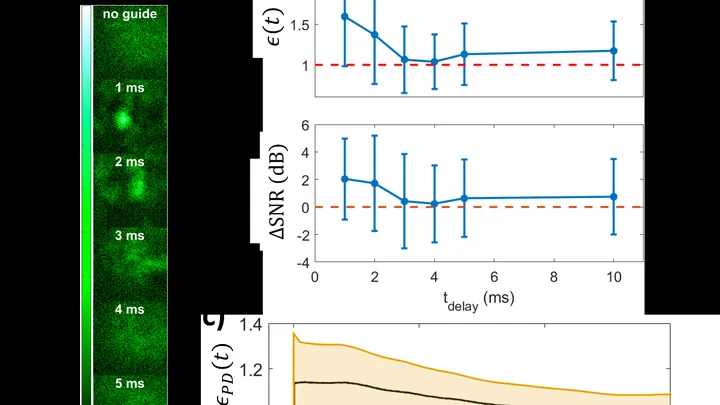
An ordinary flashlight shines in all directions, and after just a couple of dozen meters its beam fades so much it barely lights a wall. The atmosphere scatters light, and wind and heat currents distort it even more. But if you lay an invisible pipe for light right in the air, the beam will travel through it like water through a hose.
A light field, like a neat waffle iron, presses a regular pattern of bright and dark regions into space. Atoms get stuck in the brightest spots as if in tiny dimples: that's an optical lattice. It's a favorite tool for physicists who want to study quantum behavior of matter in its pure form.
A weak laser beam falls onto a tiny structure — a hybrid cavity made of metal and glass. Inside is trapped a single light-emitting molecule. Normally, such light only slightly changes color as it scatters off thermal vibrations of atoms.
Radiation therapy is a precision strike on a tumor, but every shot must be calibrated to within a millimeter and a fraction of a second. The problem is that existing dosimeters are either bulky, or they distort the beam themselves, or they require pauses for readout.
Deep inside molecular clouds hide natural amplifiers — cosmic masers. They work like lasers but in the radio band: excited molecules collectively emit waves of a single frequency, creating a bright beam. The catch is that these molecules often have several ways to shed energy.
A laser beam can do more than heat things up: it can also calm motion. When light enters a mirror trap, it exerts pressure on the mirrors, and if you tune the beam's color just right, that pressure becomes a gentle braking force. This is how tiny mechanical vibrations are cooled to nearly absolute zero.
A laser is like a tuning fork that rings at a single note. But even in complete silence, its sound trembles slightly. Previously, it was thought that this tremor, random kicks from spontaneous emission of light by atoms inside the laser, was the main limit to precision.
Light running through a waveguide sometimes gets trapped. In special structures, flat bands, it freezes in place: the wave doesn't spread but sits in a few neighboring channels, like a squeezed spring. A flat band is an energy range where the speed of light drops to zero.
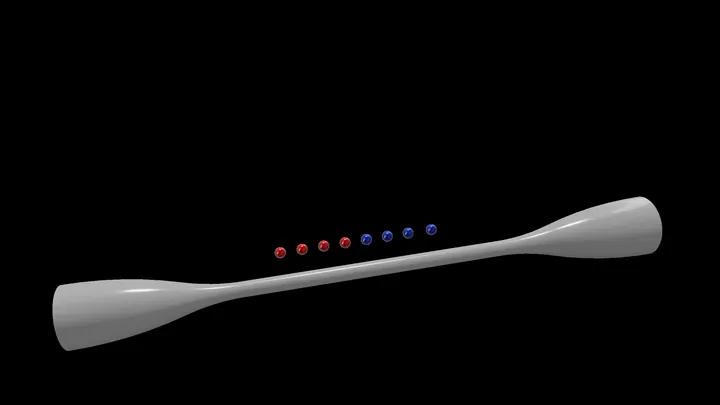
An orchestra without a conductor, where musicians hear each other through a shared wall. That's roughly how the new type of laser works: a few atoms (emitters) sit along a waveguide — a thin track for light on a chip. Light from each atom runs along this track and affects its neighbors.
A typical laser is a cavity where light bounces between mirrors and gets amplified. But you can ditch the mirrors and make light circulate inside a tiny particle smaller than the light wave itself. That's how the new lasers work: nanoparticles of indium phosphide sitting on perfectly smooth gold.
A laser isn't just about light. If you make a particle oscillate like a pendulum and those oscillations sustain themselves, you get a phonon laser. Sounds complicated, but the idea is simple: instead of light waves, the device emits orderly waves of mechanical vibrations — phonons.
A string sounds perfectly pure until a draft touches it. That's roughly how a superradiant laser works: a beam of atoms, pre-charged with energy, flies through a room made of two mirrors — an optical resonator (a trap where light bounces back and forth).
The universe is permeated by invisible mass, dark matter, whose existence was first proposed by Fritz Zwicky in the 1930s, based on his observations of galaxies moving in clusters.
A factory laser that cuts and welds metal on production lines has been made to work as a particle accelerator for the first time. Physicists took a standard ytterbium laser, its heart is a crystal the size of a palm, and turned its flashes into a tool for accelerating electrons to nearly the speed of light.
Deep inside the atomic nucleus of thorium-229, there's a stiff lever. To flip it from one position to another, you need to apply force, and that usually takes time. This isotope has two very close energy levels, and the transition between them can be triggered by a laser pulse.
An orchestra without a conductor: each musician hears only their neighbor and is slightly late or early. In ordinary atomic clocks, the picture is similar — atoms oscillate, but their rhythm is disrupted by thermal jitter, limiting timekeeping accuracy.
However, a group of physicists has managed to turn this flaw into a feature.
A regular rangefinder sends a single light pulse and waits for it to return — like a person shouting into the void and listening for an echo. But if you use multiple sources that glow in unison, and analyze not the volume but the rhythm of the echo of reflected flashes, the picture becomes sharper.
The atomic nucleus is a natural spring of colossal power. When the protons and neutrons inside it rearrange, it enters a special long-lived state — a nuclear isomer. It stores energy like a spring compressed to its limit.
The scene is lit by spotlights, but the most interesting action happens in the shadows — where molecules invisible to the eye are hiding. The new camera picks up the heat of these "invisible" objects and turns it into ordinary light.
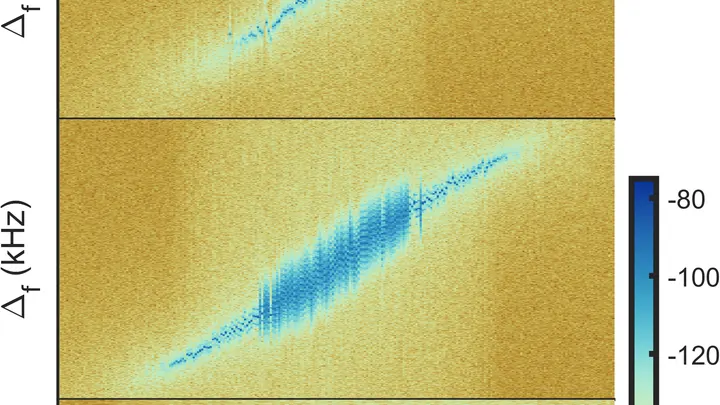
A tuning fork sounds incredibly pure, but touch it and the pitch changes almost instantly. Engineers faced a similar challenge: creating a laser that simultaneously possesses two seemingly incompatible properties — exceptional spectral purity (a very narrow emission line, like a tuning fork producing a single note without wobble) and the ability to rapidly tune that frequency.
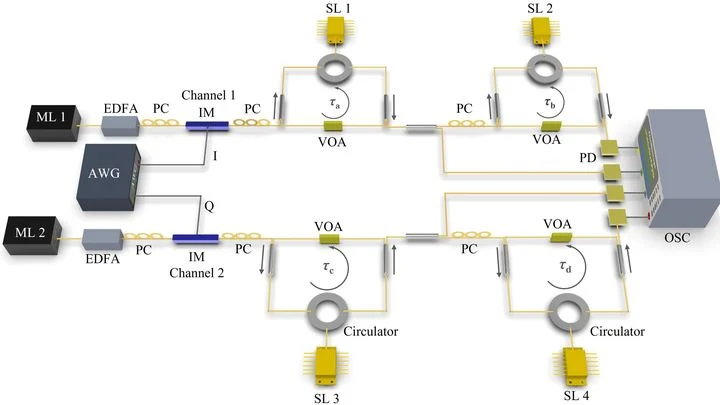
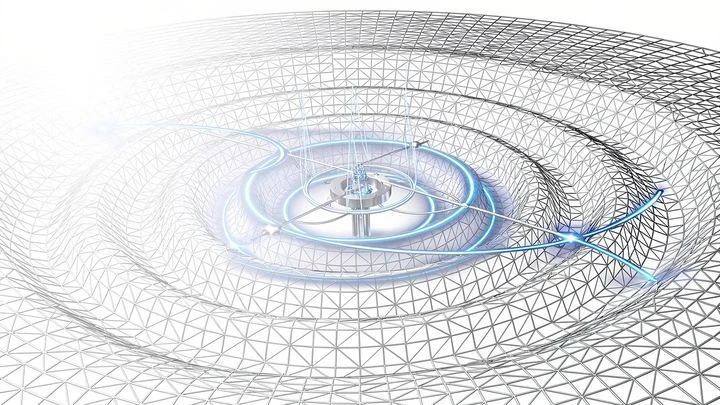
The Universe speaks two fundamental languages — gravity and light. Under normal conditions, they do not mix: gravitational waves glide through matter without a trace, while photons dance in mirror labyrinths.
The Universe speaks two fundamental languages — gravity and light. Under normal conditions, they do not mix: gravitational waves glide through matter without a trace, while photons dance in mirror labyrinths.
A pendulum swings with such precision that, had it been counting seconds since the Big Bang, it would have drifted by only half a second by today. That is the stability of the new portable ultraviolet laser — the heart of aluminum atomic clocks.
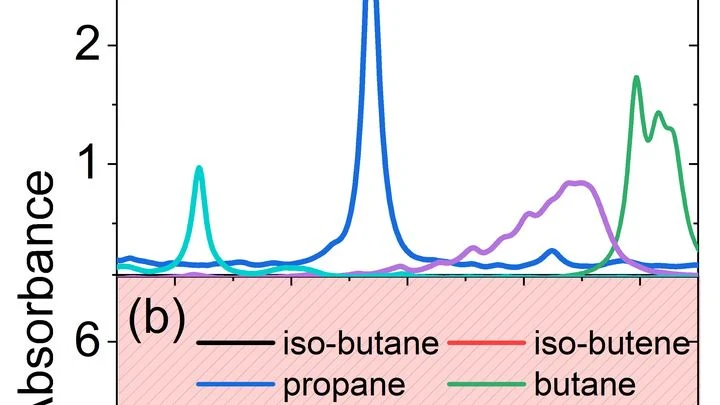
A hundred people are talking at once in a large hall. You try to hear one, but voices blend, some whisper, and you don't even suspect the existence of others. That's roughly how a conventional laser gas analyzer feels when dozens of substances mix in a combustion chamber or a factory pipe.
A light carousel spins not people but electrons. Instead of wooden horses, there are invisible blades of light. This is exactly the kind of 'carousel' physicists built to give electrons a spin.
Usually, to twist an electron beam into a vortex, you need a tiny mask — a stencil with slits carved on the atomic scale. Fabricating it is extremely challenging.
An ordinary laser emits narrow lines, like a string that sounds only one note. For spectroscopy, this is inconvenient: if a substance absorbs light between the lines, you might miss it.