Popular

Satyendra Nath Bose

1894–1974 · Quantum physics, Statistical mechanics, Theoretical physics
Contribution to quantum mechanics, especially the creation of Bose-Einstein statistics, which describes the behavior of particles with integer spin (bosons). This discovery made it possible to explain the properties of photons, predict the existence of Bose-Einstein condensate (observed, for example, in superfluid helium), and laid the foundations of modern quantum statistical mechanics.

Biography

Born in Calcutta, India. Graduated from Presidency College in Calcutta. Taught at the University of Calcutta and the University of Dhaka. In 1924, he sent a paper with a new derivation of Planck's law directly to Einstein, who appreciated the work and translated it into German for publication. Together with Einstein, he developed statistics for atoms, leading to the concept of bosons. Awarded the Padma Vibhushan (1954), elected Fellow of the Royal Society of London (1958). He did not have a formal doctorate.

Key discoveries

💡 Bose sent his paper on quantum statistics directly to Einstein after it was rejected by British journals. Einstein immediately appreciated it and translated it into German for publication, then extended Bose's ideas to atoms, leading to the prediction of Bose-Einstein condensate. Bose did not have a doctorate when he made this discovery.
Quote: "Science can only flourish in an atmosphere of free thinking."
Links in the knowledge graph 1
Related tags
Bose-Einstein condensateheliumQuantum Fieldsuperconductivity
Related laws
Bose–Einstein statistics
Related scientists
Fred HoyleMargaret BurbidgeJohannes RydbergEmilio Gino SegrèPaul DiracPeter HiggsRichard FeynmanWerner Heisenberg

Related articles

Quantum gas unlocks the secrets of the universe's birth

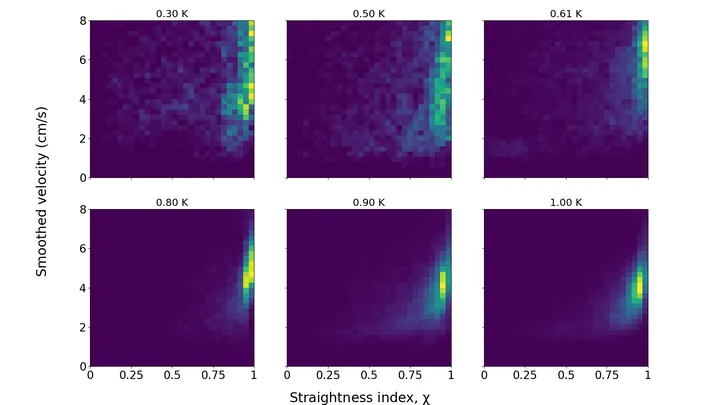
Scientists used a Bose–Einstein condensate (Bose and Einstein) — a state where atoms move as a single wave — to simulate the first moments after the Big Bang. By tuning interactions, they made it mimic the behavior of spacetime at the tiniest scales. This allowed them to observe “Planckian damping”
arXiv:2506.02719v3 · 2025-06-03

Quantum Glue for the Universe

Physicists have found that in the extreme gravity of neutron stars and black holes, a Bose–Einstein condensate emerges — a quantum state where particles merge into a single whole, like droplets of mercury. If dark matter consists of ultra-light axions, it naturally turns into a cosmic glue that keep
arXiv:2508.15864 · 2025-08-20

Neutrino Laser: The Collective Glow of Ghost Particles

Physicists have revisited the idea of neutrino superradiance—a laser-like effect where these ghost particles escape not randomly but in a coordinated stream. For a long time, atomic noise was thought to prevent this. New work shows how to tweak a cold atomic cloud to make the collective effect emerg
arXiv:2511.22450 · 2025-11-27

Supersolidity Is Born at the Liquid Boundary

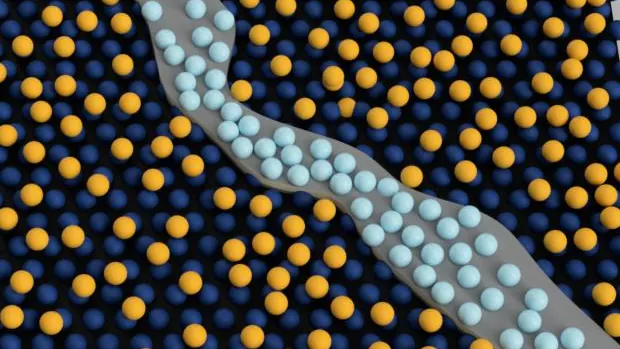
Scientists have shown that supersolidity—a symbiosis of solid order and liquid flow—can arise from ripples at the boundary between a liquid and a substrate. No need to chemically alter the medium; just the right container size is enough. This opens the door to materials with a solid shell and a flui
arXiv:2512.08739 · 2025-12-09

Qubits Need Space: Cold and Weightlessness Help Quantum Computers

Qubits—the computational elements of quantum computers—are extremely delicate. Heat, vibration, and even gravity disrupt their operation. Scientists have found that weightlessness and deep cold near absolute zero create ideal conditions for them. Experiments on the ISS with special quantum states an
arXiv:2512.11091 · 2025-12-11

How to Cool Light to Quantum Order

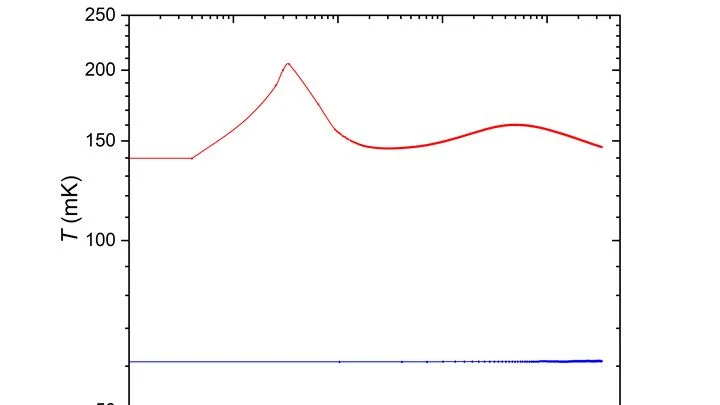
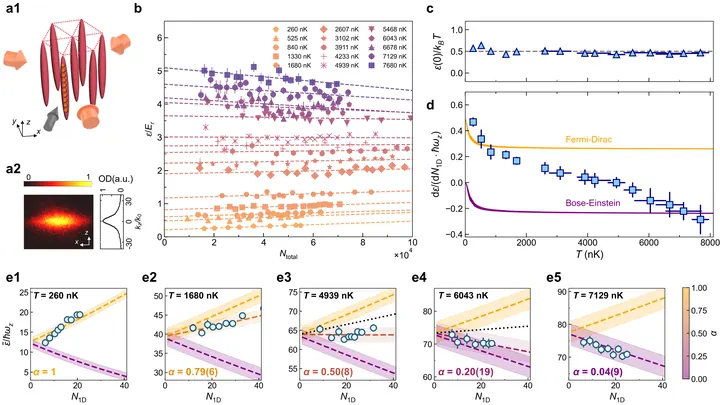
A quantum mix of light and matter — polaritons — was cooled to near absolute zero. The cloud not only became ordered but split into two parts with different temperatures, each obeying the laws of Bose and Einstein. The key surprise: the temperature of such a gas depends not on heating, but on the nu
arXiv:2601.15080 · 2026-01-21

Maxwell's Demon Prefers Indistinguishable Photons

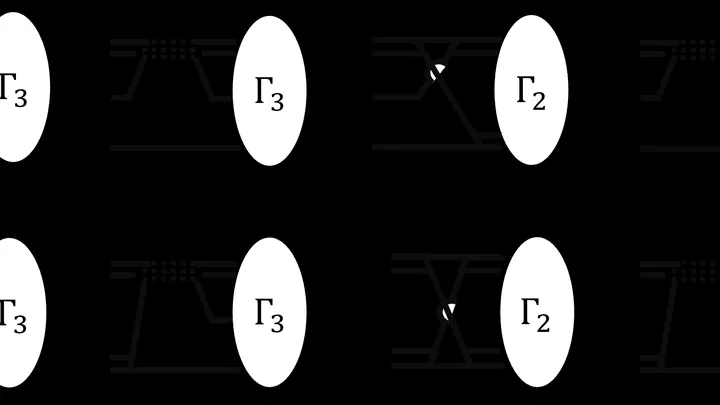
A tabletop experiment with a programmable optical circuit proved that the famous thought demon creates a larger temperature difference when the particles of light cannot be told apart. The result ties together heat, information, and quantum statistics, and will be useful for testing quantum devices.
arXiv:2602.11276 · 2026-02-11

Cosmic Rhythm: From Snowdrifts to Quantum Gas

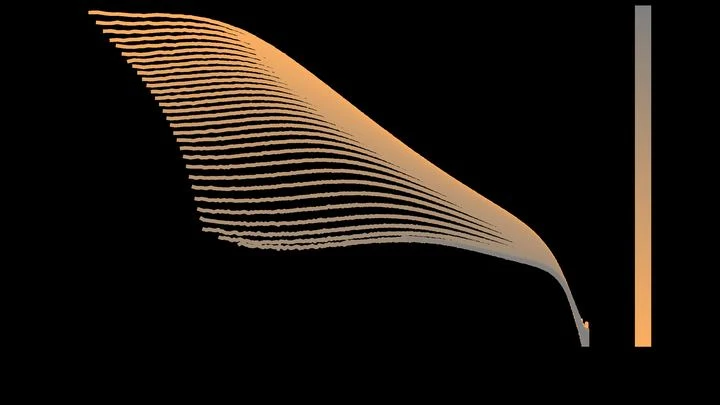
The bumps of a 'quantum snowdrift' made of cold atoms grow according to exactly the same scenario as a snowdrift in your yard. This universal law works for sand, water, and even cities. The experiment proved: nature is unified from atoms to skyscrapers.
arXiv:2603.09060 · 2026-03-10

Quantum Gravity Trick: How Atom Clouds Harmonize Through Spacetime

Two ultra-cold atom clouds, known as Bose-Einstein condensates, become mysteriously linked when placed a hair's width apart. Their internal sound waves synchronize in a way only possible if gravity follows quantum rules, offering a powerful new path to glimpse the grainy fabric of spacetime.
arXiv:2604.20767 · 2026-04-22

Dark Matter: Quantum Vortices Around Black Holes

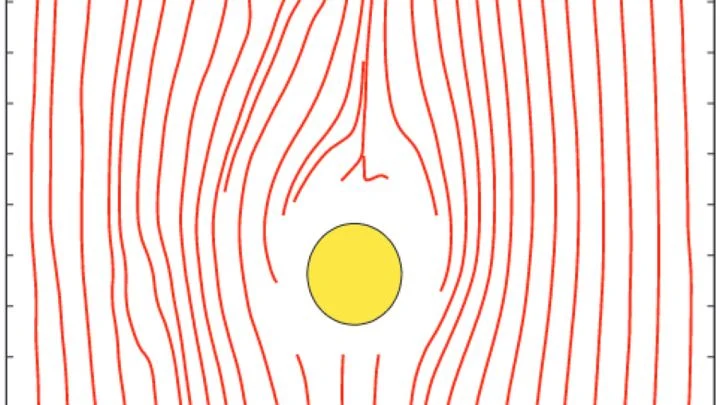
A new study models dark matter as a superfluid near a black hole. Physicists found two types of stable structures: a dense core and a rotating vortex. It turns out the vortex is stable if dark matter particles attract each other weakly; strong attraction makes it collapse. This discovery suggests th
arXiv:2605.29069 · 2026-05-27